Description, Force and Fantasy in Medieval Art
Foregrounding the means of representation, highlighting the principles of design, deploying style as a force for persuasion - these are artistic strategies that ingrained habits of historical (and ahistorical) thinking attribute to the Renaissance and typically deny to the Middle Ages.
But centuries before the interdependence of imitation, invention and imagination was formally worked out in Italian art theory, medieval writers had reactivated the ancient equation of style with persuasion,[1197] and painters and sculptors had already learned to produce powerful visions of violent struggle, likewise capable of mobilising the minds of their viewers.A canonical instance is the breathtaking carved column at the Abbey of Sainte-Marie in Souillac, in southern France, a monumental work designed to serve as a trumeau but now installed, along with several other displaced fragments, inside the western entrance to the church (Figure 31.6).
Renowned for its formal daring, the Souillac trumeau presents a tangle of rapacious beasts on its facing side, chaotic on first impression but organised into repeated pairings of diagonally crossed animals (apparently lions and eagles or griffins) who bite at a common victim held between them. Twisting around the scalloped colonettes that run the support's length at its four corners, the pattern of knotted bodies simultaneously obeys and violates what Henri Focillon (1881-1943) called Romanesque art's ‘law of the frame' (loi du cadre).[1198] It was this dynamic explosion of form that American art historian Meyer Schapiro (1904-96), writing in the run-up to US involvement in Europe's war, set out to investigate in his classic study of the carved
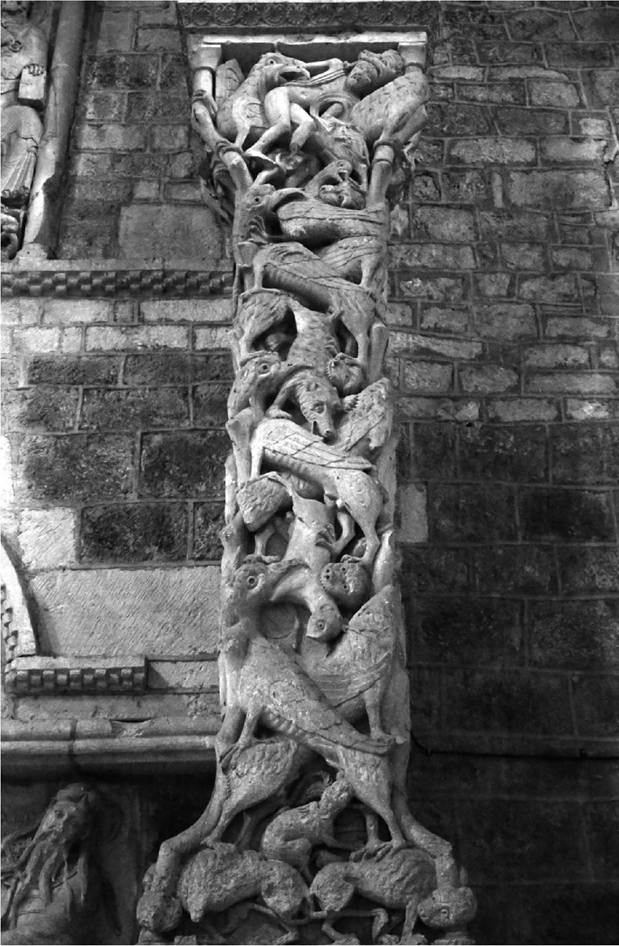
Figure 31.6 Southern France; animal combat with allegorical figures, trumeau re-installed near western interior wall, Abbey Church of Sainte-Marie, Souillac, c.
1140-50, carved stone.ensemble.[1199] Keen as Focillon was on discerning the visual intelligence of the medieval sculptor, Schapiro sought in the Souillac carvings a ‘conscious method of design', one in which the fantasy of the artist freed itself from a priori architectural constraints. Significantly, the result was a spectacle of expressive form on the margins of the church's official programme. As a formalist, Schapiro based his study on a highly original set of observations and diagrammatic drawings - a model analysis, then as today. As a Marxist, he parlayed these observations into a theory that the abandonment of formal symmetry at Souillac, and the embrace of ‘discoordination' as a design principle, owed something to the tensions and conflicts inherent in feudal society.[1200]
Schapiro attributed to the sculptors a new kind of achievement in embodying meaning directly in images. Precisely because the trumeau was not constrained by iconographic reference, the fear of violence and the attractive power of physical force could ‘strike' the senses with an overwhelming immediacy and attain a robust metaphorical expression. Religious meaning is likewise subordinated to the tension between sensory perception and metaphor. Concentrated in the raw dynamism of bodies in space, the imagery's visual force exempts it from the routines of sublimation or idealisation:
The fear of violence or the respect for aggressive force which was usually sublimated in mythical themes of divine protection... is here embodied directly in a non-religious fantasy of rapacious beasts. The very existence of the trumeau implies that sculpture has begun to emerge as an independent spectacle on the margins of religious art, as a wonderful imaginative workmanship addressed to secular fantasy. But this fantasy is governed by the content and material levels of social experience. The trumeau is a passionate drolerie, brutal and realistic in detail, an elaboration of themes of impulsive and overwhelming physical force, corresponding to the role of violence at this point in the history of feudal society.[1201]
Schapiro clearly saw the force of representation as a gathering point where social and spiritual experience reflect each other, where metaphors of predation and domination (hunting, overtaking, trapping, devouring) stand in for the conflicted character of feudal relations (the bondage of the contract, the dream of rebellion).
Spiritual conceptions reveal their secular axis (121) and secular desires their spiritual (i.e., penitential) value for the individual. In the art historian's eyes the ‘incipient realism' of twelfth-century sculpture links artistic style in its changing aspects to the violence of the individual's spiritual struggle - metaphorically, materially and psychologically. By emphasising the role of fantasy Schapiro also acknowledged a commonplace of medieval faculty psychology: the doctrine that mental images were formed from the raw material of sense perception, and that the resulting ‘phantasms' were something like a sympathetic union of outer fact and inner attraction, making every mental image a partial reflection of the beholder's desire.[1202] Violent images could therefore be attractive and repellent, beautiful and terrifying at the same time.Subsequent art-historical writing on the Souillac trumeau has expanded the metaphorical reach of its expressive visual violence. British art historian Michael Camille (1958-2002), most notably, called attention to the monument's thematisation of the mouth. Somatic site of primal terror and pleasure, as he put it, the mouth was the place of ‘vocal production as well as material ingestion', an ambivalence especially marked in the monastic context.35 In his effort to clear a path for a discussion of the ‘uninscribed codes and cultural practices' in which the trumeau's imagery participates, Camille, with knowing irony and unabashed verve, doubled down on Schapiro's modernist exercise in formal criticism:
On its front face, stone turns to feathers, claws and fur, textures that ruffle and slither between the cranky joints of shaft and pillar to create an architecture of animality, a spiraling ascent and descent of biting bestiality. Four birds on the left and four lions on the right twist inward and upward to engorge a small, torn, helpless thread of quadrupeds in the center, dragging them downward.
Contrary to their fall, a naked man struggles upward at the summit, his vulnerable flank torn by a beak and his face contorted with pain as he is held in the vice-like grip of a lionish mouth.36Few art historians have used exuberant description so effectively to map the formal violence of an image; fewer still would dare use it to assert a work's resistance to iconographic decryption, what Camille calls the trumeau's ‘anti- textuality'. Far more explicitly than Schapiro, Camille designates the trumeau's riot of violent form as a site of desire, and the art historian's text as a register of description's struggle against sublimation. Certainly both scholars had in mind the indelible example of St Bernard of Clairvaux (1090-1153), the Cistercian abbot whose famous iconoclastic complaint about profane images in the monastery also took the form of a showy rhetorical exercise:
in the cloisters, before the eyes of the brothers while they read - what is that ridiculous monstrosity doing, an amazing kind of deformed beauty and yet a beautiful deformity? What are the filthy apes doing there? The fierce lions? The monstrous centaurs? The creatures, part man and part beast? The striped tigers? The fighting soldiers? The hunters blowing horns? You may see many bodies under one head, and conversely many heads on one body. On one side the tail of a serpent is seen on a quadruped, on the other side, the head of a quadruped is on the body of a fish. Over there an animal has a horse for the front half and a goat for the back; here a creature which is horned in front is equine behind. In short, everywhere so plentiful and astonishing a variety of contradictory forms is seen that one would rather read in the marble than in books, and spend the whole day wondering at every single one of them than in meditating on the law of God.[1203]
Puritanical in his official outlook, Bernard intended not to stoke desire or afflict the receptive soul of his reader but to satirise Cluniac luxury, and advance his own order's cause of clerical reform.
Nevertheless, his powerful evocation of a contradictory creaturely carnality - an imaginative fantasy that employs rhetorical antithesis (quaedam deformis formositas acformosa deformitas) among other stylistic devices - demonstrates a strong awareness that the receptive intellect of a reader or a beholder could be ‘impressed' by violent and monstrous imagery, for better or worse. For Bernard as for numerous other monastic authors, acts of seeing and reading - whether in stone or on the page - could be metaphors and prompts for a spiritual striving in the ‘morally-divided individual' (this is Schapiro's phrase). That striving was visualised as combat between the vices and virtues, for example, between lust and chastity (Figure 31.7).[1204] Against the background of this martial model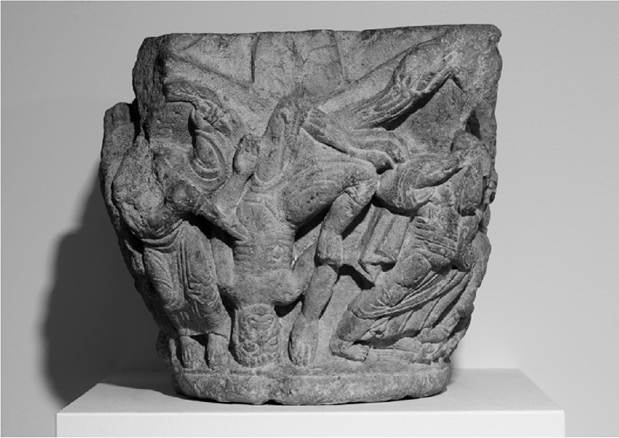
Figure 31.7 French; capital with battle of virtues and vices, early 1100s, limestone, 39.4 x
40.7 x 30.1 cm.
of the soul's movements, seeing and reading were material-cognitive processes, undergirded by a specific psychology of the receptive mind and the sensitive soul as image-making organs.