Staging a Massacre
Art historians have struggled to identify the sculptures Bernard describes, and candidates have cautiously been put forward; but it is nearly certain that his account is ekphrastic.
This single fact opens a broad vista onto medieval representations of violence. For it reveals the particular ways premodern writers and image-makers negotiated the challenge of mapping violence between its visibility before the eyes and its invisible reception in the soul. Concentrating on its emotional effects, rhetorical description exploits the power of style, artifice and even sheer convention to convey the ‘indescribable' surpluses of warfare, massacre, torture and cataclysm.A long tradition of description geared towards making the reader see what's portrayed ‘as if with his or her own eyes can be traced from the rhetoricians of the ancient schools - figures such as Hermogenes of Tarsus (d. 180 ce) and Quintilian (d. 100 ce) - through early Christian writers and Byzantine homilists - such as the two Gregories, Basil the Great and Basil of Seleucia (fifth century) - down to their numerous medieval readers and commentators. The full extent to which such models of eloquence guided the work of medieval painters and sculptors is still difficult to assay, given the dearth of ambitious studies among medievalists. Pioneering in this respect is Henry Maguire's 1981 work on Byzantine homilies and hymns from roughly the fifth to the twelfth century.[1205] Maguire showed how Christian preachers with classical educations, in their effort to embroider the characteristically spare narratives found in the New Testament, drew upon the advice, conventions and formal techniques of pagan oratory to create strikingly vivid, mimetic images that would move the souls of their listeners. Maguire's first example is directly germane to our purposes: the adaptation of ancient rhetorical descriptions of war to the gospel story of Herod's persecution of the first-born sons of Bethlehem, the Slaughter of the Innocents (Matthew 2:16-18).
A sermon penned by the fifth-century archbishop of Seleucia, Basil (d. 460), influential in later centuries, is foundational for the genre. Following Quintilian's advice for rendering the horrors of war vivid and memorable, Basil first describes the preliminaries: Herod enthroned in splendour, taking counsel from advisers, then levying the troops and exhorting his soldiers to ‘rush like lions upon the city'. The narrator follows this with a long, grisly account of the slaughter, a spectacle of cruelty in which children are torn from their parents' grasp, sliced open and dismembered, or murdered in their mothers' arms, even as the more courageous ones fend off ‘the sword edges with their hands'. Finally, with an evident taste for horror, the bishop describes the aftermath: the deluded celebrations of the ‘victors', the tearful laments of the victims, and the macabre search for remains. Basil describes how ‘each mother tearfully collected together the sundered limbs of her child, searched for any part of the body that might be missing, and, having found it, kissed it. At last she placed the complete corpse in her bosom, and broke into vehement cries.'[1206]
By the Middle Byzantine period (c. 843-1204) many of the descriptive cliches Basil employed had entered the artistic tradition; conversely the sermons themselves, according to Maguire, begin to betray a productive interchange with visual representations, perhaps even a kind of rivalry with the painter's descriptive art. A sermon composed in Greek by the south Italian monk and preacher Philagathus of Cerami (d. 1154 or later), for example, introduces the rhetorical conceit of claiming that he had seen Herod's massacre depicted on a painted panel (en pinaki). This allows him to explore the scenes of carnage and desolation - Herod ordering his troops ‘to mercilessly harvest the field of children', mothers ‘given to a piteous lament and mixing tears with blood', and so on - not once, but twice for his rapt audiences.
In the painted depiction, Philagathus explains, the soldiers sprang ‘like wild beasts' and ‘pitilessly dismembered the wretched infants'. With equal vividness the painter,depicted the unhappy mothers given to a piteous lament and mixing tears with blood. And one tore her hair, another scraped her cheeks with her nails, another tore apart her robe, and baring her chest, showed her breast, deprived of the feeding baby. Another collected together the scattered limbs of her dismembered child; and another held her newly slain infant on her knees and bitterly wept.[1207]
With this last cliche Philagathus betrays his knowledge of the homiletic tradition as well as the technical advice of the pagan orators.
Did medieval artists engage in a similar process of transforming bare narration into full-bodied description? Were the new descriptive details we find progressively added to the visual tradition of Herod's massacre over the course of nine centuries transferred there from the literary repertoire, or instead from the emergent tradition of religious drama, which included Herod spectacles enacted during the feasts of Epiphany and Corpus Christi?[1208] Although Matthew's account navigates around the killing itself, from the earliest attempts at pictorial narration, especially in the medieval West, it was precisely the violent actions of the soldiers that took centre stage.[1209] Early medieval artists learned to provide the missing details. A Carolingian ivory relief carved in the famous Metz workshop for a gospel book cover now in Paris, for example, telescopes the narrated and unnarrated elements of the gospel story into an explosive, near-simultaneous sequence of command, execution and response, all within a continuous space of action (Figure 31.8). While Herod issues his orders from stage left, two soldiers fling
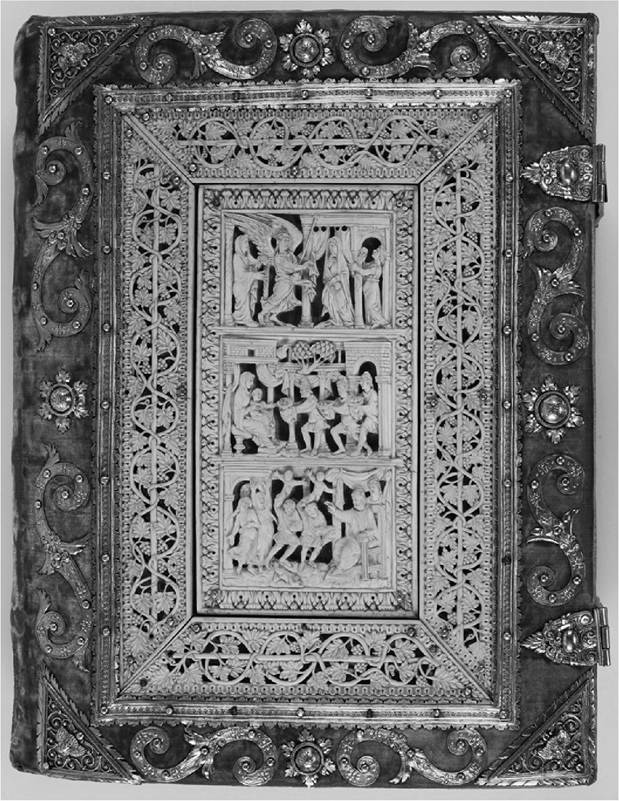
Figure 31.8 Carolingian; book cover from Metz, ivory.
the helpless baby-martyrs above their heads, preparing to dash them to the ground.
No artist deserves more credit for transforming the Herodian massacre into an elaborate spectacle of terror than Giovanni Pisano (c. 1250-1319), the master sculptor from Pisa, whose work precedes Giotto by about a generation. Four years in the making and completed in 1301, Giovanni's multi-panelled, hexagonal marble lectern for the Romanesque church of Sant'Andrea in Pistoia was modelled on his father Nicola's innovative project for Pisa's baptistery (1260) (Figure 31.9). In both, elaborate relief panels are coordinated with threedimensional console figures around a polygonal module, allowing the salvation narrative to be telescoped into five marble reliefs, meant to be viewed in counter-clockwise rotation. At Pistoia the scene of massacre, which spreads across the entire south-west-facing panel, is given striking prominence. As the beholder circumnavigates the lectern, he or she finds that a riot of killing has already broken loose.
Chaos control is Giovanni's pictorial challenge, and it is through the precise interleaving of sculptural units, and the alternation of two types of figure-vignettes - those displaying agitated movement, and those frozen in expressions of horror - that he achieves it. The imperious and implacable Herod, commanding the troops with an outstretched hand, galvanises the outrage of those around him. Anticipating the beholder's actual position in space, Giovanni has ensured that the most interesting angle of view would align with the dominant one inside the narrative. A shared focal point, Herod is now framed dramatically by the pitiable spectacle of mothers weeping over the dismembered bodies of their children, each of them a biblical Rachel, ‘refusing to be comforted' (Matthew 2:18) (Figure 31.10).
The Pisano lecterns have been the subject of sustained attention by art historians for several decades running, and the Pistoia project in particular has been studied in the light of Giovanni's transformation of antique models; innovations in Christian storytelling; eucharistic and baptismal symbolism; and communal responses to regional warfare in the Tuscan city-states.[1210] What has still not emerged with clarity is Giovanni's complex strategy for addressing the beholder as both a witness to and a subject of overwhelming violence - a strategy that combines formal inventiveness with the mobilisation of descriptive cliches, both borrowed and newly elaborated.
Consider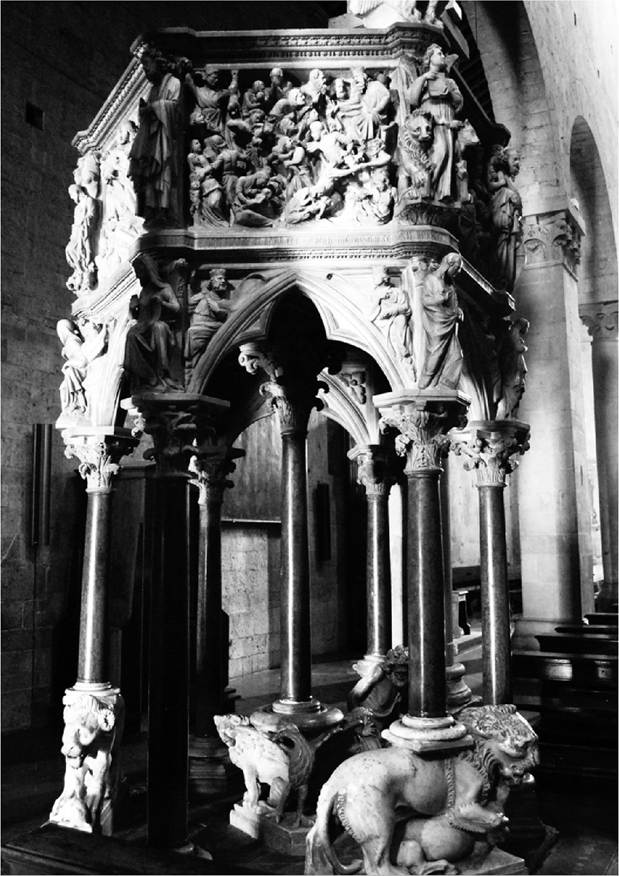
Figure 31.9 Giovanni Pisano, Marble lectern showing ‘Massacre of the Innocents' panel, Church of Sant'Andrea, Pistoia, Italy, 1297-1301.
the two schema he develops for the abduction of the babies and the climactic coup-de-lance. Towards the centre of the composition a soldier thrusts a sword
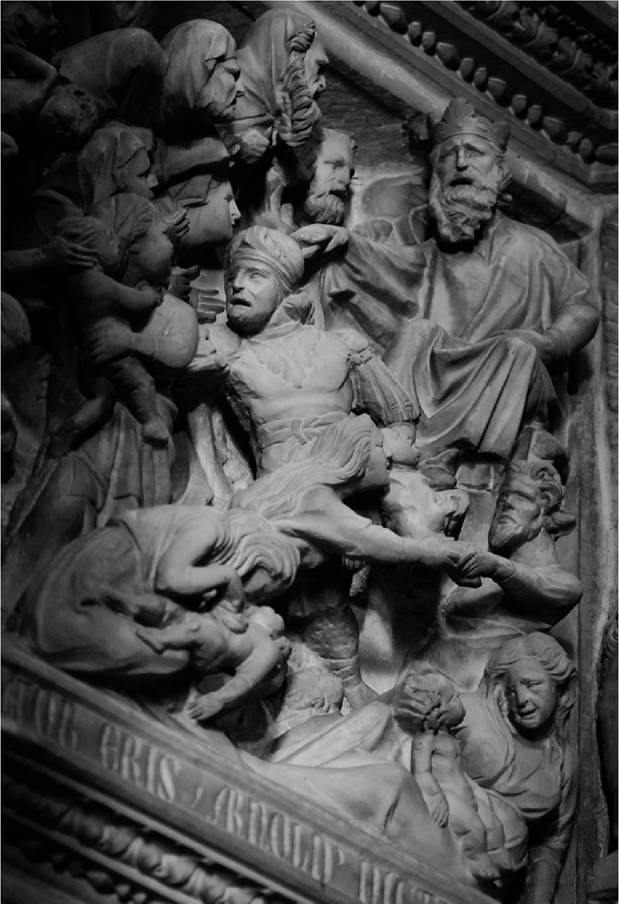
Figure 31.10 Giovanni Pisano, detail from ‘Massacre of the innocents' panel, viewed from the ground.
into the back of one infant; the victim grimaces in pain, recoiling his right leg and reaching pitifully back towards the weapon, a gesture betokening resis- tence. Where a youthfUl soldier grasps the feet of another victim in the panel's upper-left corner, we discover a shocking contrast. Helplessly inverted, the infant here is visually equated with a small animal, ready to be bled and eviscerated. This equation of child-murder with butchery refracts older descriptions of Herod's soldiers as carnivorous beasts, ‘lions' unleashed by their master; it seems to raise the terrifying spectre of cannibalism.[1211] Suddenly Herod's riot of pre-emptive political murder looks to be transformed into a blood-soaked pagan rite. Yet Giovanni's visualisation of extreme cruelty is just as likely to be based on conventional descriptions found in the pictorial and ekphrastic tradition. The motif of the soldier holding the child upside down by the ankle in his left hand can be found in earlier visualisations of the scene, and may also reflect Old Testament scenes such as the Judgment of Solomon.[1212] Similarly, the Pistoia lectern's wild-eyed Herod closely approximates Philagathus' description of him as ‘sitting proudly on some high throne, giving sharp and savage looks with wide- open eyes... Stretching out his right hand, he seemed to be commanding the soldiers.'[1213]
Whatever can ultimately be said of Giovanni's procedures of borrowing and translation, it bears emphasising that the sculptor has not conjured atrocity away, nor has he dissolved its victims into ‘faceless' exemplars of terror, unrecognisable to those who mourn them.
Violence has been granted a kind of immediacy, but not as an unmediated extension of the real. It is, rather, mediations themselves that produce the effects of violence. The agitation of form is transferred by the concrete action of signs (signa) to the soul of the beholder because the latter is already receptive, and because that receptivity is determined, according to Aristotle's theory of rhetorical persuasion, by a ‘disposition' (diathesis) in the soul, shaped by the passions (pathe) unique to the individual.[1214] Late medieval devotional culture understood that disposition as a special receptivity to suffering-with (compassio), a yearning for affective experience that merged penitential spirituality and Christian virtueethics. Indescribable yet described, overwhelming in its varietas but ordered by the artistic form, the visual violence of late medieval imagery ‘makes sense' most powerfully as a collection of effects - but only when the beholder, the addressee of the picture, consents to become a subject of violence.