Conclusion: ‘There Must Be Blood’
Descriptive elaborations of gospel stories such as those found in the sermons of Basil of Seleucia, the marble reliefs of Giovanni Pisano or the painted panels of the late medieval Master of the Karlsruhe Passion required little defence as products of the pious Christian imagination, however disturbing their violence (Figure 31.11).[1215] Contemporaries recognised that the gospel accounts were stories plainly told, written in a popular, almost lapidary style, and that they always fell short of describing all that Christians naturally wanted to know.
Matthew's account of the Bethlehem slaughter, for example, is the very model of what ancient rhetoricians called simple narration: nothing described, nothing adorned.Absence of detail and adornment is especially marked in the gospel sequences encompassing the Passion of Christ.[1216] Consider the night-time seizure of Jesus on the Mount of Olives: from Mark we learn only that, after being identified by the traitor Judas, ‘they laid hands on him, and held him' (14:46); Matthew's account hews closely: ‘Then they came up, and laid hands on Jesus, and held him' (26:50); Luke is still more matter-of-fact: ‘And apprehending him, they led him to the high priest's house (22:54); and John, while insisting that the soldiers led Jesus first to Annas, father-in-law to Caiaphas, adds little to the action itself save the posse's composition: ‘Then the band and the tribune, and the servants of the Jews, took Jesus, and bound him' (18:12). In contrast, a German Passion tract from around 1350, entitled Christi Leiden in einer Vision geschaut (Christ's Passion as Seen in a Vision),
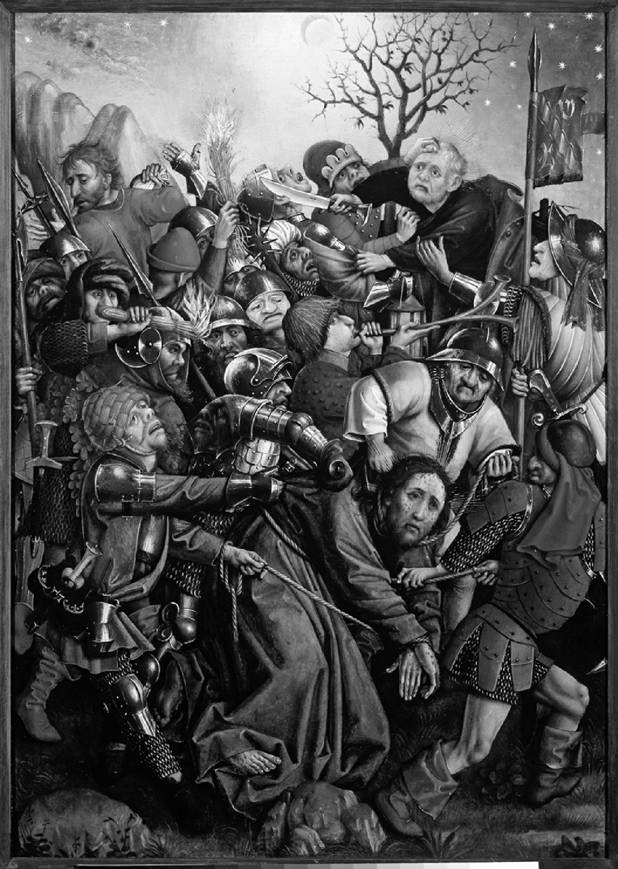
Figure 31.ii Master of the Karlsruhe Passion (Hans Hirtz?), The Arrest of Christ, c.
1450-5, mixed technique on walnut, 66 x 47 cm.revisualises the scene as a dramatist might, fleshing out the basic action and turning it into a savage rumpus:
Then they seized Christ with raving violent devilish gesticulations, one grasped his hair, a second his clothes, a third his beard. These three were as foul hounds as ever might cling to him... and so he was pulled away, with violent wild raving abandon, with fierce blows of mailed hands and fists upon his neck and between his shoulders, on his back, on his head, across his cheeks, on his throat, on his breast... They tore his hair from his head so that the locks lay strewn around on the ground; one pulled him one way by the hair, the other pulled him back by the beard [twelve further lines of print]. So they dragged him down from the Mount... [four lines]. And they hauled him to the gate of the town in such a way that he never set foot properly on the ground.[1217]
According to the accepted scholarly view, the growing appetite for narrative detail exemplifies the profound changes that came over Christian art and literature in the later Middle Ages, a time when the humanity of Christ and the Virgin took centre stage in devotional culture. Visual devotion and meditative visualisation were promoted as personalised forms of ‘witnessing' the events of sacred history. And violence? Mental, verbal and visual recreations of the Passion under this paradigm acknowledged an almost obligatory abundance of brutality and gore. One fifteenth-century French playwright insisted upon it when, in his stage directions for his Passion play, he noted: ‘There must be blood.'[1218] Yet it was not unaided imagination that stepped in to provide this detail but rather, as F. P. Pickering demonstrated long ago, a creative process of embroidery based on Old Testament exegesis, a ‘translation of ancient [i.e., biblical] prophecies, metaphors, similes and symbols... into “history”'.[1219]
The problem of defining the nature, function and meaning of ‘sacred realism' within Europe's diverse devotional regimes before 1500 has preoccupied scholarship for well over a century, and the place of violence within them has received ample attention.
Although Pickering recognised the rhetorical character of the tracts he edited, his explanation for the introduction of new elements into late medieval Passion narratives focused on textual methods of translation, de- and re-composition, not their persuasive impact on listeners or readers. Yet there can be little doubt that the learned author of Christi Leiden conceived his text as a pious ekphrasis, beginning with its framing avowal to be a description of a vision, and extending to the rapidfire litany of blows, slaps and kicks, the vivid, bestialising characterisations of the soldiers, and the frenzied assault on their prey. To the degree that the middle Rhenish Karlsruhe Master followed the lead of the Passion tractates, it is anything but servile. Bright colour and varietas; the play of textures - absorptive and reflective surfaces - that guides the eye through the work; the sense of forceful gesture and movement swirling around the sorrowful Christ; the mixing of fearsome ‘real' violence with contrived onstage buffoonery - these are the distinctive elements of a painterly style capable of instigating a transfer of violent effects from the image to the mind of the spectator. Painters matched wits with poets well before Renaissance humanists gave them licence to do so.Neither the claim that an ekphrasis is based on a vision nor the brutality of its contents should lead us into thinking of this imagery as untamed emotional extravagance. Despite its reputation for wallowing in violent effects, for prolonging the spectacle of sacred bloodshed beyond what audiences could endure, late medieval Passion piety was not designed to run experience off the emotional rails. Pious witnessing was above all a performative cultivation of virtue - emotional and intellectual, spiritual and ethical - for the sake of the soul. We miss this inherent therapeutic dimension when the frame for interpreting late medieval imagery is that historicist constuct of a ‘violent' medieval Weltbild. Medieval devotional texts and images have a clear logic, and they display a diversity of methods for ‘grounding the medieval imagination in the physicality of violent acts'.[1220] To grasp the rhetorical elaboration of violence in medieval texts and images is to come to terms with their essential rationality.
More on the topic Conclusion: ‘There Must Be Blood’:
- Blood transfusion and blood products
- BLOOD-PRODUCT TRANSFUSIONS
- Blood Vengeance
- Testing of patients and blood donors
- Blood: Symbolism of Violence
- Blood, Bodies and Bones
- Blood Ties
- 9∙ The Call of Blood
- Blood Sport and Ritual
- HIV-1 SANCTUARIES AND THE ROLE OF BLOOD-TISSUE BARRIERS: CENTRAL NERVOUS SYSTEM, TESTES, AND RETINA
- White Blood Cell Disorders
- CASE 210: Bad Blood
- For us everything is permitted, because we are the first in the world to wield the sword not to oppress and enslave, but to liberate mankind from its chains Blood?
- THE HOLY GRAIL AND THE HOLY BLOOD
- In 1983, the virus that came to be called the human immunodeficiency virus (HIV) was discovered in human blood samples.
- HIV is a virus that infects white blood cells, primarily those called CD4 cells (also called T4 cells or T-helper cells).
- As we have just seen, Plasmodium has specific mechanisms that enable it to live inside a red blood cell. When both a parasite and its host possess such specific mechanisms, that observation suggests that the strong selection pressure that hosts and parasites impose on each other has caused their populations to evolve.
- Kidneys are not only the primary excretory organs, but also contribute to many other functions including electrolyte balance, blood pressure regulation, vitamin D metabolism, and secretion of hormones, e.g. erythropoietin and prostaglandins. Apart from primary renal diseases, kidneys are also involved in many systemic disorders or just by being the excretory outlet of body.
- Conclusion
- Conclusion