Battle Images, Visual Rhetoric and the Force of Conflict
Battles and warfare pose a special problem of representation. A privileged and complex type of event, the battle vexes in perfect proportion, it seems, to everything historical experience seeks to discover or preserve in the act of describing it.
Tactics that won the day, the chaos of clashing forces, the confusion of the scene amidst rising dust, hails of arrows, the smoke of cannons, the abjection of the fallen - to record a battle in word or image is to be faced with an unruly surplus, a spectacle of ‘endless detail’ according to Voltaire, one that has always challenged the available means of description. J. R. Hale put it with blunt precision: ‘Battles sprawled. Art condensed.’[1178] [1179] Yet images of warfare have routinely been treated as documents and historical sources to be mined for information. The antiquarian impulse to trace a particular type of cavalry formation or the use of longbowmen, for instance, the workings of a siege engine or the appearance of the stirrup, or the peculiar fate met by famous men on the battlefield - such questions give the battle piece its uneasy identity as a document, whereby its ‘reliability’ as a source of visual evidence is measured according to a variety of factors (Figure 31.1).11But artists rarely behave as mere recorders of events, and claims of historical eyewitnessing are very often only that. Medieval and early
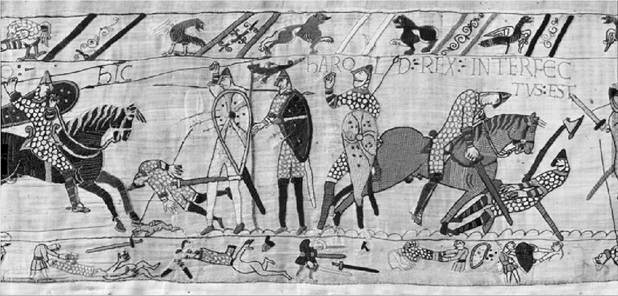
Figure 31.1 Anglo-Norman; The death of King Harold, detail from the Bayeux Embroidery, before 1077, embroidered cloth, ht approx. 50 cm.
modern images of battle were designed to arouse the wonder and admiration of their beholders in a shared present, one in which reception is performed as much as experienced.[1180] Considering battle images as sources for the history of violence in the modern sense highlights this challenge and reveals its dilemmas.
In fact, the most essential happenings of warfare - the primal actions of killing and being killed - are the most elusive when it comes to the search for historical realities. ‘Real violence', then, may paradoxically be the first casualty of war - at least as far as evidentiary status of the work of art goes. This is because violence, knowable only through its effects and the evidence of those effects, is not to be found ‘outside' the image, somewhere in past reality, but ‘inside' the circuit created between maker, artefact and beholder.For all its colourful specificity and descriptive detail, a work such as Paolo Uccello's (1397-1475) three-part monument to the Battle of San Romano (divided today between London, Florence and Paris) is a work that subsumes ‘accuracy' and ‘reliability' beneath a concern for figural inventiveness, rhythmic force and what John Pope-Hennessey, responding to centuries of criticism of the Florentine master's ornate style, called the painting's ‘allpervading decorative sense'.[1181] All three panels once adorned Lorenzo the Magnificent's chamber in the Medici family palace. In the widely accepted
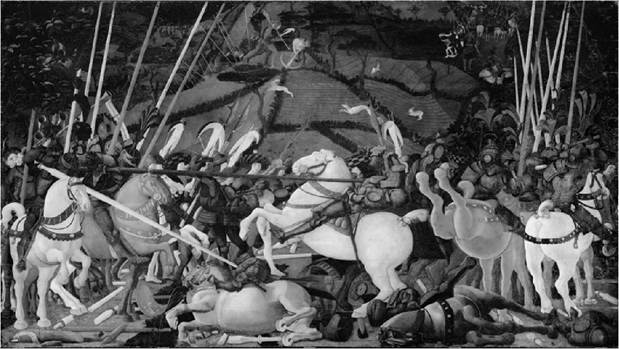
Figure 31.2 Paolo Uccello, Niccolò Mauruzi da Tolentino unseats Bernardino della Ciarda at the Battle of San Romano, 1435-40, tempera on wood, 182 x 322 cm.
reconstruction it was the Uffizi's panel, depicting the pas de deux in which Bernardino della Ciarda, condottiere for the Sienese army, is unseated by Niccolò Mauruzi da Tolentino, commander of the Florentine forces, that occupied the central position (Figure 31.2).[1182]
Because Uccello's innovative cycle celebrates a recent event, still alive in the minds of contemporaries, expectations for its historical value have been high among past commentators. This is in contrast to trecento battle scenes based on episodes from the vita of a military saint, for example Altichiero's fresco in Padua depicting St James at the Battle of Clavijo,1[1183] where the hunt for verisimilitude must content itself with genre-like military details such as armour, weapons and heraldry - ‘accurate' precisely because they are anachronistic.
Historical battles as ancient as David's assault on the Amelakites or Saul's rout by the Philistines (I Samuel 30:16-19 and 31:1-6 respectively) were rendered in completely contemporary terms by the French illuminators of the Morgan Bible of c. 1250, where biblical cavalrymen sport the trappings and employ the tactics of chivalric warriors (Figure 31.3).[1184]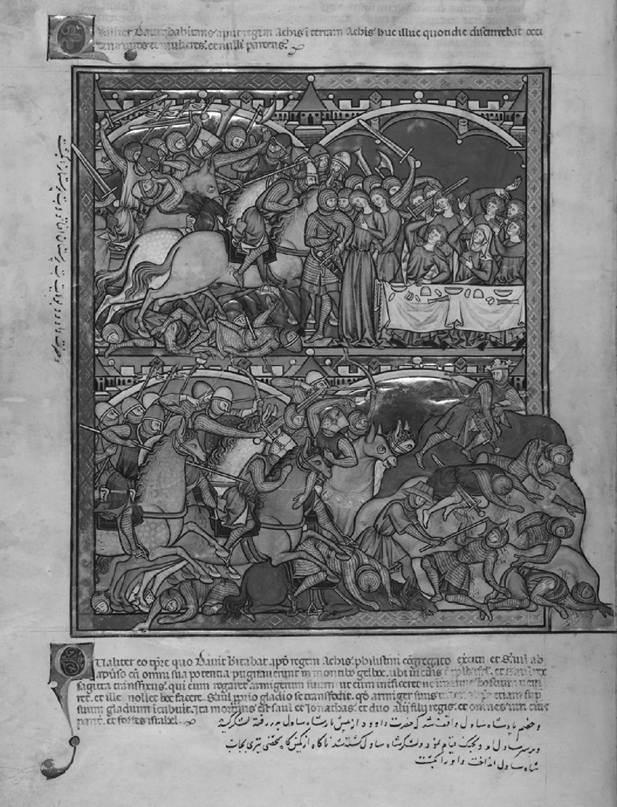
Figure 31.3 Parisian; David attacks the Amalekites during their feast and rescues captives (upper part) and Saul and his sons fall before the Philistines (lower part), illumination from the Morgan Bible, c. 1244-54.
Despite Uccello's proximity to the historical event he describes - a surprise attack by Tolentino against Siena's cavalry after a few hours ofheavy fighting on i June 1432 - and despite the availability of eyewitness reports and textual accounts, the three panels emphatically foreground their own artificiality. Noting the processional quality of the troop's entry from the left in the London panel, where parade regalia rather than combat helmets are worn, Hale observes, ‘the whole work shows battles as episodes in a pageant, well removed from any apprehension of the reality of war'.[1185] Starn and Partridge (1984) concur. In their view the three paintings ‘positively insist upon their painted superficiality as flat spaces on which colors are variously circumscribed and arranged'.[1186] This is the outcome of Uccello's effort to transpose the storytelling conventions generally reserved for heroicising legendary and classical subjects onto a grand scale, and onto a contemporary subject. A similar impulse ‘to prettify and anecdotalize conflict' is characteristic of the fashionable painted marriage chests (cassoni) of the period. Measured in documentary terms, they come up woefully short of what Peter Paret has termed ‘serious representations of war'.1[1187]
At first glance, northern European battle images from around the same time, despite their crisp optical naturalism, are even further removed from Paret's realist categorisation.
Pagan bodies are impaled, trampled and crushed in the terrifying onslaught of Christian knights in the Master of St Lambrecht's twilit scene, now in Graz (Figure 31.4).[1188]The panel, still in its original frame, ostensibly depicts the fourteenthcentury victory of King Louis of Hungary and Croatia (r. 1342-82) over the Serbs, but is cast in even more contemporary terms as holy war against the Ottoman Turks. Crowned and clad in iron plate armour and chain mail, his sword raised in a gesture of divine vengeance, Louis leads the cavalry from atop a white charger, recalling St James in his legendary role as the ‘slayer of Moors' (Santiago matamoros) at the Battle of Clavijo.[1189] That the crusading king also defends the holy church as he delivers his territory from infidel occupation is shown by the monumental figure of the Virgin, pictured as a living cultimage (Gnadenbild), a ‘Mother of Mercy' who harbours the faithful under her protective robe. This identifies the work as a votive offering. Meanwhile, the picture's storybook quality, its indeterminate space and non-progressive narrative, the sense of discoordinate pieces brought together in a visionary or
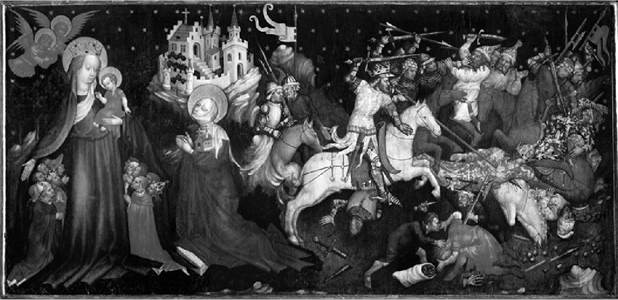
Figure 31.4 Master of the St Lambrecht Votive Panel (Hans von Tübingen?), Battle of Louis of Hungary and Croatia, c. 1430, tempera on chalk-prepared spruce panel, with original frame, 94 x 182.5 cm.
symbolic space, even the patterning of stars that suggests a tapestry (the privileged medium for battle scenes among French aristocrats) - all of this casts Louis's quest as holy and his victory as a chivalric tale of sacrificial valour.
Amidst the violent pageantry of the Graz panel, it is easy to overlook the little scene of ambush and murder unfolding in its foreground. Taking place at the margins of the main action, yet directly aligned with the beholder's angle of view, this knaves' scuffle recalls the soldiers gambling for Christ's robe in countless Crucifixion images.[1190] In this sense it is a stock motif among others.
Yet it also projects a genre-like realism that shows the painter attentive to the collateral violences of war: the looting and pillage, the flight of refugees, the desperation of the wounded. Anti-heroic interpersonal violence and crime, perpetual companions to warfare, are here contrasted with the sanctified violence enacted by the Christian warrior. It would be nearly a century, however, before European artists would begin to address - in a serious way - the horrors and moral paroxysms unleashed by war: Urs Graf s Schlachtfeld drawing in Basel (1521) may be the first instance;[1191] better known are Jacques Callot's Les grandes misères de la guerre (1633) or Francisco Goya's Los desastres de la guerra (1810-20).Preoccupied with ennobling violent action at narrative hotspots, late medieval battle pieces north and south of the Alps indulge cliche, formula and decorative fantasy over the recollection of facts. If such images frustrate the historian's effort to recover the reality of military violence, they nevertheless disclose the historical experience of violence in ways that have escaped notice. Among the historical forces often cited in discussions of late medieval warfare are the effects of shifting military practices, technologies and tactics. Key examples are the increasing use of the English longbow, with its range of 100 yards; the mobilisation of infantrymen to complement the heavily armoured, charging knight; the Swiss use of pikesmen to degrade or halt cavalry advances; and above all the growing reliance by major warmaking powers - city-states, kings and emperors - on mercenary armies led by professional military contractors (condottieri). Each of these changes contributed to a greater tactical emphasis on the clash of massed forces, a greater ruthlessness in killing, as well as a broader rippling out of the social devastations wrought by war. San Romano was, in fact, exceptionally bloody.[1192] Even with the new emphasis in warfare, however, the charging line of mounted knights remained the defining feature of open battle, and the tournament-like, chivalric pas de deux its dramatic focal point.[1193] It was against a backdrop of chivalry's growing military obsolescence, then, that our Italian and Austrian masters foregrounded the ‘beautiful feats of arms' (belli fatti d'arme) of the chivalric commander, whose deeds and honour the battle piece commemorated, often crossing the line into portraiture (this is another way Uccello's cycle may be interpreted).
In this strategy of stylisation we can recognise the counter-documentary dimension of battle images and their functional identity as artful fictions. Their conscious artifice allowed them to be, on the one hand, patently propagandistic: it was for the edification of his Florentine patrons, after all, that Uccello projected an image of glory upon a war that had actually ended in stalemate.[1194] On the other hand, it allows them to be distinctly memorable. Their unstated aim is to produce what Aristotle and his medieval commentators called ‘mental impressions' or ‘impressions in the soul', that is, signs that produce meaning by imposing themselves on cognitive operations rather than reality itself.[1195] Calling attention to the artificiality of means, the choreography of gesture, the familiar conventions for describing armed conflict and bloody violence, the painter's description assumes the quality
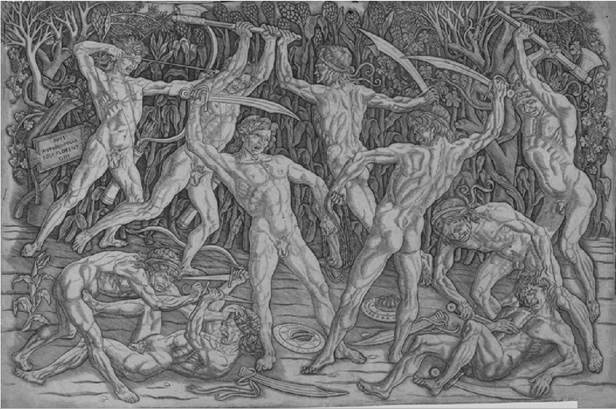
Figure 31.5 Antonio del Pollaiuolo, Battle of the ten nude men, c. 1465, engraving, 33.25 x
59 cm.
of a rhetorical exercise keyed to the spectator's capacities. The ancient doctrine that every art (techne) can, with the means available to its practitioners, ‘move' the soul from one state to another would become enshrined in quattrocento art theory around the same time Uccello painted his San Romano cycle. Its most influential exponent was Leon Battista Alberti (140472). In Book 2 of Della pittura (1435-6) Alberti explains that it is visible movements (mozione) that reveal the invisible movements (emozione) of their characters' souls, for like begets like, and this mimesis extends to the beholder: ‘It happens in nature that nothing more than herself is found capable of things like herself; we weep with the weeping, laugh with the laughing, and grieve with the grieving.'[1196]
Contemporary works, especially those conceived in a mythological vein, could dispense with the pretence of historical description or legendary narrative altogether to spotlight these effects. To modern eyes, Antonio Pollaiuolo's celebrated engraving known as the Battle of the ten nude men, having eluded any satisfactory iconographic explanation, seems to approach the conditions of ‘pure violence' (Figure 31.5).
But rather than a meditation on the primal origins of human combativeness or aggression, Pollaiuolo's collection of lunging, hacking, stabbing and wrestling figures trades on the rhetorical power of expressive and agitated gesture, implied movement and rotation, the percussive clash of weapons and the penetration of bodies. In proclaiming mozione, the beautiful and terrifying movement of live bodies in space, to be the visible outward form of emozione, the turbulent ‘passions' of the soul, Pollaiuolo certainly touches his era's moral understanding of physical violence; but he also registers an awareness that the beholder's mind is the real arena in which violentia plays out.
More on the topic Battle Images, Visual Rhetoric and the Force of Conflict:
- Visual Rhetoric
- Chapter 32 Scanning Visual Mental Images: The First Phase of the Debate Stephen Kosslyn
- Early Christian authors from the richly expressive religious environment of northern Mesopotamia were comfortable appropriating images of the feminine spirit of God known from the Hebrew tradition and developing their own language and images for her.
- Visual Impairments
- Visual Impairment
- Visual Space
- Visual perspectives on environment and empire
- The Ritual of Battle
- The Idea of New Rhetoric
- Sources of Visual Imagery
- The Battle for the Donbas