Disease and colonial countermeasures
Disease was often worn as a badge of colonial honour, as a sign of having acclimatised, or of having completed a successful colonial career. Thus, in 1908, the young schoolteacher and budding literary figure Jean Paulhan wrote home to France from Madagascar.
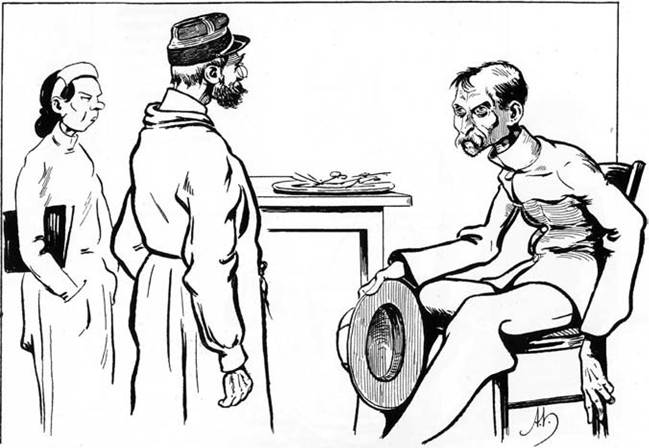
With a mix of trepidation and admiration, he evoked a friend of his who supposedly had contracted ‘pernicious fevers’, rabies and syphilis over the course of his colonial sojourn.13 For others, years in the colonies were counted in terms of strain on the liver. In the French context in particular, hepatic fatigue or distress represented a key marker of the length of one’s colonial stay. Whatever the point of attack, the impact of the tropics thus seemed inscribed on the settler’s body. A cartoon from Andre Joyeux’s 1912 La vie large des colonies shows a gaunt and forlorn colonial official in a doctor’s office. When the patient answers that he has been in the colonies for eight years, the doctor responds ‘Goodness’ (see Figure 23.1).‘Pretext or prophylaxis?’ asked John Western and Stephen Frenkel of British colonial segregation in early twentieth-century Sierra Leone. Colonial fear of disease, they conclude, was certainly real, and inscribed itself on an earlier reputation of the territory as insalubrious. Yet they also note that in instances where imperatives of comfort and medicine clashed, the former tended to prevail. Medical considerations, they conclude, were just one of many pretexts utilised to justify separation, often outright segregation, from Africans.14 What is more, malady itself proved extremely mutable and malleable.
- Combien de sijour?
- Huit ans.
— Parbleu.'...
Figure 23.1 Diagnosis; ‘How long have you been here (in Indochina)’ asks the medic.
‘Eight years’ responds the patient. ‘Goodness,’ replies the doctor. Andre Joyeux, La vie large des colonies. Paris: Maurice Bauche, 1912.As Warwick Anderson and others have shown, while much colonial concern was expressed over malaria, for instance, even when that affliction could be avoided or overcome, ‘it was feared that the environment might still independently precipitate degeneration in the qualities supposedly typical of the white races’.15 Environmental determinism did not vanish overnight with the advent of germ theory. Rather, it continued to condition comportments and justify everyday colonial strategies.
Indeed, health functioned as an all-encompassing explanatory terrain, used to justify everything from segregation to indigenous policy. Individual colonials successfully borrowed medical codes and imperatives for a variety of ends. In January 1910, Jean Paulhan recounted that a villa built by an administrator as a place to meet his lovers had been expropriated by the administration, the structure having been illegally purchased with public funds. Seeking to justify the government’s sudden ownership of a garsonnière, officials promptly and conveniently reinvented the house as a ‘sanatorium’.16 In this instance, the pretext seems manifest. Rest, pampering and relaxation became stand-ins for colonial health obsessions, yielding a lifestyle many colonials could not afford at home.
This is certainly not to deny that the colonies elicited very real fears. Thomas Metcalf writes that: ‘always, Bengal embodied the vision of India as a land of peril’.17 Moral and physical degeneration were believed to go hand in hand. Catastrophic reports, stoked by serious data on morbidity rates in the tropics in the nineteenth century, led some European scientists to declare that their compatriots could degenerate within a single generation in the tropics, if proper countermeasures were not adopted. Such countermeasures, such as the pith helmet, hill stations, a strict regimen and diet featuring quinine-infused drinks, at first appeared to stand as firm commandments, then vague prescriptions, before gradually blending into the matrix of colonial culture.
Whatever its precise origins (pragmatic, medical, psychological or ideological), the desire to reproduce the motherland overseas proved a powerful imperative indeed. At its core, it involved fashioning the landscape, people, even the climate of the colonies. Aline Demay has uncovered a fascinating proposal hatched in Indochina in 1896, that involved ‘refrigerating’ a vast space of some 10 square kilometres, to render it hospitable to European constitutions. The colony’s head of public works enthusiastically endorsed the project, deeming it ‘an essential element in the success of French colonialism in Indochina’.18 Although the scheme was never realised, it reveals the degree to which colonials sought to recreate home, modifying space and air in the process. Where it was possible to do so, Europeans sought higher elevations, marine breezes or other microclimates to avoid the tropical heat they blamed for everything from disease to degeneration.