Egyptian Pyramids
All of the kings and important people buried in Egypt had gold and jewels in their graves. And everyone in Egypt knew that the graves were full of treasure. What do you think happened?
At first, the Egyptians of the Old Kingdom dug underground rooms in the desert to bury their mummies.
But thieves knew that the mummies had jewelry and treasures buried along with them. Grave robbers often broke into these underground rooms and stole all the treasure. So the Egyptians started to build stone tombs out of huge stone blocks with a hole, or shaft, cut into the middle. The mummy and all its clothes, furniture, and jewelry were lowered down the shaft into a treasure room. Then the shaft was filled with stones to keep anyone else from climbing in. These tombs were called mastaba tombs.But even mastaba tombs weren’t good enough for pharaohs. The pharaohs were buried in the biggest tombs of all—pyramids. Pyramids were giant fortresses to keep the pharaohs and their treasures safe. And pyramids were important for another reason. They pointed upwards to the sky. The Egyptians believed that the pharaoh was a god, and that he would rise up and join the other gods after his death. They thought that the dead pharaoh would climb up to heaven, using the sides of the pyramids like steps.
Cheops spent over twenty years building his pyramid before he died. He knew that he would be buried in this pyramid when he died, and he wanted his pyramid to be the biggest of all. His pyramid still stands in the desert near Giza (which today is called Cairo, Egypt). It is called the Great Pyramid, because it is the largest of all the 35 pyramids that the Egyptians built for their pharaohs.
The Great Pyramid was built around 2550 BC/BCE. It was the highest building in the world for four thousand years. It was built with over two million blocks of stone—and each block weighs almost three tons.
That’s as heavy as an elephant! And the Egyptians didn’t have any cranes, bulldozers, or earthmovers. Instead, they cut the stone blocks out by hand, with copper and stone tools. Then they built ramps out of rocks and earth up the sides of the pyramids, and dragged the stone blocks up the ramps with ropes. Hundreds of men pulled together to move the largest stones. Thousands of Egyptians worked on the Great Pyramid, year after year. Finally, the pyramid was finished. Then the Egyptians pulled the ramps down and covered it with sheets of white limestone. Archaeologists think that the pointed stone at the very top of the Great Pyramid even had a golden cap on it. The white stone and golden top are gone now, but when the Great Pyramid was first built, it shone in the sun.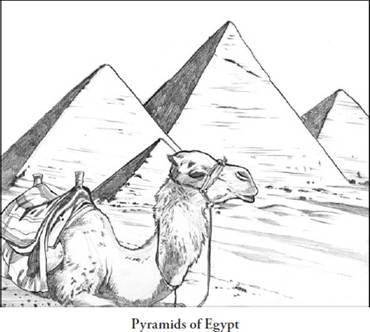
Inside the Great Pyramid was a burial chamber, just for Cheops. But there were also empty chambers and unfinished rooms, and passages that led off into dead ends. Cheops hoped that any thief who broke into the pyramid would get lost in the maze of rooms before he could find the treasure. And after the pyramid was finished, workmen sealed off the door to the outside. They slid huge plugs of stone down the passage to block the way into the pyramid—and then went out through a small escape passage that had been dug down into the ground and came up in the desert outside.
The Great Pyramid even has its own watchdog. Near the Great Pyramid, the Egyptians built a mysterious monument shaped like a sphinx—an imaginary animal with a man’s head and a lion’s body. We now call this giant limestone animal the Great Sphinx. The Great Sphinx is as tall as eleven men, standing on each other’s shoulders. And it is almost as long as a football field. The Sphinx was made out of limestone, which is a kind of stone that is easily chipped and broken. Desert sand keeps burying it and wearing it away. Its nose is broken. But even though it is almost five thousand years old, you can still see that the Sphinx has the face of a man. Many people think that the Sphinx was built to protect the pyramids.
But thieves found Cheops’s burial chamber anyway. They got past the Sphinx and through the maze of passages inside the Great Pyramid and stole Cheops’s treasure—and his mummy. By the time archaeologists made their way into the pyramid, Cheops and his gold had disappeared forever.
alt=line.jpg>
Note to Parent: Cheops is also known as Khufu.