Making Mummies
After King Narmer united Upper and Lower Egypt into one country, Egypt grew to be rich and powerful. We call this time in Egyptian history the “Old Kingdom of Egypt.” The Old Kingdom lasted for almost a thousand years—until about the year 2100.
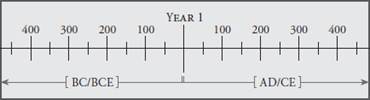
Before we go on, let’s look at that date a little more closely. Usually people write this date with a “BC” or “BCE” after it. “BC” means “Before Christ,” and “BCE” means “Before the Common Era.”
About fifteen hundred years ago, historians began to use the birth of Jesus as a way to count years. In this system, Jesus was born in “Year 1.” Dates before Year 1 count down from highest to lowest (for example, 99, 98, 97 … and so on), and end at Year 1. The “Common Era” begins with Jesus’ birth. The years after Jesus’ birth are called “AD” or “CE.” “AD” stands for Anno Domini, or “The Year of Our Lord” in Latin. “CE” means “Common Era.” In the Common Era, dates are counted forward (for example, 2006, 2007, 2008, 2009 … and so on). The timeline on the next page shows the BC/BCE years getting smaller as they approach Year 1, and the AD/CE years getting larger as they move away from it.
During the Old Kingdom of Egypt, the Egyptians began to make mummies for the first time. Mummies were the bodies of dead people, treated with spices and salts and wrapped in linen so that they wouldn’t decay. The Egyptians believed that dead people went on to another life in the afterworld. But they also believed that the dead could only enter the afterworld if their bodies were preserved. This was called embalming.
Embalming was a very complicated process. Only priests—men who were in charge of worshipping the gods—were allowed to make mummies. And it took more than two months to make a mummy!
Let’s imagine that we’re back in the Old Kingdom of Egypt, at the time of the pharaoh Cheops.
Cheops has been pharaoh for years. He has made Egypt’s army strong, and he’s kept Egypt safe from enemies. But in the middle of the night, word comes from the palace that Cheops is dead.Instantly the priests start to make preparations. They collect all the things they’ll need to make Cheops’s body into a mummy—salt, spices, oil, and linen. Cheops is carried from the palace to the temple, where the priests are waiting for him.
The priests take the body to a holy place inside the temple. They wash it with wine and spices. Then they take all of Cheops’s organs—his liver, his stomach, his lungs, and his intestines—out of his body. They cover the organs with special spices to preserve them.
Cheops’s heart gets special treatment. The chief priest takes the heart out, washes it, wraps it in linen strips, and puts it back into Cheops’s chest. The Egyptians believe that Cheops will need his heart in the afterlife. They think that when Cheops reaches the afterworld, the god Osiris will weigh his heart on a special scale. If his heart is good, it will be light and Cheops will spend the rest of the afterlife in happiness. But if his heart is full of sin, it will be heavy—and a monster will eat it!
After they finish with the heart, the priests cover the pharaoh’s body with salt and more spices and leave it covered for forty days. During this time, Egyptians mourn the death of their king.
When forty days have passed, the priests come back and uncover the body and the organs. They wash the organs and the body again and cover them with oil and more spices. They put the liver, the stomach, the lungs, and the intestines into four special jars called canopic jars. Each jar has the head of a god on top of it. These gods are supposed to protect Cheops’s organs.
Then the priests wrap Cheops’s body in strips of linen. They put special pieces of jewelry between the linen strips. The jewelry is supposed to protect Cheops on his journey to the afterworld—just like magic.
Then they make a gold mask that looks just like Cheops, and put it onto the mummy’s face, so that the gods will recognize the mummy when Cheops arrives in the afterlife. Finally, the chief priest holds a special ceremony. He touches the mummy’s mouth with a special tool. He thinks that this will allow Cheops’s mummy to hear, see, and talk in the afterworld.Finally the mummy is finished. But before Cheops is buried, he has to be put into three coffins. The first coffin is gold and has Cheops’s face on the outside. This gold coffin is put into a wood coffin to protect it. Then Cheops’s wooden coffin is carried through the streets in a huge funeral procession, all the way to his tomb—a pyramid!
Inside the pyramid is a special burial chamber. The chamber has a big stone coffin in it, called a sarcophagus. The wooden coffin is placed inside the sarcophagus. The stone lid of the sarcophagus is so heavy that four men have to push it into place. Now Cheops’s mummy is safe inside its coffin. His spirit can begin the journey to the underworld.
Before the Egyptians leave the burial chamber, they make sure that Cheops has everything he’ll need to be comfortable in the next life. They fill the chamber with furniture, jewelry, clothes, and food for him to use. They leave toys and games for Cheops to play with, and scrolls for him to read. They even bury a full-sized boat beside the pyramid, so that Cheops can sail through the afterworld. Finally, they leave the burial chamber and seal up the door. Cheops’s body will lie undisturbed for years—until grave robbers discover that his tomb is full of treasure.

Note to Parent: See Chapter 37 for more on BC/BCE and AD/CE.
