Hieroglyphs and Cuneiform
The Egyptians were among the earliest people to use writing. Why do you think it’s important to be able to write things down?
Suppose I write a message for you on a piece of paper and put it on the table.
Then I leave the room. If you look at the paper, you’ll know what I wanted to say to you—even though I’m nowhere around. That’s one reason writing is important. Once the Egyptians learned to write things down, they could send messages from one part of the kingdom to another.What if you found my message a year after I wrote it? You would still be able to “hear” my words—even though I had written them down long before. That’s the second reason that writing is so important. The Egyptians could write down the important events that happened during their lifetimes, and leave them for their grandchildren and great-grandchildren to read.
The Egyptians used pictures to write with. We call these pictures hieroglyphs. The pictures stood for certain words. The Egyptians used to carve these hieroglyphs into stone tablets.
The stone tablets lasted for a very long time—but they were heavy to carry, and carving the pictures into stone took weeks of work.
Another country near Egypt had a better idea. They carved their pictures into tablets of wet clay. This country was called Sumer.
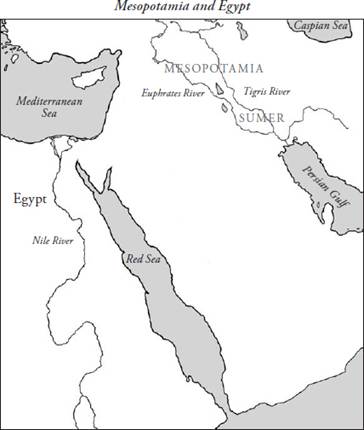
Sumer was in the Fertile Crescent, between the Tigris and Euphrates rivers. This place between the rivers is called “Mesopotamia.” The word Mesopotamia means “between two rivers.” Do you know what the word hippopotamus means? Hippo means “horse,” and potamus means “river.” A hippopotamus is a “river-horse”! In Mesopotamia, we can see the word potamus again, only this time it has a different ending. Potamia means “rivers,” and meso means “between.”
The Sumerian picture-writing was called cuneiform. Because the Sumerians lived between two rivers, they had plenty of damp clay.
Instead of carving their cuneiform onto stone, they would mold this clay into square tablets. Then, while the clay was still wet, they would use a sharp knife or stick to make the cuneiform marks. After the message was carved into the clay, the Sumerians could either wipe it out and write another message (if the message was something unimportant, like a grocery list), or else bake the clay until it was hard. Then the message would last for a very long time.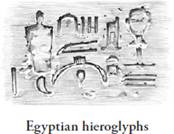
Writing in clay is easier than carving stone. But even clay tablets can be heavy. And clay tablets are thick; if you want to store a whole lot of them, you need a lot of space—whole buildings full of rooms for even a small library.
After several hundred years, the Egyptians came up with an idea that was even better than clay. They learned how to make paper and ink.
Egyptian paper was made from reeds that grew along the banks of the Nile. The Egyptians learned how to soften and mash them into a pulp. They would then spread the pulp out to dry in thin sheets. These sheets became reed-paper, which the Egyptians called papyrus. It was much easier to write on paper than on clay or stone. Paper was also easier to carry around; you could fold it up and put it into your pocket, or roll it up into a scroll. And paper took up less room. When they started using paper, the Egyptians thought they had found the best way to keep records.
But paper has a problem. When paper gets wet, the ink on it dissolves and the paper falls apart. And paper also starts to fall apart over time. The older paper gets, the more likely it is to crack up and turn into dust. We know a lot about Egyptian history from the times that Egyptians wrote on stone, because those stone writings have lasted for centuries—from Egyptian days until now. We know a lot about Sumerian history too, because clay tablets last for a long time if they’ve been baked hard. But we don’t know a great deal about what happened in Egypt after the Egyptians started writing on paper, because in the thousands of years that have gone by, the paper writings of the Egyptians have crumbled and disappeared.

Note to Parent: The Sumerians and Egyptians used cuneiform from about 3200 BC/BCE, with Sumerian writing developing slightly earlier.
More on the topic Hieroglyphs and Cuneiform:
- Hieroglyphs and Cuneiform
- Bauer Susan Wise. The Story of the World: History for the Classical Child: Volume 1: Ancient Times: From the Earliest Nomads to the Last Roman Emperor. Peace Hill Press,2015. — 338 p., 2015
- Contents
- COSMOLOGY AND THE POWER OF WORDS
- History, language families and textual content
- CONCLUSION
- A kind of ending: reading two modern texts on the secular