Sargon and the Akkadians
Do you remember how the Egyptians used to be divided into two countries—Upper Egypt and Lower Egypt? They spent all their time and energy fighting each other. But once King Narmer conquered Lower Egypt and made the Egyptians into one country, the Egyptians could spend their time on farming and on building instead of on war.
Egypt grew richer and stronger, once all the quarrelling Egyptians were united into one.The same thing happened over in Mesopotamia, between the Tigris and Euphrates rivers. People called the Sumerians lived in Mesopotamia. You’ve learned a little about the Sumerians; they wrote picture writing, called cuneiform, on clay tablets. The area where the Sumerians lived was called Sumer. But Sumer wasn’t really one country. It was filled with villages of farmers. The villages grew larger and larger until they became cities. Each city built thick walls and high towers to protect itself. Each city had its own king and its own army. And the cities fought with each other all the time! We call them city-states because each city was like a separate country. The cities put all their energy into protecting themselves from their neighbors.
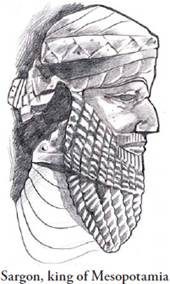
But one Sumerian wanted to make all the quarrelling cities into one country—just like King Narmer made Egypt into one country. This man was named Sargon.
There are many stories about Sargon. One of the oldest stories says that he had no parents—he just floated down the Euphrates River in a basket when he was a baby. The basket got stuck in the reeds at the edge of the river near a city-state called Kish. One of the servants of the king of Kish happened to be down at the river, getting water in a jug. He heard a strange sound. Where was that sound coming from? The servant saw a basket. He bent down to look inside and saw a crying baby—the baby Sargon.
The servant took the basket back to the palace of the king of Kish.
The king gave him permission to keep the baby and raise it. So Sargon grew up inside the palace. He became strong, handsome, and popular with the other courtiers. He even became the cup-bearer to the king; at every meal, he would bring the king his wine in a golden cup. The king’s cup-bearer was one of his most trusted servants, because it would have been very easy to poison the king’s wine. But the king of Kish trusted Sargon.He shouldn’t have. Sargon made friends with the most powerful people at the palace—including the commanders of the army. He became so popular that he convinced the army to follow him instead of the king. And he even persuaded the army to kill the king, and make him, Sargon, the ruler instead. This happened around 2334 BC/BCE.
But that wasn’t enough for Sargon. He didn’t just want to be king of one city—he wanted to be king of the whole land of Mesopotamia. So he started to attack the cities all around him. He fought over fifty wars to conquer Mesopotamia. Eventually, Sargon ruled all the country between the Tigris and Euphrates rivers. He built a new capital city called Akkad, and named his new empire Akkadia. Now Sumer was united into one country under one ruler.
But many of the cities Sargon conquered didn’t like being part of the Akkadian empire. They were used to making their own laws and running their own affairs. Sargon knew that to stay in charge, he would have to make the cities all obey his laws.
So he used his army to force all the Akkadian cities to follow him. He sent soldiers from the Akkadian army to live in each conquered city. They made sure that the people who lived in the city were following Sargon’s laws instead of their own. If the conquered cities didn’t obey, the soldiers punished them. This is called a military dictatorship. Military means “having to do with the army.” A dictatorship is when people have to obey the government without asking any questions. In a military dictatorship, the army is in charge. Sargon’s empire lasted for years—but only because he used the power of his army to keep it together.
More on the topic Sargon and the Akkadians:
- Contents
- God Speaks to Abraham
- The Empire United
- Militaries as Learning Organizations
- Egypt Invades Nubia
- Warring States
- The “princely graves”
- Hammurabi’s Code
- The Mystery of Mohenjo-Daro
- Index
- Boon Andrew. The Ethics and Conduct of Lawyers in England and Wales. Hart Publishing,1999. — 808 p., 1999
- Griffiths-Baker Janine. Serving Two Masters: Conflicts of Interest in the Modern Law Firm. Hart Publishing,2002. — 227 p., 2002
- Grisso T.. Evaluating Competencies: Forensic Assessments and Instruments. 2nd edition. — Springer,2002. — 564 p., 2002
- Luban David. Legal Ethics and Human Dignity. Cambridge University Press,2007. — 350 p., 2007
- Ayupova Z.K.. Theory of state and law: textbook. - Almaty: Kazakh University,2015. - 192 pages., 2015