Einhards Life of Charlemagne, written shortly after the emperors death, records Charlemagne' s burial in his palace chapel dedicated to Mary the Virgin at Aachen.
Above his tomb a gilded arch with an image and an inscription was erected. The inscription stated:
Under this tomb lies the body of Charles, the Great and orthodox emperor (corpus Karoli Magni atque orthodox imperatoris) who gloriously increased the kingdom of the Franks and reigned with great success for forty-seven years.
He died in his seventies in the seventh indiction, on 28th January in the year of our Lord 814 (Anno domini DCCCXIIIIIndictione VII, V! Kal Febr).1Quite apart from the crucial designation of Charlemagne as “orthodox” and that he died in the year 814 of the Christian era, the resonance with the Roman past is most obvious with the provision of the inscription itself, recognizing both his imperial title and his achievements. In this the Franks followed the custom of the Roman Senate's erection of monuments to celebrate their emperors,2 a custom that was deliberately emulated subsequently by many who hoped to bolster their political prestige with an appeal to imperial Roman precedent. In October 1721, for example, the Senate in Russia declared new titles—father of the fatherland, Emperor of all Russia—for Peter the Great “as was the custom of the Roman Senate in recognition of their emperors' famous deeds to pronounce such titles publicly as a gift and to inscribe them on statues for the memory of posterity.”3 The imperial title and rank was a prize jealously guarded as well as aspired to: Russian claims to empire caused particular problems for relations between Catherine the Great and the Hapsburg emperor Joseph II in 1781.4
Although Charlemagne's inscription has not survived, his supposed sarcophagus, a reused third-century monument of Carrara marble depicting the Rape of Proserpina, is still on display to modern visitors to the palace chapel in Aachen. The sarcophagus itself was the object of further imperial pretensions on Napoleon's part, for it was looted by Napoleon Bonaparte and only returned to Aachen after the debacle of
1 Vita Karoli, c.
31, ed. Holder-Egger 1911; Dutton 1996.2 Alfoldy 1972; Elsner 1996; Davies 2000; Cooley 2009.
3 Hughes 1998, 97.
4 Beales 2009, 118-119.
Rosamond McKitterick, Charlemagne, the Carolingian Empire, and Its Successors In: The OxfordWorld History of Empire.
Edited by: Peter Fibiger Bang, C.A. Bayly, Walter Scheidel, Oxford University Press (2021). © Oxford University Press. DOI: 10.1093/oso/9780197532768.003.0017.
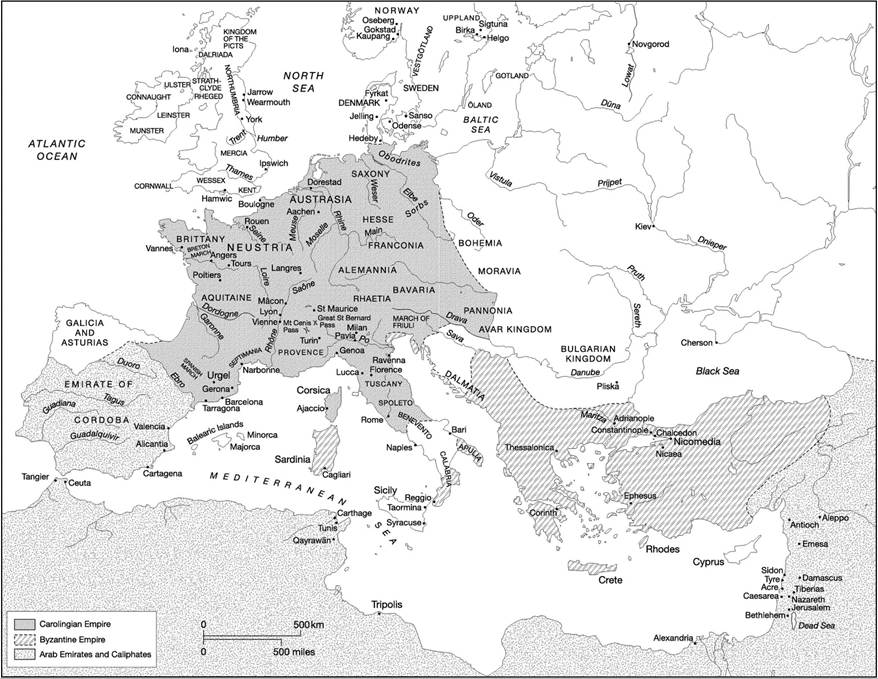
Map 17.1. The Carolingian Empire, Europe ca. 814.
Source: McKitterick, 2001, The Short Oxford History of Europe, The Early Middle Ages, pp. 284-285 Copyright: Oxford University Press.
CHARLEMAGNE, THE CAROLINGIAN EMPIRE, AND ITS SUCCESSORS 469
Waterloo in 1815.[1265] Napoleon’s appropriation of so much that was Carolingian and early medieval in his ideology of empire, moreover,[1266] as well as the Hapsburgs’ pride, serve as eloquent witnesses to the role of the medieval empire in the development of imperial ideology generally, especially in the eighteenth and nineteenth centuries.
The Roman and Christian elements in the Franks’ own representation of the emperors role expressed in Charlemagne’s funerary inscription are a useful reminder of the dominant twin themes of the ideology of empire, at least within Europe. Alongside the claims to territorial expansion and effective government, they highlight the degree to which that ideology was rooted in the Roman past. A consideration of the early medieval empire, therefore, is necessarily one that has to encompass the Franks’ own dialogue with, and knowledge of, the past, quite apart from their conscious emulation of the careers of past Roman emperors. Charlemagne’s titles used in royal charters and on portrait coins after his coronation in Rome in 800, and the sole surviving example of one of his lead seals, for instance, convey similar messages to that of his funerary inscription: he was styled Karolus serenissimus Augustus a Deo coronatus magnus et pacificus imperator Romanum gubernans imperium qui et per misericordiam Dei rex Francorum et Langobardorum in his charters (Charles, most serene Augustus crowned by God, mighty and peaceable emperor, ruler of the Roman empire and through the mercy of God king of the Franks and Lombards);[1267] [1268] his portrait coins depict him as a Roman emperor wearing a laurel wreath with the inscription IMP[erator] AUG [ustus]·? and his seal signals the renewal of the Roman Empire: Renovatio Rom[ani] Imperii.[1269] Einhard’s account of Charlemagne’s career and achievements, written between 814 and 817 and unashamedly presented as funerary panegyric, was itself a literary representation of the ruler, influenced by specifically Roman portraits of political leaders and emperors, not least Suetonius’ Lives of the Twelve Caesars, Tacitus’s Agricola, and the extraordinary fourth-century concoction known as the Historia Augusta.[1270] All these texts, including Einhard’s Life of Charlemagne and the narrative accounts of the Carolingian family’s dominance in Europe,[1271] proved hugely influential models for kingship and an inspiration for subsequent rulers, whether those with imperial pretensions, or otherwise.