The Creation of the Frankish Empire: Territorial Expansion and Dynastic Succession
When Charlemagne’s father Pippin III usurped the Frankish throne in 751 and deposed the last Merovingian king, he came into possession of a kingdom that was the most successful of Rome’s heirs among the barbarian successor states of the Roman Empire.
Catholic since the conversion of Clovis, the first Merovingian king, at the turn of the fifth century, the Merovingian rulers had achieved a thorough synthesis of Frank and Roman within the Roman provinces of Gaul, with many Roman administrative and documentary practices retained, the church and the Christian faith firmly embedded within society, and bishops as important as counts in the governance of the kingdom.[1272] Particular officials within the royal household exercised greater political influence than others in relation to the kings, and in the course of the seventh century it was especially the office of mayor of the palace that provided successive leaders of the Carolingian family—Pippin II, Charles Martel, and Pippin III—with the means first of all to dominate the Merovingian kings and kingdom in the late seventh and eighth centuries, and then for Pippin III eventually to make himself king.[1273] The narrative sources emphasize the Carolingian mayors’ military prowess and their relationship with the church throughout their careers, and Charles Martel and Pippin appear to have set themselves the task of restoring the territory of the kingdom of the Franks to the greatest strength it had enjoyed under Merovingian rule.When Pippin III died in 768 and handed on his newly won kingdom to his two sons Charles and Carloman, therefore, the Frankish realm occupied the whole of the former Roman provinces of Gallia, Germania, and Belgica. Under Charlemagne, sole ruler of the Franks after his brother’s death in 771, the kingdom expanded to embrace most of what we now include in western Europe, and incorporated former Roman territory as well as areas that had never known Roman rule.
It is essential to acknowledge that the territorial expansion under Charlemagne was not a grand strategic plan of conquest, but the result of what were initially and inevitably short-term political and diplomatic decisions. Only occasionally were particular political issues, such as the pope’s need for military support, recognized as opportunities to be seized. At the time there was, of course, no knowledge of what the consequences might turn out to be. It is only hindsight, for the most part since the late nineteenth century, that has imposed a heavy burden of significance on many of the political developments of this period.
The first major acquisition of Charlemagne’s reign was the kingdom of the Lombards. In answering an appeal for help from the papacy, which had been presenting itself with ever mounting urgency as threatened by the Lombards’ aggressive expansion into papal territories, Charlemagne was able to capture the royal city of Pavia after a short siege and be accepted as the Lombards’ ruler in the winter of 773/774.[1274] By 781 Charlemagne was sufficiently confident of the Franks' hold on northern Italy to establish his four-year-old son Pippin as king in Italy with his own entourage. In 788 Charlemagne annexed Bavaria. Blood ties between the Carolingian family and the Agilolfings, the ruling family of Bavaria, had initially strengthened the latter's regime in the earlier eighth century but were ultimately to prove its downfall.[1275] Our understanding of Bavaria's position is much distorted by the Franks' excessively biased portrayal of the events,[1276] but essentially claims were made at a “show trial” in 788 that Duke Tassilo of Bavaria had broken his oaths to both his uncle Pippin III and to his cousin Charlemagne. After being threatened with major aggression, Tassilo's duchy was taken away from him, and he and his family were incarcerated in various West Frankish monasteries far from their own homeland.[1277]
Campaigns were conducted by Charlemagne and his armies, with the successful creation of two “marches” in eastern Brittany (by 799)[1278] and in the far south of Gaul and northwest Spain, a region known as Septimania (between 797 and 803).
The demands of tribute from the Bretons were made in the aftermath of Frankish acts of aggression. Not enough is known of the political context to know whether these were originally due to local magnate rivalries rather than royal policy, whereas the initial interest of the Franks in the Spanish region was a response to an appeal for help in an internal power struggle on the part of one of the Muslim rulers.[1279] Although there is some indication of peaceful overtures being made by the eastern people called the Avars in the early 780s, they were regarded as potential allies of Tassilo of Bavaria, and their paganism was also cited as a reason for attacking them. Frankish military expeditions were mounted against the Avars in the late 780s. These culminated in the defeat and capturing of the “Avar Ring” and what was reputedly fabulous treasure in 799.[1280]With hindsight, the only intended Frankish conquest appears to have been the protracted series of campaigns, over more than three decades, against the Saxons. Summer after summer from 772 until 803, the military host was assembled and led against the peoples of Westphalia and then of the regions beyond the Weser and Elbe rivers. Even against the Saxons at the outset, however, Charlemagne may well simply have been dealing with Saxon raids, or mounting preemptive acts of occasional aggression. But the campaigns were subsequently presented, by Einhard as well as by later Saxon historians, as a determined conquest of the pagan Saxon people and their conversion to Christianity, which made the Saxons “one people” with the Franks.[1281]
The series of expeditions against the Saxons, as well as the incidents in relation to Lombards, Basques, Bretons, Danes, Avars, Obodrites, and Wilzi, cannot be simplified as the outcome of aggression or defense, for there does seem to be an ideological element involved as well. As we shall see later in this chapter, the strategy of Carolingian rule included a program of religious reform and the expansion of Christian culture.
With the establishment of Carolingian rule over the vast area east of the Rhine and north of the Danube, the limits of the Carolingian Empire were defined, and the end of expansion appears to have been a conscious decision.[1282] The diplomacy conducted with the peoples beyond his borders suggests that Charlemagne at least, and to some degree his successors, perceived these limits themselves, rather than their being imposed by the greater strength of some of the peoples on the periphery.[1283]Certainly it is in terms of the territory created by Charlemagne that the inheritance and succession of subsequent kings is discussed. These kings, moreover, had to be legitimate adult male members of the Carolingian family. In 806, for example, Charlemagne himself made provision for the division of his realm between three of his sons: Charles the Younger, Pippin of Italy, and Louis the Pious, in which Charles was to inherit the greater part, including Saxony, while Pippin was to receive Italy and Bavaria and Louis was to retain the subkingdom of Aquitaine.[1284] Because Charles and Pippin predeceased their father, all these plans came to naught, and Louis alone succeeded to the kingship and the empire on his father's death in 814. In his turn, Louis the Pious tried to determine the succession in the famous Ordinatio imperii of 817 by dividing his realm between his three sons, Lothar, Louis “the German,” and Pippin of Aquitaine. These plans too were foiled, both by the rivalry between the brothers and by another son, Charles the Bald, born six years after the Ordinatio imperii, to Louis the Pious and his second wife. On Louis's death in 840, these fraternal rivalries came to a head, and the Frankish realm was divided again in 843 at the famous Treaty of Verdun between the surviving sons by Louis's first wife—Lothar and Louis “the German”—and Charles the Bald. All these kings—Charles the Bald ruling the western region, Lothar ruling the “middle kingdom” from Frisia down to Rome, the northern part of which subsequently became known as Lotharingia, and Louis “the German” ruling the eastern region and Bavaria—had legitimate male heirs.
Succession disputes between uncles, nephews, brothers, and cousins punctuated the politics of the next century, but the disputes about kings were nevertheless about which members of the same family to accept as ruler. Whatever the internal divisions, the succession was perceived as a dynastic matter in a “political system focused on a particular definition of a ruling family”[1285] in which the system itself was resilient enough to sustain weaker rulers as well as support stronger ones. The Ottonian rulers in Saxony and the Capetians in France emulated this strong sense of family succession, as well as inheriting the political system that supported it.[1286]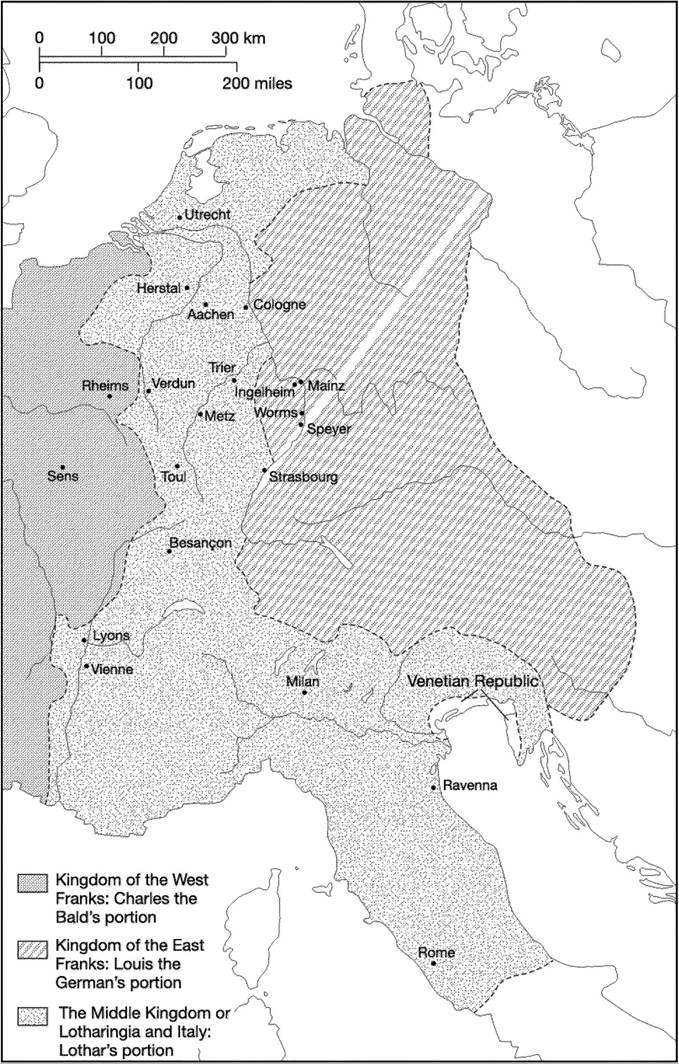
Map 17.2. The Division of the Frankish Empire in 843.
Source: McKitterick, 2001, The Short Oxford History of Europe, The Early Middle Ages, p. 286. Copyright: Oxford University Press.
More on the topic The Creation of the Frankish Empire: Territorial Expansion and Dynastic Succession:
- Territorial Expansion in the Early Republic
- The Apex of Ottoman Territorial Expansion and the Issue of “Imperial Overextension”
- From Territorial Empire to the Open Door and Dollar Diplomacy
- Historians have traditionally regarded the Ottoman Empire's failed second siege of Vienna in 1683 as a turning point in the empire's long history, bringing to an end centuries of military success and expansion.
- The Qing Empire (1636-1912) was one of a set of very large, long-lived Eurasian empires ofthe early modern period, and like any ofits contemporaries the empire raises a number of questions regarding the sources of its stability, expansion, and durability.
- Primary succession and secondary succession differ in their initial stages
- THE DYNASTIC PROPHECY
- Creating a Dynastic Order
- Violence and Dynastic Loyalty
- Soviet Ukraine's Administrative-Territorial Structure
- Territorial Settlements and Population Changes
- Exploring the territorial dynamics of SHD processes through the STEHD framework
- From Territorial to Neo-colonial Imperialism
- THE FIRST VIRTUAL CREATION