From Territorial to Neo-colonial Imperialism
In the Bronze Age some powerful city-states that specialized in trading, rather than conquering adjacent neighbors, developed a different kind of empire: they established colonies in distant regions to facilitate their trade.
In the modern worldsystem, core nation-states deployed this commercial form of colonialism. This development marked a shift in emphasis from tribute-gathering to profit-making. A capitalist world-system eventually emerged.Modern colonial empires replicated, on a much larger scale, a tactic that some Phoenician and Greek city-states had pioneered at interstices between tributary empires. Imperialism evolved through three epochs: tributary imperialism, colonial empires, and neo-colonial dependency. The old form of tributary empire—which involved conquering adjacent territory and extracting tribute and taxes—yielded to the emergence of thalassocratic empires in which a “mother country” established dominion over distant colonies in order to facilitate competitive commodity production and profit-making. Meanwhile commodification had been expanding and deepening since the Stone Age.
The modern, Europe-centered world-system has become increasingly capitalist in waves of commodification and decommodification since the thirteenth century ce.[320] These waves of capitalism corresponded to the increasing size of the hegemonic core state, and to changes in the structure of interpolity relations.
134 CHRISTOPHER CHASE-DUNN AND DMYTRO KHUTKYY
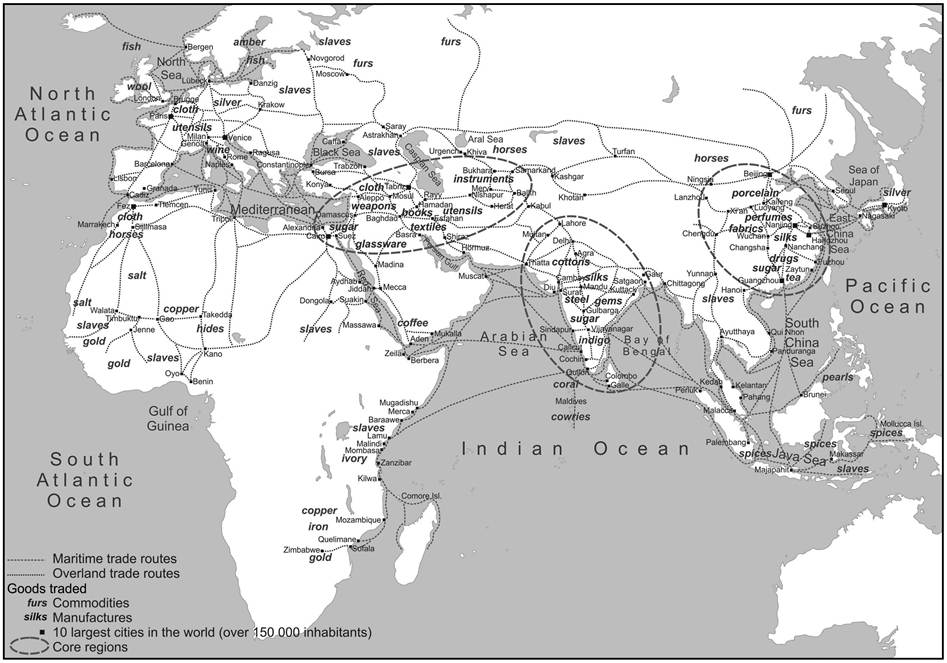
Map 3.1. Old World Trade Routes, c. 1340 Copyright: Eric Ross.
The question of when capitalism became the world-system's predominant mode of accumulation remains contentious. No human society has ever commodified everything: moral and political orders shelter some aspects of life from market forces and privatization.
Waves of deepening commodification, interspersed by periods of decommodification, have accompanied shifts in the dynamics of political power and in the logics of domination and exploitation.All world-systems large and small have something like global governance in the sense that patterns of interaction among polities become at least partly institutionalized and develop a distinct logic. In Europe the interstate system (what political scientists usually call the “international system”) was formalized in the Treaty of Westphalia of 1648, which proclaimed that states should recognize and protect each other's territorial sovereignty; the treaty required that any state breaching the territorial sovereignty of another state would face punishment by all the other states. This formal interstate system did not apply to colonies outside of Europe, and many of the European great powers continued to hold or expand colonial empires in distant regions. But the Westphalian system became extended to the rest of the world as a result of decolonization movements that established sovereign states in what had formerly been dependent colonies. These occurred in two main waves (see Figure 3.2).
The European interstate system extended to the rest of the world via these waves of decolonization and by incorporating China and the few other states that were never colonized by European empires. The result is a single global system of states.
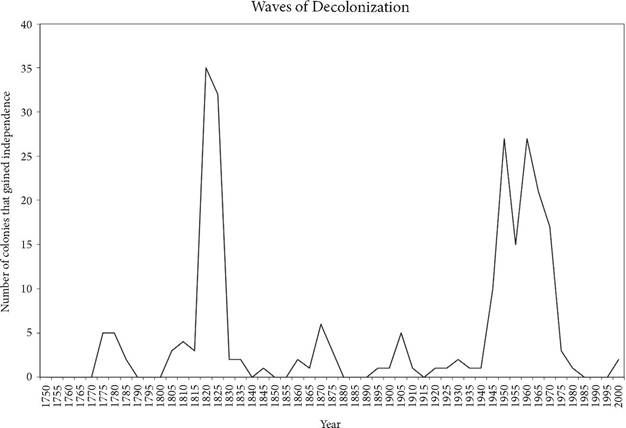
Figure 3.2. Waves of decolonization as shown by the number of colonial governors sent home.
Source: Henige 1970.
136 CHRISTOPHER CHASE-DUNN AND DMYTRO KHUTKYY
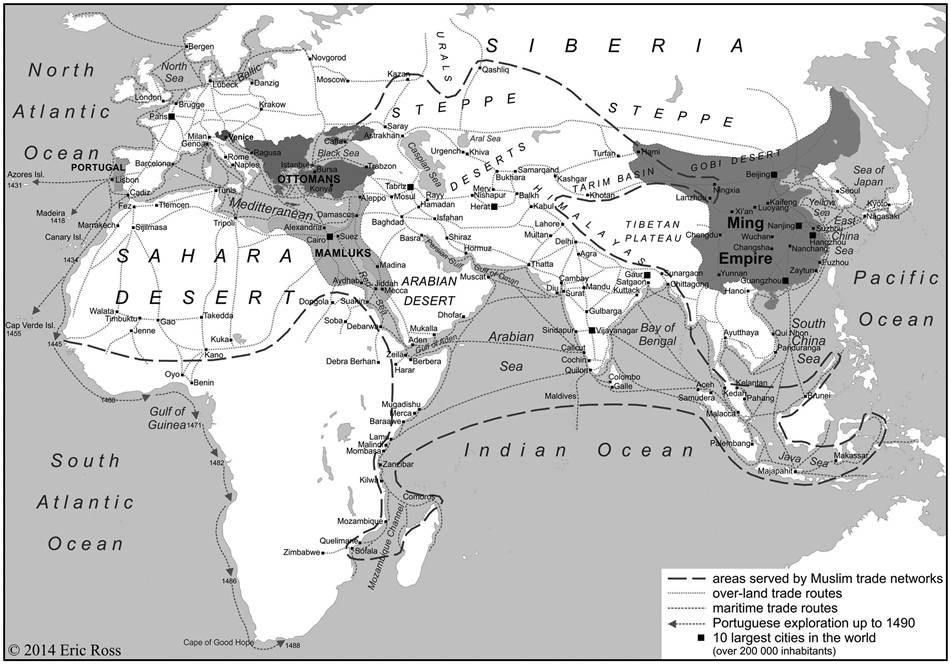
Map 3.2. Old World Trade Routes, c.1490 Copyright: Eric Ross.
The shift toward profit-making as the main form of accumulation changed the game in which core powers rise and fall.
In the contemporary system the rise and fall of hegemonic core powers has replaced the rise and fall of territorial empires. Contemporary core powers do not try, or do not succeed if they try, to conquer neighboring core states. Rather they use their military power to set up a world in which they can succeed at making profits.Waves of decolonization since the late eighteenth century transformed the system of colonial empires into a system of neocolonialism in which global power is exercised through the hegemony of the United States, international governmental organizations, financial exchanges, and property arrangements that allow actors in rich and powerful countries to exploit non-core peoples. The demise of the old territorial and colonial empires resulted in a single global polity of formally sovereign states and a system in which economic power is stronger than it has ever been at the level of a whole world-system. Such a system may be ripe for the emergence of a true world state, though that has not happened yet and may not happen soon because the interstate system is highly institutionalized.
The political globalization evident in the trajectory of global governance evolved because the great powers and the largest firms were in heavy contention with one another for geopolitical power and for economic resources, but also because resistance emerged within the polities of the core and in the regions of the non-core. The series of hegemonies, waves of colonial expansion and decolonization, and the emergence of a proto-world-state occurred as the global elites tried to compete with one another and to contain resistance from below. We have already mentioned the waves of decolonization: other important forces of resistance were slave revolts, the labor movement, the extension of citizenship to men of no property, the women's movement, and other associated rebellions and social movements. These movements affected the evolution of global governance in part because the rebellions often clustered together in time, forming world revolutions.81
More on the topic From Territorial to Neo-colonial Imperialism:
- Backdrop as foreground: environment and histories of imperialism
- Western Imperialism
- Democratic Kampuchea as a Non-Aligned State
- THE THEORY AND PRACTICE OF EMPIRE-BUILDING
- The Postcolonial Condition
- 1956 War
- What does decolonization mean?
- Multilingualism and Hybridity
- Did Pakistan Inherit a Good Judicial System?
- UGANDA