Environmental Abstraction
But not all aspects of the Out-of-Africa-Hypothesis can and should be modeled as intelligent software agents. There are also other factors affecting the dispersal processes such as outside influences (weather or climatic changes) or the condition of the landscape (vegetation or geological formation).
These factors cannot be implemented by using software agents. Instead, they are meant to be modeled as part of the environment the agents are located in. Hence, another modeling technique is needed for abstracting these aspects.On closer consideration, all factors mentioned in Sect. 2.1 have in common that they influence the suitableness of land for hominin dispersal. The influence can either be positive, as for example an abundant vegetation providing a sufficient food supply, or negative, as geographical conditions can make a trace of land impassable to hominins. However, the impassableness can be caused due to physical reasons, for example a mountain which is too sheer, or a lack of appropriate tools, for instance
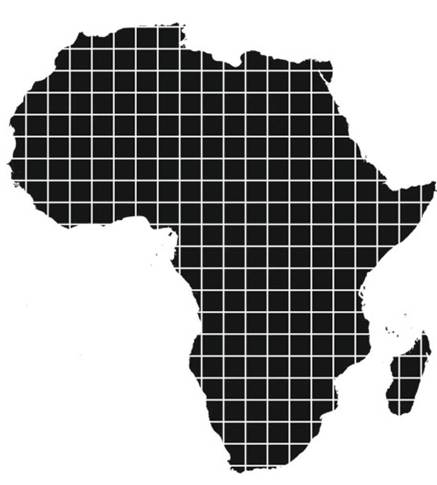
Fig. 2.8 Segmentation of a map of the African continent into equal cells as used for the modulation and implementation of potential fields
for building a raft for crossing a broad river. To put it another way, all of these factors influence the land’s potential for hominin dispersal. Yet, the potential is not a constant value but it may change over time.
As part of earlier work an approach for simulating migration processes on potential field based landscapes has been proposed (Dallmeyer et al. 2010). Dividing a landscape into subsegments of equal size provides the possibility of calculating an individual potential for hominins to migrate to each cell (Fig. 2.8). By combining different domain models evaluating specific aspects of the overall potential of a certain cell, a detailed estimation can be given.
A geographer might provide a domain model for estimating the potential of landscapes. In this case a desert might be assessed with a low score and the borderlines of freshwater areas with a high score. A biologist might then complete this model with statements about how the landscape’s potential mentioned above influences the settlement of prey or the vegetation which can be expected due to the potential of the landscape. But also weather models need to be taken into account as they can change the potential of a cell as well, for example due to the absence of rain. Finally, a holistic model arises for evaluating the potential of individual cells.
In computer science the use of cellular automata has been established for implementing spatially discrete dynamical systems. A regular grid of cells is the basis of each cellular automaton. Each of these cells can have a state, yet, the state is calculated using a mathematical function whose variables are defined as the states of cells located in a cell’s neighborhood. However, the definition of which cell is considered as a certain cell’s neighbor may vary. Two prominent definitions of neighborhoods are shown in Fig. 2.9 (Toffoli and Margolus 1987).
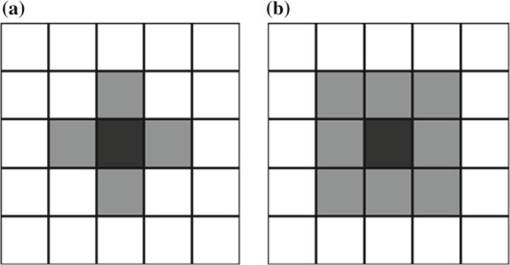
Fig. 2.9 Visualization of different neighborhoods in cellular automata. a von Neumann neighborhood. b Moore neighborhood
Starting from the dark cell shown in the center of each grid in Fig. 2.9 the von Neumann neighborhood contains the direct neighbors on each side of the cell. The Moore neighborhood instead contains the cells located diagonally from the starting cell as well. Depending on the environmental definition given by the model neighborhoods can be implemented individually in cellular automata.
When modeling and simulating hominin dispersal processes the potential of each cell may be implemented as the cell’s current state. Depending on the influencing factors being regarded for the calculation of a cell’s potential, the neighborhood needs to be defined according to the domain models.
In case of weather models this might even imply the definition of a three-dimensional cellular automaton, as weather phenomena like rainfall or wind occur from multiple directions. Certainly when modeling rain a distinction between the vertical rainfall and the horizontal drain of rain water needs to be considered.When modeling rainfall and its impact to the potential of a certain cell in a cellular automaton, the amount of water falling on each cell needs to be defined. Depending on the capacity of the soil, defined by geological domain models, and the liquid requirements of the plants, being part of a biological domain model, a certain amount of the rainfall will not be retained by the cell’s components. This surplus of water will then drain off to the neighbor cells, as defined by a geographical domain model and become another factor of the calculation of the cell’s potential.
Analogous to this description the dependencies and interferences of each domain model as well as effects towards cells in its neighborhood need to be defined. Based on this an overall potential for hominin dispersal may be calculated in order to simplify decision making of hominin agents.
1.6
More on the topic Environmental Abstraction:
- The Theories of Environmental Justice and Comparative Environmental Law
- ENVIRONMENTAL HUMAN RIGHTS
- Environmental Auditing
- Understanding the Term “Environmental Justice”
- Environmental factors and their classification
- Environmental Pollution
- Structural Environmental Injustice as a Matter of Collective Responsibility
- ROLE OF ENVIRONMENTAL PROTECTION
- 5 The Environmental Statement
- Empire-making and environmental change are interconnected.
- Environmental Impact Assessment
- High Environmental Temperature
- 1 The Environmental Assessment Directive
- Environmental context can change the outcome of species interactions