Modeling Dispersal Processes
In order to use agent-based simulation for understanding the reason why hominins migrated from Africa to Eurasia and to reconstruct the actual route taken by them, a sophisticated agent model needs to be created.
As emergent phenomena were a reason for dispersal processes to occur, decisions and actions of each individual need to be modeled. Based on the agent models introduced in the previous section, intelligent utility-based agent seems to be most suitable for this task.Assuming that hominins had a concrete reason to leave their original habitat, a detailed consideration of potential influencing factors seems necessary. Utility-based agents, in contrast to simpler agent structures, consider changes of their environment and evaluate the consequences of their actions in advance. Furthermore, the happiness regarding new states created by performing an action will be considered as well. Transfered to the challenges hominins faced when crossing Africa towards Eurasia, this happiness might be equated with the sufficient availability of food and other
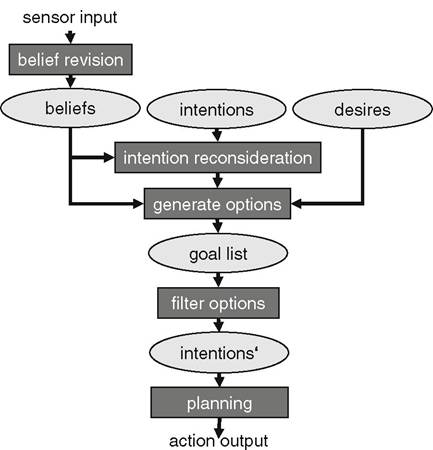
Fig. 2.7 Sequence of a BDI agent’s reasoning process (Timm 2004)
resources of vital importance. Alternatively, the level of happiness was likely being influenced by the absence of predators or other hostile creatures. With other words, we can assume that the path of hominins was influenced by the pursuit of multiple goals.
When transferring a multi-goal scenario into agent-based modeling the so called BDI architecture for software agents has proven to be suitable. In the belief-desire- intention software model, as shown in Fig. 2.7, a distinction is made between the selection and the execution of the agent’s plan. According to the model of human practical reasoning developed by Bratman, the BDI architecture consists of three components: (Rao et al.
1995; Bratman 1987)• Beliefs: The agent’s beliefs represent its perception. All information collected about the environment and other agents located inside this environment as well as information about the agent itself are stored in a beliefset.
• Desires: The motivational state of an agent is stored as its desires. Desires may be perceived as the objectives agents want to accomplish. However, the term goal is not equivalent to the term desires when talking about BDI agents. A goal is a specific desire which is actively pursued by an agent. Hence, the desires of an agent may be contradictory whereas the goals of an agent must not be.
• Intentions: The deliberative component of a BDI agent is represented by its intentions. In order to attain its goal, agents are provided a set of plans. The plans purposefully chosen by the agent are referred to as the agent’s intentions. A plan consists of a sequence of actions which can be performed by the agent, yet, plans may be composed of other plans.
Transfered to the modulation and simulation of dispersal processes, hominins may be modeled using a BDI architecture. As hominins were able to perceive their environment and had to choose certain actions according to their needs, this way of modeling seems suitable. Hence, the recurrent reasoning process of BDI agents (see Fig. 2.7) needs to be fit to the behavior of hominins.
Initially, the beliefs already known to the agent need to be revised using recent sensor input. New perceptions need to be added or changes in the environment need to be considered for further planning. Based on the updated beliefset, agents need to consider whether the execution of the current plan is still expedient or even possible. Changes in the environment or new observations may cause the current goal to become unattainable pursuing the current plan or the selection of another goal might have become more reasonable. For instance the observation of a group of carnivores close to a nearby river crossing might require a tribe of hominins to discard their current goal of crossing a river course at a certain place.
Instead another crossing located further away may need to be chosen instead.Generating the agents’ new options by considering the updated beliefset, desires and feasible plans, a new list of goals is being created as well. Based on this goal list a new plan is chosen and the actions which are necessary to accomplish this plan are executed. Executing BDI agents requires this process to be performed over and over again in order to consider changes of the world.
However, hominins are not the only actors which are part of the Out-of-Africa- Hypothesis that deliberate their behavior in regard to their actions. The behavior of carnivores might for example be modeled by using a BDI architecture as well. Choosing appropriate prey as well as selecting, defending and marking their territory are processes which can be modeled using intelligent software agents. Yet, specialized domain models is a need to be provided by domain experts.
1.5
More on the topic Modeling Dispersal Processes:
- Chapter 2 Multi-scale Agent-Based Simulation of Long-Term Dispersal Processes: Towards a Sophisticated Simulation Model of Hominin Dispersal
- Understanding Hominin Dispersal
- Challenges for Scaling Agent-Based Modeling
- Dispersal is a process that distributes organisms across the landscape
- Agent-Based Modeling and Simulation
- CONCEPT 9.4 In metapopulations, sets of spatially isolated populations are linked by dispersal.
- SIMULATING PAYMENT SYSTEMS BY AGENT BASED MODELING
- CONCEPT 9.3 Species are limited in their distribution and abundance by habitat suitability, historical factors, and dispersal.
- Modeling Credit Markets
- MODELING PORTFOLIO PERFORMANCE
- Imperial Modeling in Byzantine Constantinople
- Appendix 2.1: Alternative ways for the modeling of LDSs
- Modeling People’s Bank of China Policymaking
- Processes of Language Shift
- AGENT BASED MODELING IN MARKETS AND PAYMENT SYSTEMS: WHICH WAY FORWARD?
- Chapter 18 Modeling the FX Market Traders’ Behavior: An Agent-Based Approach
- LEDAs' enabling processes for local economic development
- Landscape patterns affect ecological processes