Understanding Hominin Dispersal
Hominin fossils discovered by archaeologists do not provide sufficient evidence regarding the concrete route our manlike ancestors have taken on their way from Africa to Eurasia.
Therefore, a number of opposing hypotheses and assumptions are suggested by researchers. However, further excavations will likely neither provide certainty concerning the actual route taken nor give indication of the reason hominins migrated. By modeling these dispersal processes, which occurred 1.5-0.5 million years BC, we aim at providing a simulation platform for validating the hypotheses and assumptions by creating individual artificial dispersal processes.As the access to real pieces of evidence is limited, paleoanthropological researchers are restricted to the use of established technologies and methods. The possibilities of validating hypotheses and analyzing how certain assumptions regarding the environment or the behavior of hominins and other creatures influenced migration processes have been exhausted. Yet, feedback whether or not the hypotheses apply and how assumptions influence the entire system’s behavior are essential for researchers in order to gain further insights.
The scope of research questions is wide and evaluating which of the potential routes hominins have chosen to get from location A to location B is only a first step
Fig. 2.1 Potential expansion routes between 2 million and 20.000 years before present (ROCEEH 2014)
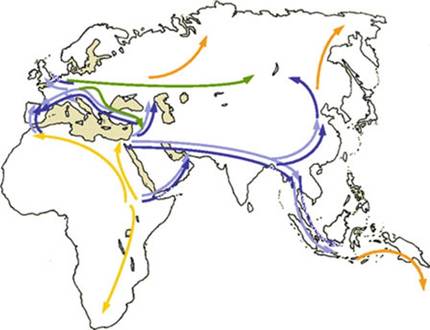
(see Fig. 2.1). Even estimating probabilities for different routes may help archaeologists on their search for further fossils or other relics. Additionally, insights regarding the time hominin populations needed to complete a route or a segment of a route as well as the preconditions (ecological, physiological/anatomical, technological or cultural) required for the resettlement are of peculiar interest, too.
Concerning this, factors determining the dispersal processes most significantly need to be identified first.The simulation platform (see Fig. 2.2) proposed in this article aims at enhancing the research process at this point. In this regard, by considering a computer science view, it is an important challenge to enable domain experts, i.e. researchers in the field of hominin dispersal processes, to specify hypotheses and to support the interpretation of results by providing the possibility to navigate through them in an adequate way. By conceptualizing a dynamical and extensible simulation platform, researchers and domain experts are provided a tool for specifying and formulating own hypotheses, assumptions and discoveries. Based on this, multiple simulation runs can be performed and artificial scenarios are being created. Thus, the platform provides simulation-based evaluation of hypotheses. As a visionary approach, we are working on assistance functionalities for performing and varying simulation runs in an automated way to avoid the demand of simulation engineers supervising and controlling the execution of simulation experiments (Lattner 2013).
In case of researchers requiring an exact reproduction of simulation runs it is possible to repeat the same scenario but also to vary certain parameters for the purpose of comparability. The output generated by different simulation runs can then be integrated, visualized on a map, and analyzed individually. As a result, researchers can learn from these simulation runs and formulate further hypotheses and assumptions. An iterative process emerges supporting the generation of knowledge with respect to hominin dispersal processes from Africa to Eurasia.
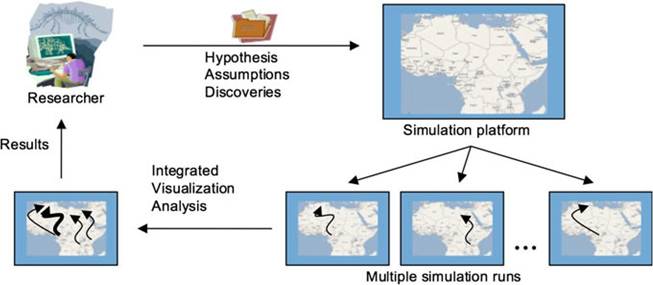
Fig. 2.2 How the simulation platform can be integrated into the process of validation hypotheses
The dispersal processes themselves originated from group dynamics and hominins interacting and reacting with regard to the environment. In the research field of systems theory these effects are referred to as emergence effects. They are characterized by the fact that global features, structures, or behaviors of a system arise from local interactions of its components. Yet, these global observations can only partially be reduced to features of the system’s components. Out of this, the necessity of applying a modeling technique taking these effects into account is derived.
2.3
More on the topic Understanding Hominin Dispersal:
- Chapter 2 Multi-scale Agent-Based Simulation of Long-Term Dispersal Processes: Towards a Sophisticated Simulation Model of Hominin Dispersal
- Modeling Dispersal Processes
- Dispersal is a process that distributes organisms across the landscape
- CONCEPT 9.4 In metapopulations, sets of spatially isolated populations are linked by dispersal.
- CONCEPT 9.3 Species are limited in their distribution and abundance by habitat suitability, historical factors, and dispersal.
- Knowledge and Understanding
- Weber’s Methodology: Understanding and Ideal Types
- Understanding the Term “Environmental Justice”
- The revelation of Islam: the Wor(l)d and its understanding
- The Use of Molecular Epidemiology in Understanding the Dynamics of M. bovis
- Understanding Sorcery
- Understanding Other Societies