Agent-Based Modeling and Simulation
When trying to understand, analyze or optimize a real world system, the transformation of processes and entities into a model has been established as a first step. By modeling systems based on its components, a profound basis for the representation of emergent phenomena is provided.
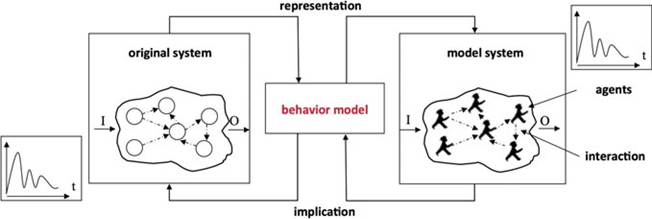
So called agent-based models (ABM), consisting of individual actors having opportunities for decisions and actions, are used for gaining further insights into the behavior of actors when certain rules are given. Due to diverse areas of application for intelligent software agents, they are particularly even seen as a way of thinking rather than a technology for implementing autonomous entities (Bonabeau 2002).When using ABM to create systems of agents trying to solve problems, multiagent systems (MAS) are formed (Ferber 1999). In order to simplify the creation of MAS, a number of software toolkits like NetLogo1 or RePast[1] [2] were developed since the beginning of the nineties. As a result of this even non-informatical sciences, such as social sciences or economics, adopted ABM as inherent part of their set of research methods. MAS can be used to generate or reconstruct emergent behavior by executing agent-based models and simulating interactions between the agents. The process of executing models is called computer simulation and provides a series of benefits. In case real world experiments would influence or even damage the real system, using computer simulation prevents risk to the real system. Furthermore, experiments might be too sophisticated in order to be executed in real systems or real systems are not accessible to researchers. Finally, and this is the most relevant aspect when analyzing long-term dispersal processes, even systems that are not or no longer existent can be examined by using computer simulation. Fujimoto defines computer simulation as follows: A computer simulation is a computation that models the behavior of some real or imagined system over time (Fujimoto 2000). This definition names three relevant components of computer simulation: the system, the model and the simulation itself (see Fig. 2.6). A system, also referred to as original system or real world system, is the object of study. It contains a holistic view on relationships between entities and processes. The original system is then being mapped to a model or model system, a formal description of certain effects or phenomena being part of the original system. This is accomplished by the use of domain specific methods for describing the behavior of the system. However, the process of mapping real systems to models is associated with a loss of precision. Models, by definition, are never equivalent to the original system, as the only adequate model of a real system is the system itself. Nevertheless, it meets certain appropriate features or relationships of the original system’s object of study. Simulation can therefore be used for performing experiments with the model. By this means either the real system’s model or artificial scenarios generated by altering the model can be analyzed (Klugl 2001). In order to use simulation results for predicting the original system, two requirements need to be met: verification and validation. Verification describes the process Fig. 2.6 Relation between original system and model system (Timm and Hillebrandt 2006) of evaluating whether the software itself is designed and programmed in a correct manner, whereas determining the model’s appropriateness for representing the original system is called validation. However, a detailed consideration of how to verify and validate a computer simulation will not be part of this article as a variety of methods is sufficiently described in literature (Kleijnen 1995). When providing a valid and verified model of a real world scenario, which depends on the research of domain experts, computer simulation can be used for gaining knowledge from experiments. By applying assumptions to the simulation model, artificial scenarios can be created and analyzed. Furthermore, hypotheses concerning the behavior of the system under certain circumstances can be evaluated. Therefore, and due to the condition given in the context of the Out-of-Africa- Hypothesis, we propose the application of agent-based modeling as an innovative methodology for modeling, simulating and analyzing artificial societies for understanding the dynamics of hominin dispersal processes. 1.4
More on the topic Agent-Based Modeling and Simulation:
- Challenges for Scaling Agent-Based Modeling
- Chapter 2 Multi-scale Agent-Based Simulation of Long-Term Dispersal Processes: Towards a Sophisticated Simulation Model of Hominin Dispersal
- SIMULATING PAYMENT SYSTEMS BY AGENT BASED MODELING
- Agent-Based Simulation for Investigating Genetic and Cultural Transmission
- Agent-Based Computer Simulation
- AGENT BASED MODELING IN MARKETS AND PAYMENT SYSTEMS: WHICH WAY FORWARD?
- Chapter 18 Modeling the FX Market Traders’ Behavior: An Agent-Based Approach
- Chapter 11 Cultural and Genetic Transmission in the Jomon-Yayoi Transition Examined in an Agent-Based Demographic Simulation
- Several design routes regarding the trading agent type, market mechanisms, traded assets, time, and validation have been used in previous works on agent-based financial markets (Lebaron, 2001a).
- Chapter 66 The Adoption Process of Payment Cards: An Agent-Based Approach
- An Agent-Based Approach[607] [608] to Legal Pluralism