European Requirements and Colonial Expansion
Spanish and Portuguese explorers guided the two countries' transoceanic expansion. For Portugal, this meant the simultaneous opening of two routes to Africa, Asia, and America. For Castile, it led first to the Antilles and the New World, and then extended to the Philippines in the second half of the 1560s.
In 1571 Spanish conquerors founded the port-city of Manila, an enclave that was strategically vital due to its proximity to the Chinese world. Indeed, access to Asian markets had long been a motive for American exploration. When he reached the Caribbean islands, Christopher Columbus erroneously celebrated having found a new and easier route to China and Japan. Further expeditions expanded this ambit, taking Spaniards from their initial settlements in Santo Domingo and the Antilles to the western coast of the continent, Mesoamerica, and North America. Of course, Scandinavian, Breton, and Basque seafarers and fishermen had already explored the North Atlantic coast, but the Spaniards were different: supported by monarchical power, they meant to settle the continent on a permanent basis.The demand for New World settlements increased considerably when gold was discovered in what is today the Dominican Republic. Indeed, Columbus returned to Spain with a formidable treasure. However, from quite early on, the Crown—fearful of losing prestige and treasure to adventurers like Columbus and his family—did their best to short-circuit their ambitions. Moreover, from a very early date, the Court was made aware of ongoing demographic catastrophe in the Antilles. The Amerindian population was being worked to exhaustion in surface mining, so that food production was gravely jeopardized precisely at a time of increasing demand. The Crown sent Nicolas de Ovando to regulate labor and thus ensure food supplies, but he proved incapable of stopping the demographic collapse (even if he provided a significant measure of institutional stability).
It was in this context that the native population was divided into groups of laborers assigned to individual Spaniards. Those who resisted this were directly enslaved. After a decade of subjection, the Caribbean’s native population was left decimated by a genocidal labor regime, diseases to which aboriginal peoples did not have immunological resistance, and consequently by social and psychological collapse.In the early sixteenth century, two phenomena foreshadowed events in the New World. The first was the arrival of the first African slaves early in the 1500s, brought by Hieronymite friars under the patronage of the queen’s councilor, Cardinal Cisneros. The second was the denunciation of the heavy toll of mortality among the indigenous population by Dominican friar Antonio de Montesinos in 1511, which would be echoed in both the Laws of Burgos the following year, proclaiming the aboriginal population as free people, and in Lopez de Palacios Rubios’ requerimiento (the bizarre declaration that Spaniards were required to read to the Indians, informing them of the Spanish Crown’s right to conquer them).
Events on the American continent itself, however, overshadowed the depopulation of the Caribbean islands. First came Hernan Cortes’ conquest of the Aztec world, which had been ruled by a military-religious state that had secured domination of the entire Mesoamerican region. Aided by shrewd alliances that Cortes had forged with the Aztecs’ adversaries, the conquest of the empire was swift, lasting from 1519 to May 1521 and the final fall of Tenochtitlan.[1956] A decade later, Francisco Pizarro’s men took Cusco, capturing and assassinating Atahualpa, the last Inca king. Within three years (1531-1534), they had destroyed an empire already weakened by smallpox, as well as by conflicts over succession. The Amerindian population on the continent, like that of the Caribbean, began a long decline. The magnitude of the collapse depended on particular social and geographical conditions: It was much worse for smaller societies, for instance, in hot or warm climates than for Andean communities in the highlands, which had the largest pre-conquest population concentration.[1957] It was nevertheless devastating for all affected peoples.
The colonial society that took shape in this conquered and decimated landscape was different from the native societies that it replaced, and different as well from the European societies of the conquerors. Despite resting upon royal authority, these new societies were private enterprises financed by Iberian merchants and bankers who expected high returns on investments. In the medium term, after pillaging readily available, accumulated treasure, the Spaniards shifted their strategies of exploitation toward indigenous labor, secured through encomiendas, tribute, and personal services (which were “exchanged” for the Spaniards’ guidance toward Christian salvation). The value of each encomienda—measured in numbers of natives and territories it assigned control over—was largely dependent upon the political clout of the conquistador who received it. Once the value of an encomienda was set, the communities’ native lords (senores de indios) were assigned an amount to be paid in tribute. In fact, since these lords maintained direct control of the local economy, on more than one occasion native lords offered the Crown significant amounts of money in order to free themselves from their obligations to encomenderos. Such conflicts among Spaniards—between Spaniards in the New World and the Spanish Crown—served as fissures in the imperial project, and native lords and communities seized upon them from an early date. Underlying all this was an alarming demographic decline, which constituted a crucial factor shaping the new colonial society, directing its economy into certain preferred sectors and consolidating indigenous survivors around enterprises pursued by the Crown and its Spanish colonists.
The monarchy’s imperial project was built upon these contradictions and was motivated by a desire to expand the flow of American wealth into the royal treasury. For this reason, the Crown refused to cede complete control over Amerindian populations to the conquistadors, requiring that encomiendas expire after several generations, thus limiting their heritability.
The Crown also refused to allow the general enslavement of Indians beyond those considered prisoners of war. This explains the monarchy’s alliance with sectors of the Church and some religious orders, which from the very beginning had denounced the treatment of Indians at the hands of the colonizers.[1958] The famous debate on the legitimacy of the subdual and enslavement of Indian populations by the Spanish, which was started by Bartolome de las Casas and the Dominicans and included friars and priests from other orders and even the secular church, culminated in the New Laws of 1542. These laws did not represent the Crown’s sincere desire to free the Indians—whose capacities were considered equal merely to those of Christian children—but rather its desire to place them under the tutelage of Crown and Church, and thus to avoid their probable extinction. In the mid-sixteenth century, this existential threat to the American natives was filtered through the lens of Francisco de Vitoria’s ideal of “two republics.” De Vitoria, a Dominican friar and author of De Indis (1538), envisioned two polities in the classical sense—Native and Spaniard—separate, with their own laws and rulers, both of which would exist under the protection of a common ruler, the king of Spain. The aim was to separate the Spaniards and the Indians, each with their own rights and privileges, theoretically allowing each population to evolve in parallel, with no contact between them—an obvious case of utopian thinking. In theory, the only contact was to be through labor and tribute relations mandated by law, which the Indians owed to the Spanish in return for elevating them into political society and into the Catholic world.Nonetheless, it would prove impossible to prevent sexual intercourse and marriage—even undesirable in certain situations (for instance at the frontiers). People of mixed Spanish and Indigenous descent, so-called mestizos, came from the very beginning to constitute a distinct group, and made social classifications increasingly complicated.
The arrival of slaves of African origin further complicated the “two societies” schema. To define these groups, the Spaniards adopted the word castes, probably from the Portuguese Jesuits, who had observed it in India. The prospect of mixing European, American, and African blood predictably evoked sentiments of Catholic suspicion, filtered especially through the lens of “blood cleansing,” a concept that Castilians remained very much aware of in the seventeenth century.[1959] In a society built upon a culture of calidad (quality), family protection of the honor of its members was crucial, especially from the perspective of those atop the pyramid.The “two societies” project failed. The Church, Spanish colonists, and the Crown were all more interested in shaping facts on the ground as best they could, as opposed to implementing a segregationist social ideal. Nothing shows the contradiction between theory and practice better than the process that authorized forced labor in the mines of the Peruvian highlands at the very moment when the discussions between theologians and royal representatives were coming to a close. Simply by staying silent, Philip II—who was beset by financial demands he could not meet—de facto allowed Viceroy Toledo's petition to organize a labor repartimiento (known as the mita) among Peru's highland Indians. This would regulate the Indians' forced labor in the silver mines, particularly in Potosi's so-called Cerro Rico (in present-day Bolivia).[1960] Indeed, the mining mita would guarantee an enormous increase in the supply of silver in the 1580s.[1961] This is the clearest example of the way in which a colonial society emerged in the post-conquest territories, a society that could be described as a series of concentric circles of power and wealth. At the center, fulfilling the labor needs of all economic sectors—something that often required the movement of whole populations to new locations, however remote— stood Indian laborers.
The basis of Indian labor was the native support network provided by the Andean ayllu, a kinship group led by native lords, whose lineages often survived into the eighteenth century.[1962] Colonial societies in areas with high Amerindian populations differed from those in other latitudes around slavery or the forced labor of poorer compatriots. Here, the so-called tribute that all Indian adults had to pay forced entire communities—as well as individuals who abandoned their original communities—to sell their labor in exchange for money that was then transferred to the Crown. Thus, the Royal Treasury was the core of those concentric circles formed around the indigenous population.[1963] In such societies, tributary lists were the colonial instrument par excellence. Notwithstanding the importance of tributary Indians, enslaved Africans and their descendants were employed in the interstices of this system, with many of them joining a growing mass of freedmen referred to as pardos and morenos. In fact, black slavery was crucial in some economic sectors across the continent. It continued to grow in importance in the late sixteenth century across the continental empire up until its collapse in New Spain, New Granada, and the Pacific coast in the nineteenth century.[1964]Although decried as archaic by later, liberal critics, this colonial social model— marrying a Catholic ideal of community with an ethnically ordered assignment of labor and tribute—was very much in keeping with sixteenth-century norms. The complex intercontinental system revolved around the flow of precious metals that the American mines produced upon this basis.[1965] Silver in particular enjoyed an extraordinary demand as the currency employed in commerce between Europe and Asia, as well as for the tributary systems of the great imperial states of the Asian world, particularly Mughal India and China, which were becoming increasingly monetized.[1966] Silver brought a flow of European merchandise to Seville and later Cadiz (including mercury, necessary for the amalgamation of silver ore), much of which continued on to the American ports of Veracruz and Portobelo, and thence to inland markets. Having an official primary port, along with the system of fleets and galleons, guaranteed protection for transatlantic traffic as well as control over tariff duties and prices, which ensured that the entire annual production of American silver was siphoned into the pockets of private individuals (Spaniard or otherwise), as well as the Crown's coffers. In the end, the terms “free trade” and its opposite, “mercantilist monopoly,” cannot encompass this model, which was in fact highly rational, albeit significantly limited in its results (something that we will explore further).
The cost ofwar in Europe and the Atlantic, as well as the decline ofthe Amerindian populations, must be taken into account in order to understand key decisions taken by the Crown in the first phase of imperial formation. Indeed, I. A. A. Thompson and Bartolome Yun have shown that military expenses, particularly those that went to the army in Flanders, increased steadily during the last decades of the sixteenth century. Between 1559 and 1598, these costs increased fourfold, with a remarkable peak between 1589 and 1593.[1967] Circumstances thus forced the monarchy to adopt several measures. First, the encomenderos were liquidated. Second, the Crown established and came to rely upon a system centered on the mining of precious metals, a sector that guaranteed elastic (and growing) income to the royal treasury through the “royal fifth.” This supplanted (without abolishing) the income from the personal tribute of the Indians, which was in decline on account of demographic collapse. Third, the Crown consolidated a system of fleets that allowed the organization and administration of tariffs on transatlantic commerce. Once silver arrived in Seville, a significant portion was channeled through German banking firms—and later, from the reign of Philip II onward, mainly through Genoese merchants and bankers— to the burgeoning cities of northern Europe. The Spanish colonial channel and its
800 JOSEP M. DELGADO AND JOSEP M. FRADERA
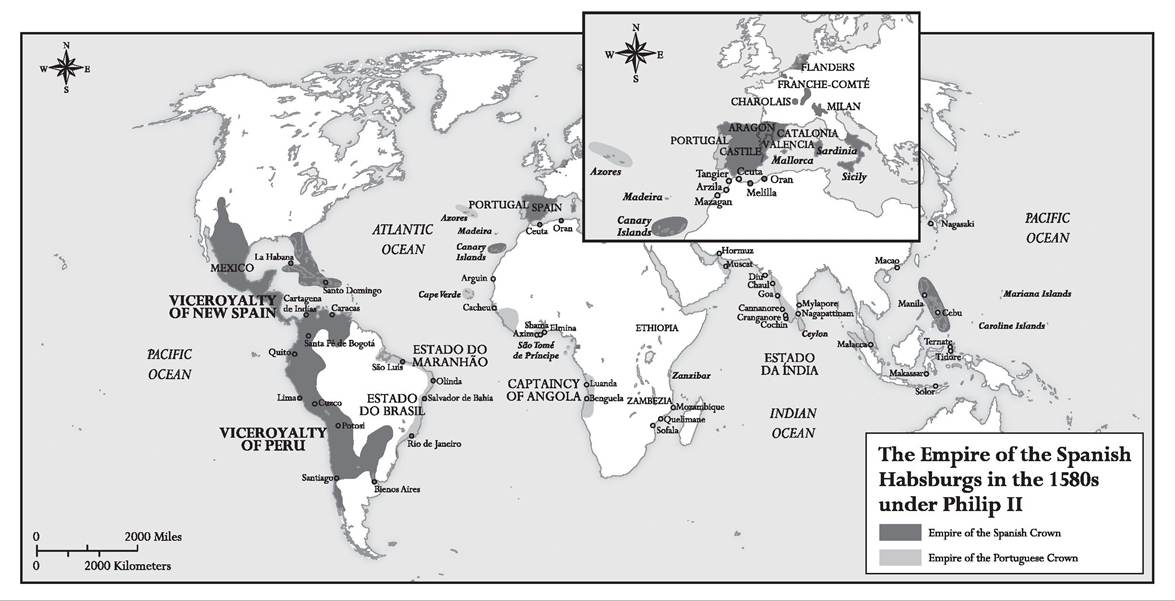
Map 28.1 The Empire of the Spanish Habsburgs in the 1580s under Philip II.
Source: George Chakvetadze based on Bouza, Cardim, and Feros 2019, xxiii. Copyright: Oxford University Press with George Chakvetadze.
extension in the Philippines became a crucial part of expanding international trade between Europe and Asia (see map 28.1).[1968]
More on the topic European Requirements and Colonial Expansion:
- DEMOGRAPHIC AND SOCIAL ASPECTS OF EUROPEAN EXPANSION
- This chapter will explore ritual violence in the form of close combat in precolonial western Africa (and the African diaspora) during the period of European contact from the mid fifteenth century until the late nineteenth century, a period which saw an end to the slave trade and the start of European colonisation.
- CHAPTER FOUR The European colonial empires, 1900-45
- The era of European losses in the Americas was followed by a significant expansion of holdings in Asia, Africa, and Oceania, most visibly and highly publicized from the 1870s onward, when a scramble for still-unclaimed territories took place.
- Was European colonial rule good or bad? The subject matter invites normative judgments, for at issue are the lives and livelihoods, the well-being and worldviews of hundreds of millions of human beings.
- While cities have always been important in the fortunes of the Indian subcontinent, most of India’s vast population has lived in villages and hamlets whether in pre-colonial, colonial or even post-colonial times.
- In modern legal systems, the requirements for marriage typically fall into three broad categories. First, there are capacity requirements, answering the question: “Who can marry whom?”
- Colonial and post-colonial distortions to traditional rule
- How European is the ‘European’ Legal Tradition?
- Imperial expansion and medical pessimism in the nineteenth century
- Organisms have specific nutrient requirements