Follow the Money
The lawyer (quoted above) who worked for the Paz family in Spain in the 1530s was insistent that one simply needed to follow the money - to borrow a phrase popularised in the Watergate era - in order to see that Paz's death was murder and the motive was financial.
The culprit was, allegedly, Gonzalo de Salazar, sent to New Spain in 1524 as the royal factor, or tax collector. The governor, Hernando Cortes, was absent in Honduras (where he had gone to arrest fellow conquistador Cristobal de Olid for defying his authority, to find that one of Cortes's cousins had already murdered Olid under cover of a treason trial). So Salazar took advantage of Cortes's absence, deploying duplicity and violence to take over the governing junta, then using rumours of Cortes's death in 1525 to seize the properties - including tens of thousands of indigenous slaves - held in Mexico by Cortes and many of those who remained loyal to him. Rodrigo de Paz, another of Cortes's cousins, was one such loyalist. In the words of the Paz attorney, during 1525
under cover of the powers supposedly given to him by the Marques del Valle and governor, don Hernando Cortes, but having seized them from and abused those who were the governor's true lieutenants, and against the will of the council of the city of Mexico, and fully armed, and with a great upheaval and scandal, [Salazar] began to wield the governorship as a tyrant.[656]
Paz was tortured to reveal where Cortes had hidden the already fabled missing treasure of Moctezuma. The application of fire to Paz - hot bricks, and the burning of oil-soaked feet - was a torture that Cortes had applied to Moctezuma's successor, Cuauhtemoc, shortly after his capture in 1521. Then too the goal of the torturers was to discover where gold and other treasures had been hidden. Cortes and Salazar were hardly alone in their quest for the elusive bounty; it was a veritable Spanish obsession throughout the 1520s and 1530s, the subject of most of the two decades' long official inquiry into the Cortes-led expedition and administration (the residencia and related proceedings).[657]
The hidden treasures of Moctezuma, Cuauhtemoc and Cortes almost certainly never existed.
Nonetheless, Cortes and scores of other conquistadors were able to acquire and ship to Spain the equivalent of fortunes in modern currencies. Salazar was among those who successfully extracted wealth from Mexico, both directly from indigenous people (as loot or by selling them as slaves) and indirectly by stealing it from other Spaniards. This despite the fact that his reign of terror ended abruptly in January of 1526 when Cortes, very much alive, returned to the city; the Spanish settlers took to the streets, armed, in factions. The resulting confrontations ended in Salazar's arrest and display in a cage in the central plaza. A few months later he was exiled to Spain, and was thus living in Granada - as a very wealthy man - when the Paz lawsuits were filed in the 1530s.In Salazar's violent actions - in how he justified them and escaped punishment for them - we can see the complex interplay between violence and the law in Spanish America. Lawyers visited Salazar in his palatial Granada home to take his testimony, which consisted of the simple defence that Rodrigo de Paz had been a rebel. Salazar claimed he was then, and continued to be, a loyal and trusted crown official; that Paz, as a rebel against royal authority, had been legally subject to interrogation under torture; that Salazar's actions were justified by ‘the notorious crimes that Rodrigo de Paz had committed and confessed';[658] that the treasures Paz was hiding included taxes owed to the king, a treasonous deception; that Paz's torture and killing were just, judicious and legitimate - carried out under cover of law. As transparent as that argument may seem, Salazar was able to escape arrest in Spain. The accusation against him - that he had illegitimately assumed the governorship and acted as ‘a tyrant' - did not stick.
Critics of conquistador methods, such as the famous Dominican friar Bartolome de las Casas, would likewise unsuccessfully attempt to use the ‘tyrant' label to halt conquest activities or bring courtroom condemnation of specific Spaniards.[659]
The law favoured perpetrators like Salazar.
Lawyers for the Paz family never extracted from him more than the court costs. In 1540 he returned to New Spain as factor; nicknamed El Gordo, he lived corpulent and wealthy into the 1560s. Thus the battle of accusations between ‘rebel' and ‘tyrant' was not a fair fight. Applied to fellow Spaniards - provided the rituals of arrest, accusation and interrogation were more or less followed, complete with a notarised written record; and as long as the accused was not socially and politically higher ranked than the accuser - the charge of ‘rebel' permitted levels of violence that made ‘tyrant' a hollow allegation. Applied to indigenous peoples, it granted carte blanche to inflict violence of various and many kinds.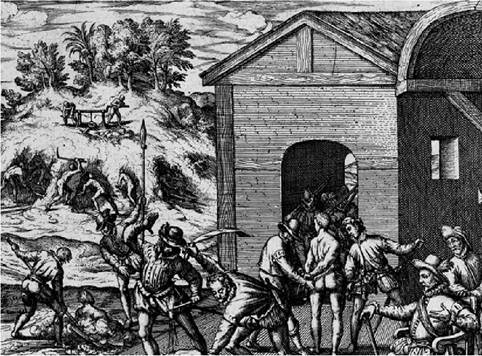
Figure 21.i One of the engravings Theodor De Bry created to illustrate the 1595 Frankfurt edition of Girolamo Benzoni's Historia del Mondo Nuovo (Plate III), depicting the excessive methods of punishment that Spaniards used to discipline and control indigenous and African slave workers. Note how the acts of torture and mutilation are legitimised by the presence of a presiding Spanish officer; his dress, chair, baton, and two attendants signify his position of authority and lend the proceedings a veneer of legalised and ritual legitimacy.
Here, then, were the twin elements of a violence that would sweep the hemisphere for centuries. One was the promise of wealth and status, as the motivating factor that drove men to violence. The other was an ideology of justification that legitimised such violence; that is, it made violence permissible and defensible by law, either officially supported by the institutions of justice and government, or unofficially through a veneer of legality or legitimacy. The slippage between those two categories permitted more violence in the colonies and on their frontiers. For acts of violence that might strike us as homicidal, personal, arbitrary or contrary to Spanish law (from the murder of a woman by her husband to the mass enslavement of indigenous villagers) could be justified and legitimised, and thus committed with impunity, as if legally sanctioned from the start.
Looking at the broad sweep of Spanish America from the 1490s into the nineteenth century, the contexts of violence that Spaniards saw as justifiable or legitimate were not restricted to invasion, conquest and frontier scenarios; as Europeans in the Americas and their descendants moved across the hemisphere, they carried with them broadly applicable notions of violence that they viewed as legitimate (or that could be legitimised). But within the ever-shifting frontier of initial contact, conquest or prolonged resistance, the primary victims of such violence were not individual Europeans but indigenous peoples - and on a massive scale. It is true that Spaniards mostly sought to profit from indigenous communities through their preservation and the maintenance of a pax colonial (which was mostly not the case in English and Portuguese colonies). But that general pattern did not prevent Spaniards from slaughtering and enslaving hundreds of thousands of indigenous peoples.