A Dance of Bureaucracy
The written record of life in colonial Latin America is replete with acts of violence that might strike us as excessive, cruel, unwarranted and committed with astonishing impunity.
The value placed on notarised record keeping in the Spanish and Portuguese world means that thousands (perhaps hundreds of thousands) of archival cases of violence have survived. The contours of violence became increasingly complex over the centuries, the range in their patterns of motivation and victimisation enormous. But for our purposes here, I briefly outline eight historical developments around which acts of violence proliferated in Spanish America, along with concomitant structures of justification or legitimation (one and two stem from the wars of conquest; three and four relate to Inquisition activities; five and six centre on slavery; seven is violence against women; and eight is the violence used to suppress revolt).The first pair of sibling developments are (one) the mass enslavement, brutalisation and demographic collapse of indigenous peoples on the Caribbean islands and in circum-Caribbean coastal regions from the 1490s into the mid sixteenth century, by which time such communities had literally been decimated (reduced by 90 per cent); and (two) the wars of the Conquest of Mexico, initiated by the Spanish-Aztec War of 1519-21, the violence of which has traditionally been downplayed, distorted, misunderstood or glorified.
Both are vast topics with huge literatures of published primary and secondary sources, especially the Mexican topic - and, furthermore, they have been tackled in a parallel chapter.[660] So suffice to suggest here that the two are better understood if seen as part of a single process, guided and enabled by a rapidly developing ideology of legitimised violence. For example, as early as the 1490s Cristobal Colon (Columbus) and his collaborators and successors constructed an abiding myth of cannibalism in the Caribbean (whose very name derives from the word ‘cannibal').
They were motivated by beliefs - backed up by royal law, beginning in 1503 - that cannibals could rightfully be enslaved. Spaniards called these alleged man-eaters caribes (‘the term that they used to make free people into slaves', as Bartolome de Las Casas put it), and expected (some perhaps hoped) to find them on the American mainland too.[661] Accounts by Juan Diaz (a Spanish priest who travelled with the conquistadors) and Pietro Martire d'Anghiera (an Italian historian who died in 1526, known in English as Peter Martyr), published in 1520 and 1521 and based on what Spaniards claimed to have seen on the 1518 Grijalva expedition along the Yucatec and Mexican coastline, generated engraved imaginings of indigenous orgies of idolatry, sacrificial slaughter and cannibalism that were reproduced for many generations.[662] When Spaniards witnessed ritual executions and ritual violence in Mexico - including what is usually termed ‘human sacrifice' - they quickly paired that transgression with cannibalism as twin sins. As an account of 1566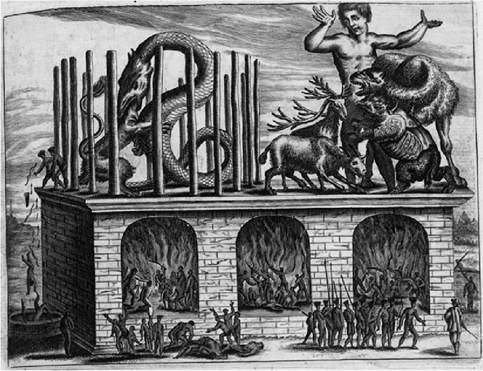
Figure 21.2 In 1518, Spaniards claimed they saw a sacrificial altar on the coast of the Gulf of Mexico; by 1671, illustrated versions of that claim had evolved into this image, included in America, the great compendium of New World geography and history published in English by John Ogilby (1670) and in Dutch by Arnoldus Montanus (1671).
told European readers in several languages, indigenous Mexicans ‘are the cruellest people to be found in warfare, for they spare [nobody], killing them all and eating them’.[663] [664]
Added to a supposed treasonous propensity for rebellion, human sacrifice and cannibalism formed a trio of legitimising ‘facts’ that gave Spaniards licence to invade the many regions that became the viceroyalty of New Spain (the Caribbean islands, the sea’s rim and Mesoamerica) - despite Las Casas’s decades of arguing in print and at court that the wars of conquest caused greater harm and evil than human sacrifice by Aztecs and other ‘Indians’.11 The quebrantimiento, or great ‘breaking’, of the Taino and other indigenous groups in the Caribbean and coastal Central America was followed by mass enslavement of Mesoamericans from 1519 into the 1540s, and then of other indigenous peoples in the Mexican far north and beyond.
The claim that Moctezuma had surrendered to Cortes in 1519 underpinned the use of the rebellion loophole, one used to justify the massacre and enslavement of hundreds of thousands. While the elimination of ‘Indians' was never an official Spanish or Portuguese policy (contrary to policies in some parts of British America), individual officials and settlers periodically engaged in sustained levels of violence that were tantamount to genocide - arguably in effect if not in intent.[665]The third and fourth historical developments relate to the evolution of activities in the Americas by Spanish church officials. The third was the Spiritual Conquest, or the conversion of indigenous peoples, overwhelmingly by Spanish priests and friars. The fourth was that of activities by the Holy Office (also known as the Inquisition), most notably anti-Semitic campaigns in seventeenth-century Mexico City and Lima. These two developments comprised a pair of ecclesiastical movements that displayed periodic outbursts of violence, legitimised through judicial process.
The Spiritual Conquest was an often peaceful process, and is increasingly being understood by historians as a collaborative one, leading to numerous regional variations in belief and practice. But there were also moments of frustration by church officials, leading to violent campaigns of extirpation. Recidivism and the persistence of so-called idolatry were viewed as a pestilence or disease whose cure sometimes necessitated systematic torture - legitimised by following a specific series of torments, set by the ecclesiastical authorities, with torture sessions recorded in detail by a notary. Investigations and extirpations also often necessitated violent public humiliation, and even execution, of the afflicted.
A well-known and illustrative example is the campaign against ‘idolatry' conducted during the summer of 1562 in the small province of Yucatan. Some 4,000 Maya men and women were interrogated under torture, all notarised and conducted according to proper judicial procedure, culminating in the death of several hundred Mayas and the public humiliation of leaders in auto- da-fe rituals of penance.
Fray Diego de Landa, the provincial or head of the Franciscans in the colony, led the campaign. He later explained in straightforward terms what justified the campaign and what legitimised its violent methods. Having been ‘instructed in the religion' the local Mayas were ‘turned to idolatry' by their priests, whose ‘sacrifices' included those of ‘human blood'; thus Landa followed the inquisitorial procedure of processos (denunciations, investigations and trials) and an auto. Although Landa had the support of key Spanish officials, the campaign was opposed by the governor and the conquistador settlers. Their objection was economic, not moral; they feared for the profitability of their encomiendas, or grants of tribute goods and labour rights from groups of Maya villages. Although moral objections were eventually raised - by an incoming bishop - resulting in the campaign being halted and Landa being dispatched back to Spain, the fearsome friar later returned as bishop himself.[666]Largely as a result of violent anti-idolatry campaigns like that of Landa, which were carried out under cover of the powers of the Inquisition or Holy Office, indigenous peoples were removed from the jurisdiction of the Spanish Inquisition in the Americas after the 1570s (in Mexico, for example, from 1571, when the Mexican Inquisition was established). As a result, regional inquisitions continued to police orthodoxy among the growing non-indigenous populations in the colonies, generating a relatively small but steady stream of prosecutions. In Mexico, at least 400 people were officially investigated for heresy between 1571 and the abolition of the Mexican Inquisition in 1820, of whom at least fifty were executed. A small number of these were foreign Protestants, mostly captured pirates, tried and executed by the inquisitions of Mexico, Lima and Cartagena in the sixteenth and seventeenth centuries. But most notably more than half of those who were tortured and executed in public rituals were condemned for being crypto-Jews - which brings us specifically to the fourth historical development, anti-Semitic violence lead and legitimised by the Inquisition.
It was therefore New Christians, many of them Portuguese, who suffered the most under the Inquisition. Merchant families were especially targeted for practising the ‘Law of Moses', although records show that awareness of alleged heretical beliefs or practices among the accused varied tremendously; some of those jailed viewed themselves as good Catholics, and regularly attended mass, whereas others openly proclaimed themselves practising Jews, and were even willing to be martyrs for their faith. In Mexico, the most violent outburst of church-sanctioned, Inquisition-led anti-Semitism occurred in the 1640s (for example, in one week in 1642 some 150 accused were arrested and most of them questioned under torture; in 1649 twelve alleged secret ‘Judaisers' were burned at the stake in Mexico City).[667] Because anti-Semitism was itself legitimate, its violent expression could quickly spread under cover of law. The 1649 outburst of legitimised anti-Semitic violence in Mexico followed an equally deadly one in Peru; in the viceregal capital city of Lima in the late 1630s the Inquisition arrested and interrogated 100 alleged participants in the complicidad grande, or Great Jewish Conspiracy. Fifty-two of the accused were whipped, humiliated in public auto-da-fe rituals, and exiled; a dozen were burned alive at the stake. In a controversial study of the Inquisition in Peru, Irene Silverblatt characterised the activities of the Holy Office as a ‘dance of bureaucracy and race, born in colonialism', contributing ominously to ‘the creation of the modern world'. In other words, Silverblatt saw the Spanish Inquisition's culture of legitimised anti-Semitic violence as a central root of twentieth-century manifestations of similar violence - most obviously the Holocaust.[668] Whether she went too far or not, in drawing a line from seventeenth-century Peru to twentieth-century Europe, there is no doubt that colonial administrators and church officials in Spanish America developed ways to commit violence under cover of government and the law.
Viceregal and provincial capitals and their hinterlands in Spanish America evolved demographically; they went from being regions of conquest violence against indigenous peoples to places where government officials feared revolts by African slaves and church officials worried about crypto-Jews and other heretics in their midst. Spaniards had as much reason as other Europeans in the Americas to fear resistance and revolt by African slaves - over four centuries, 11 million Africans were brought to the hemisphere to toil against their will. Our fifth violence-infused historical development is thus the trade and treatment of African and African-descended slaves in Spanish America. Violence deployed to prevent and discourage slave revolt was therefore seen as a legitimate means of preserving order, even if it counterproductively provoked violent reactions; as Trevor Burnard notes of the trans-Atlantic slave trade, ‘violence permeated every aspect of its operations'.[669] The Atlantic slave trade predated the European discovery of the Americas, and the trade thus soon became an established element of Iberian expansion; as it grew, so did tales of its violent nature - the high mortality rate on the middle passage, the brutal treatment of slaves by owners in all colonies, the allegedly violent nature of slaves themselves, and the use of ritual, public executions to suppress slave revolts and terrorise the growing African and African-descended communities in the hemisphere.
An example of the latter is worth mentioning because it took place in Mexico, a region less often associated with violence against slaves than plantation zones such as northern Brazil, Saint-Domingue and the US south. On a May morning in 1612 thirty-five black men and women were summarily tried and convicted as rebel conspirators, paraded through the streets of Mexico City and hanged before the city populace in the central plaza. Before the crowds dispersed, twenty-nine bodies were decapitated and their heads spiked atop the gallows, while the other six were quartered, their body parts displayed at the city's entrances. The significance of the event for our purposes is twofold. First, the high number of executions and their public nature were a vivid example of how the display of legitimate violence acted as a spectacle of state terror (as did auto-da-fe rituals). Second, no rebellion had actually taken place, nor was its plot well evidenced. In fact, the trial, which was no more than a brief investigation by the audiencia (the city and district's high court), and the mass execution appear now to have been a judicial contrivance designed to permit a public performance of state terrorism. With a sharp growth, beginning in the 1590s, of the enslaved and free black population in the city and its environs, Spanish officials and settlers grew increasingly fearful of an uprising by those they perceived as innately prone to rape, robbery and murderous revolt. Prejudice and fear meant that rumours of the alleged revolt were quickly believed. But the response was not racist mob violence or covert state persecution, but a public deployment of judicial process to lend a justificatory veneer to cautionary lynchings.[670] [671] [672]
The site of the greatest mass brutality against African-born and Afrodescended slaves was the sugar plantation, as Cecile Vidal details for the British and French colonies.18 (In a topographical study of violence in the Americas, the plantation would surely play a central role).19 As slave-worked sugar operations expanded in the eighteenth century - maintained by every European empire, from the British and Portuguese to the Dutch and Danish - so did the reputation of the slave trade as excessively violent spread within Europe itself. In the closing decades of the eighteenth century British public opinion finally turned against it, helping to fuel the abolition movement, while the eventual success of the slave revolt in Saint-Domingue (Haiti) served as an inspiring or terrifying lesson in how the over-application of violence by masters in a slave society could backfire. Nonetheless, Europeans were quick to take refuge in relativist evaluations of slave regimes, insisting that their colonies were full of contented black families, while other empires treated slaves abominably (arguably, a tacit recognition that not all forms of violence against slaves were legitimate). This finger pointing was most notable in border regions, such as that between the British logging settlement in Belize and the neighbouring Spanish colonies in Yucatan, Guatemala and Honduras.[673] Beneath the rhetoric of colonial officials lay a grim truth that African slaves in the Americas suffered legally sanctioned violence of every kind, to degrees unimaginable to us, in all colonies. It was only when public opinion, and then the law itself, ceased to view such violence as legal or legitimate that the abolition movement became possible.
The slave system in the colonial Americas was intrinsically violent, built upon seizure, dislocation, rape, murder and at times micro-genocidal community destruction. As the transatlantic trade in enslaved Africans grew along with European colonies in the New World, the phenomenon of enslaving indigenous people - the sixth of our eight violence-oriented historical developments - persisted along the ever-shifting frontiers of European expansion. In Mexico, those frontiers were in the near north in the sixteenth century, but soon moved to the far north, and then all over North America, as indigenous groups felt the impact of multiple Spanish, French, English and eventually even Russian incursions and settlements. In South America the frontiers were numerous, but most notably ran into and around Amazonia. Portuguese slavers were persistent and wide-ranging, even causing border conflicts between Brazil and Spanish colonies.
While the topography of frontier violence and indigenous enslavement was in constant flux, its illegality, coupled with the loopholes on cannibalism and rebellion, continued to apply. To clarify: it was illegal to enslave ‘Indians' in Spanish America for most of the colonial period, and the vast majority of indigenous inhabitants of Spain's provinces in the New World were not slaves; but the loopholes or exceptions to the law were abused far more than was recognised at the time, with the result that indigenous enslavement has often been ignored since then. For that reason alone, it is worth our attention, but it is particularly relevant here because it represented the abuse of law - the use of the letter of the law in violation of its spirit - to deploy legitimated violence against indigenous families.
The following description comes from an Italian traveller, Girolamo Benzoni, and refers to the Venezuelan coast in the 1540s. Those details aside, and despite Benzoni’s unreliability in many matters, this comment offers a grimly accurate glimpse into how indigenous groups outside European colonies continued to suffer in much of the Americas, and for centuries, the kind of violence outlined above for the very early Caribbean and Mexico. One day, Benzoni narrates, a Spanish captain returned from raiding nearby indigenous villages
with more than 4,000 slaves. He had captured many more, but they had died on the journey from hunger, overwork, and exhaustion, as well as from sorrow at leaving their country, their fathers, their mothers, or their children. When some of the slaves could not walk, the Spaniards tried to prevent them from making war later by burying their swords in their sides or in their breasts. It was really an upsetting thing to see the way these sad, naked, tired and lame creatures were treated. They were exhausted with hunger, illness, and sadness.
Just as in the Caribbean and Mexico, the oft-ignored theme of sexual slavery was central to the phenomenon in South America. Adds Benzoni: ‘Nor was there a woman who had not been violated by the predators. Because there were so many Spaniards who indulged their lust, many were left broken.’[674]
Benzoni’s comment brings us to the seventh violence-themed historical development, a thread that has run through all eight of the above topics: violence against women. Sexual slavery, especially of teenage girls, was at the heart of the violence that tore apart families and swept through towns and villages in the wars of invasion in the Caribbean, Mexico and Central America. The pattern was repeated across the Americas for centuries. Young women, eventually numbering in the hundreds of thousands, saw their male relatives killed, were subjected to gang rape or serial rape, then sold and condemned to a life of slave labour, often among people of alien languages and cultures - European, African, indigenous. A parallel pattern lasted for centuries among African and African-descended women on both sides of the Atlantic. Such women had little recourse to protection or retaliation, and none to justice; their slave status provided a veneer of legitimacy to their abuse. Meanwhile, women were not spared the violence of the Inquisition, including the two case clusters given above - in Yucatan in 1562, for example, over 100 Maya women were subjected to the torture-based interrogation; and women, almost as much as men, of Spanish and Portuguese ancestry in Peru in the 1640s were victims of anti-Semitic Inquisition violence.
Although heretics were relatively rare in colonial Latin America, witches were not. The topic of witchcraft is worth a brief note in the context of violence against women, simply because in the Americas, as in Europe during these centuries (but especially the seventeenth), such violence also took the peculiar but virulent form of the witch craze. Hundreds were tried and convicted across the whole colonial period. In English colonies such as Massachusetts, the patterns of violence were gender-related and on a larger scale, as in northern Europe at this time. But in Spanish America (as in Portuguese Brazil), alleged witches were virtually never arrested en masse, much less executed. Also unlike Anglo-North America and Europe, the folk and religious cultures of African and indigenous peoples complicated practices that inquisitors sometimes investigated as heretical or indicative of witchcraft, and that meant men were also investigated by the Inquisition or by a separate investigative body of the church in Spanish America, the Provisorato (sometimes called the Indian Inquisition). A minority of such investigations were violent, and most of the accused were spared execution, following public humiliation, flogging or exile - or some combination of the three.[675]
A final phenomenon within the larger topic of violence against women is worth mention, in part because it illustrates the wide-ranging and multifaceted nature of judicial violence in the colonial Americas: domestic violence. A brief case study introduces the phenomenon well. The talk of the town in La Plata (today's Sucre, Bolivia) in the winter of 1595 was the coldblooded murder by the audiencia notary of his wife. Freely admitting to the murder, the notary's defence was the accusation that his wife had been sleeping with the court's prosecutor and that the lovers had planned to use witchcraft to kill him. As it happened, the oidor (judge of the court), who lived next door to the notary and found him standing over his wife's corpse, had himself murdered his wife and her lover in Quito back in 1581. Both uxoricides (the notary and the judge) successfully claimed the right to commit violence that was technically illegal (as murder) but was justified and legitimated by the circumstances (social norms regarding men's rights over women), and as a result they suffered no worse than prosecution and temporary career setbacks.[676] In other words, women constituted a vulnerable sector in a society where violent acts, if classified as judicious, could be committed with impunity - even encouraged as being a form of justice and a restoration of the social hierarchy.
The final thread to be considered here (our eighth) is another large topic, that of colonial rebellions. The historiography of the twentieth century generally followed the lead of Spanish, Portuguese and British authorities during the colonial period - that any violence stemming from conquest or initial settlement was rapidly succeeded by a pax colonial, with the occasional uprising being an exception that proved the rule of peaceful rule. The very existence of the pax colonial now seems questionable. At the very least, it must be offset by three considerations.
First, the violence of conquest and settlement was far more extensive, even genocidal, and prolonged than has been recognised - from the Caribbean and Mesoamerican cases through to the sustained campaign by white settlers to eliminate indigenous Californians in the late nineteenth century.[677] Second, looking at the longue duree sweep of the colonial Americas, ‘revolts were rare but violence was frequent' (in Murdo Macleod's words). That is, organised rebellions were rare due to policies such as the maintenance of local semi- autonomous rule by indigenous municipalities in Spanish America; but such revolts should be seen as ‘one extreme of a continuum of violence' that included various kinds of ‘evasions, defiances, and resistance' to colonial demands.[678] Third, the outbreak of organised revolts in the final half-century of Spanish colonial rule is now seen as more than a few well-known dramatic rebellions, such as that of the Inca revivalist Tupac Amaru in Peru. For example, the Great Andean Rebellion of 1780-2 is increasingly understood in the context of uprisings up and down the Andes beginning in the 1740s. At the same time, as more studies of specific uprisings are published, scholars are increasingly conscious of the larger context, one that includes everything from indigenous Totonac resistance to tobacco reforms in the Verazcruz region of Mexico to the Maya rebellion in Yucatan in 1761 led by Jacinto Canek.[679]
The relevant point here is that rebellions tested the efficacy of the legitimised violence used by Spanish officials to maintain colonial order. Just as the violence used to keep slaves at work could be counterproductive, so did violent responses to petitions and protests by indigenous leaders often stimulate a cycle of violence; not everyone shared the belief held by colonial officials that arrests, interrogations accompanied by beatings and public floggings were legitimate actions. At times, Spanish officials understood that a negotiated end to the conflict could cut that cycle, but more often than not it resulted in spectacular displays of extreme, legitimised violence in the form of public executions of rebel leaders - of which the slow deaths of Tupac Amaru and Jacinto Canek are examples.
More on the topic A Dance of Bureaucracy:
- “if YOU WANT TO EAT, GO AND DANCE!”
- Bureaucracy in the development process
- The development of a modern bureaucracy
- The Imperial Bureaucracy
- Civil Bureaucracy and Embassies
- 7 Law, Bureaucracy, and the Practice of Government and Rule
- INTRODUCTION
- 2 Indigenous Religions of North America
- The Russian Empire
- Onto Center Stage: Warfare in the Western World
- Formation of the Imperial Russia Bureaucratic Class in Steppe Ukraine in the Late Eighteenth Century
- Conclusion
- VII The World of Poetry and Art
- Resistance Movements and Social Justice
- The Impact in the East
- Ecology