Onto Center Stage: Warfare in the Western World
Sara Buttsworth and Maartje Abbenhuis
'\'\TTe both have the joys and frustrations that are two-year-old % X / boys—Elijah and Joseph. They are great friends and love to
V ▼ dance.
Joseph is cool and likes jazz. Elijah's current favorite song, because daddy showed him the film clip, is Christina Aguilera's “Candy Man” from her 2007 Back to Basics album. Just as disturbing as seeing him mimic the dance moves is the recognition that, even through something as innocuous as a frivolous pop song, he is being exposed to representations of war, in this case the remediation of the Andrews Sisters' “Boogie Woogie Bugle Boy of Company B,” which was a worldwide hit upon its release in 1941. Aguilera's version is a romanticization of the Second World War, not only through the reworked music but also through the interspersion of film clips depicting soldiers in Second World War uniforms with Aguilera gyrating in various costumes from the era, including one that replicates Rosie the Riveter, overalls, kerchief, and all. The sexism and sexualization of women in uniform and women in the workplace that were very much present in representations of women attempting to “do their bit” in the 1940s are also very much present in this representation that was created more than 60 years after the original song was released. There are no toy guns in our homes, or tanks, or warplanes, for that matter. We refuse to buy clothing that has camouflage print on it. But war has crept into the lives of our two-year-olds even if they are too young yet to recognize it.The glamour and bright colors that attract Elijah to Aguilera's “Candy Man” are present in many depictions of war, as war is theater: pageantry, uniforms, drama, villains, victims, and heroes. Even if the colors used are actually the more drab hues of khaki and navy blue, participation in war, particularly if it can be written as a “just” war, is lauded in places as far apart as New Zealand and the United States.
Cadets march on “parade” grounds while returned soldiers parade through cities to celebrate victories or commemorate wars long past. It has become a cliche for soldiers to describe war itself as 90 percent boredom and 10 percent terror. Perhaps unsurprisingly, soldiers' experiences and their activities in armed combat sit firmly at the center of how many westerners think about war. In many popular representations of war, soldiers are, more often than not, cast as the main actors. They are the heroes we aspire to be like, revere for their achievements and bravery, and commemorate for their sacrifice. Obviously, war is also about victims, those upon whom “war is inflicted” or to whom “war happens.” They are often cast as hapless and helpless women, children, and the elderly fleeing the violence and suffering of the warfronts. If not seen as a faceless mass, noncombatants are frequently presented as the supporting actors, individuals to be pitied, cared for, and commemorated as “victims” and consequently depicted as having very little agency of their own.But what is war for those behind the scenes, or in the stalls, for the understudies, the costumers, the orchestra, the families of cast members, the protesters of controversial productions, the reviewers, or even the support crew behind the counter at the bar? In an age where war has become increasingly more total for victims than perpetrators and evermore pervasive in daily life, many more noncombatants than soldiers feel the impact of war. The omnipresence of war in everyday life renders it almost pedestrian in Western culture, which is partly due to the removal of distance between the ready availability of images and information about wars, both real and imagined. As Margaret Higgonet so beautifully expressed it in her discussion of war toys and narratives of the Great War:
War toys remind us that war is not something that happens far away on a neatly contained “battlefront” but part of the everyday; war is not simply an isolable event but an eruption within a continuum that runs through what we call peacetime.1
This is as true for the tin soldiers that were the toys of the early twentieth century as it is for the memorabilia on sale at various fairs and conventions in the early twenty-first century.
The weaponry, uniforms, and mementoes of wars past are the conduits for the continued pervasiveness of war in the present and lay the basis for the continued primacy of war in our culture into the future.Our book cover illustrates the integral place war themes have in everyday life so well. The photograph, originally one of a triptych on the same scene, was taken in 1907, in Ireland, of brother and sister, Rex and Gillian, posing in their best clothes. Rex is at play with his miniature infantry, cavalry, and artillery replicas carefully lined up and arranged, while Gillian sits slightly apart from her sibling, looking on. She is physically removed from the staging and reenactment of war, but she remains a suitably unimpressed witness of her sibling's war play. In what is obviously a posed photograph, the use of the military toys (rather than other nonmilitary ones) and the setup of the two children in a traditionally gendered way, with the sister as an audience to but not a participant in her brother's war games, indicates how integral an imagined idea of war was (and remains) to the Western world's way of life and ideas about themselves and their society. While we seek to protect the “innocence” of our children and shield them from ever experiencing the “reality” of war, staged and unstaged wars are as much a part of their lives as they were for these besmocked children photographed 100 years ago.
Although, throughout the twentieth century, war has often been viewed more as hellish horror than romance, this too is a part of the theatricality of combatant war stories that have overshadowed alternative scripts. There is a strong emphasis on the British soldier poets of the First World War in the English literature curricula of Great Britain, Australia, and New Zealand, providing an almost singular perspective on war and soldiering to audiences distanced from the mud and trenches of that conflict by a century. The marches and memorials to the First World War leave little room for public discussion of the treatment of conscientious objectors or the legacies of imperialism.
For example, the transition of the “real” soldier Audie Murphy to film star, best known for playing himself in the film based on his Second World War memoir To Hell and Back, is a fascinating example of the transition from combatant to celluloid hero and of the public's fascination with war stories as dominant narratives of the twentieth century.2 The possibility of, and capacity to, accurately depict the carnage of war in cinema remains an obsession present right up to today, where this carnage is mingled with the idealized romance of retrieving lost men as in Steven Spielberg's Saving Private Ryan.3 Popular culture is dominated by images of war, the bonds between soldiers, and the spectacles of battle. From the thunderous volley of cannons in Tchaikovsky's 1812 Overture to the melancholy and horror of Wilfred Owen's poetry, from the constant diet of films about war and soldiers to the fascination with uniforms that not only permeates adult fashion but has seen the production of pink camouflage baby rompers. Even the most apparently peaceable pursuits have been pervaded by symbols, sound bites, myths, and stories about war. War as an object of fascination with military matters or needless suffering often ignores the views and voices from the wings: the voices of those who witness or experience war as noncombatants or nonparticipants. Furthermore, the fascination with war as a legitimate pursuit can obscure the ways in which it is normalized into everyday life. Yet it is precisely these voices and influences that are myriad and crucial to a broader understanding of the central position that warfare has held in Western culture since the late nineteenth century.One of the main aims of this collection is, therefore, to investigate the ways in which war and militarism remain central foci points in Western culture. In so doing, we highlight the ways in which the assignment of primacy to soldiers in the analysis and representation of warfare undermines the recognition of the ways wars affect noncombatants both during periods of conflict and in their aftermath.
We seek particularly to emphasize that war is an all-consuming part of modern Western culture and should be analyzed as a multifaceted phenomenon that is as important to noncombatants as it is (or was) to combatants. This is not, of course, to suggest that there is no scholarship available on the impact of war on civilians or that war studies have been one-dimensional up to this point in time. Quite to the contrary: there is a growing and massive literature available on warfare and culture, war and memory, and war and society studied from numerous perspectives and approaches. We hope that this collection adds to this scholarship by reiterating the pervasiveness of war themes in everyday life and asserting the prominence of the impact and role played by wars in the lives of noncombatants in the modern world. Even more broadly, our ambition is to reposition the traditional place assigned to civilians and noncombatants, namely, from the peripheries of actual and imagined “theaters of war” to the center stage. In the process, we hope to reinvestigate the role played by martial prowess in Western culture; the concept of victimhood in postwar memory and culture; the long-term legacies of wartime events as they influenced noncombatants; the conceptualization of war, militarism, and conflict in cultural representations for children and adults; and the relevance of peace activism in war and peacetime.Overview
The simmering, inchoate conflicts that characterize the contemporary world, conflicts no longer on focused territorial disputes between nations but on claims for cultural and political recognition and the distribution of resources, make it ever more difficult to imagine an impermeable private sphere, safe from the psychic impact of global dislocation and violent disruption.
Clair Wills4
This collection seeks to move the perspectives that are marginal to mainstream war stories and histories onto center stage, acknowledging their importance and destabilizing the primacy of the combatant in contemporary Western culture.
It follows three thematic trajectories in pulling the curtain back: direct experiences of war from those who are not warriors, through gender, place in time, or neutral status; representations and memories of war; and examinations of the importance of peace movements and protests against war, the ways in which the boundaries between war and peacetime are not “impermeable” as so eloquently stated by Claire Wills. All of the articles in this collection work to either explain or undermine the staging of warfare as a monolithic and acontextual production whose primary focus is the soldier as both actor and victim.5In popular culture, as much as in the scholarly study of modern warfare, wars are often presented as having an appearance of order and coherence. Not for nothing did Rex arrange his war toys in neat orderly lines. This impression has continued even when dealing with the chaos of the battlefield and conflicts that occurred long after the set-piece battle was relegated to the world of reenactments and board games. When, in 1991, Jean Baudrillard controversially claimed the Gulf War did not take place, he was asking us to examine more deeply the spectacle and simulacra of war and to look past the action in the spotlight to what was going on behind the scenes and beyond the footlights.6 Even the most carefully staged incursions have unexpected spillage in all sorts of unforeseen areas. War is not containable in terms of time, place, or impact.
As researchers and teachers of the history and culture of war and peace, we are constantly struck by the ways in which our students construct war without texture or context. They are fascinated (to the point of infatuation) with the surface spectacle of war, and many of them are disappointed when they do not get more “war in their war.” Indeed, as we have instead attempted to situate particular conflicts within social, political, and cultural frameworks and to introduce them to new ways of reading war, peace, and society, students have actually complained. They also express amazement at the scope of different material with which they are confronted in our classrooms. Our cohort of students is not unique in this; we seem to have a society-wide obsession with certain aspects of war as any quick perusal of the History Channel’s programming reveals. This obsession seems particularly acute and anomalous in populations who have, with obvious exceptions, no direct experience of war or combat, whether through time or geography or both. Even in the post-9/11 world where many countries, including New Zealand, are making direct or indirect contributions to different war zones, whether in the form of peacekeeping, building contractors, or professional armies, most civilians do not have direct contact with the realities of war themselves. War is “foreign,” as Ken McLeish recently put it, it “is what people go away to.”1 This separation, however, does not slow the interest in certain aspects of war over others. Western society seems incapable of appreciating or connecting the multitude of voices from wars that should, in theory at least, overshadow the constructed grandeur of armed conflict that is continued by some military historians, media outlets, and politicians.8
With this collection we want to acknowledge the diversity of noncombatants’ experiences of war as well as the impact war has on noncombatants. War is rarely the carefully planned and executed mission of which tacticians and politicians dream; it is chaotic and eclectic, and, over the past 200 years, has become an inescapable theme confronting individuals throughout the Western world. For a great many of them, it is also a mediated experience, temporally, historically, through mythology, and through various forms of communication. Since the nineteenth century, with the impact of photography and mass literacy, individuals in peacetime societies can and do “experience” conflict situated vast distances away. With widespread usage of television, the Internet, and mobile telecommunications, the pervasive interest in warfare is fueled by immediacy and, in some cases, interactivity that is unprecedented. News broadcasting, the printed press, blogs, YouTube, computer gaming, and e-mail all bring war to every corner of the Western world and to people with seemingly no immediate connection to it. The theater of war is witnessed, viewed, and challenged by an audience of millions and is, in turn, affecting, changing, and challenging that audience.
The use of the metaphor of theater to link the chapters on offer here is, therefore, apt. It brings out the truisms that wars are never monocular and are often (re)mediated experiences. They are not only about fighting and death but can have many multifaceted impacts and audiences. By applying the metaphor of war as a staged production, we do not wish to trivialize the experiences contained in this volume nor those of combatants and other participants. We also do not wish to suggest that all wars are the same or necessarily experienced in similar ways. Conflicts differ widely in what they are about and why they come about. They have different contexts that shape not only the experiences of their participants but also those of their audiences. It is precisely the diversity of these circumstances that make them so interesting to study and necessitate that we acknowledge and explore the ramifications of warfare and its mediations.
The idea that an entire society and its activities can be subsumed by the needs of a war effort and can be fundamentally affected by the existence of war is not new, of course. The concept of “total war” is commonly applied to both of the twentieth century’s world wars, although more readily to the second than to the first.9 There exists a considerable body of research that analyzes the impact of these wars on the societies that fought them, but the concept of “total war” having a longer-term impact is rarely pursued. The influence of total war in peacetime, in the aftermath of conflict, deserves much more attention. Both world wars (and not only these two conflicts) had numerous everyday and long-term legacies. It took people, some of whom had no direct experience of or involvement in the war, out of ordinary situations into the extraordinary. For others, it made the extraordinary commonplace. Gabrielle Fortune's chapter in this collection on war brides makes explicit these connections between the ordinary and the extraordinary and the ways in which war became a defining identifier for some women throughout the rest of their lives—in spite of some of them never having witnessed warfare directly. Similarly, Ismee Tames focuses on the problems of constructing a new identity for the children of Dutch Nazi collaborators in the immediate aftermath of the Second World War. Their status both as children and as children of a neutral nation should have protected them from war and its impacts. The realities of the Second World War's violation of both Dutch neutrality and the “sanctity” of childhood through their parents' politics, however, made it impossible for many of these children to begin or continue new lives, untainted by their wartime experiences, once the war was over. For many, the outbreak of peace does not mean the end of the war.
In many respects, the intensity with which war themes continue in peacetime suggests that the scholarly obsession with periods of “total war” may need to be broadened. We see a need to understand the existence of real and imagined wars as a historical constant, as a theme that has influenced the Western world for at least the last 200 years, if not longer, and to take the analysis of war beyond the obvious links between military conflict and soldiers and between noncombatants and victimhood. The concept of “total war” itself has, it seems, tied scholarly attention to extraordinary periods of participation by noncombatants in warfare, such as occurred in the two world wars. Admittedly, this has enabled scholars to understand war as more than a military phenomenon, a very important development and one that is supported by several of the contributions in this volume. However, the label “total war” also suggests that there is something extraordinary about the seconding of society to war, that, in fact, war is meant to be for soldiers, not for noncombatants.10 In a rather perverse way, the fascination with periods of perceived “total war” and war crisis, such as the First and the Second World War, has diverted attention away from the continuities of war in supposed “ordinary” “peaceful” times.
It is difficult to define the concept of “peace”. In its most simplistic form, “peace” can best be classified as “the absence of war”. We contend, however, that in the Western world in the modern era, an absence of war does not
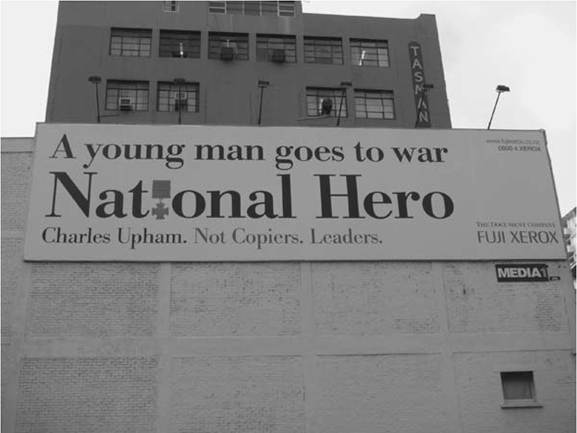
Figure 0.1 Charles Upham, the New Zealand Second World War veteran and doubleVictoria Cross awardee, used to advertise photocopiers on this giant billboard visible in central Auckland, New Zealand, November 2007.
Source: Photograph courtesy of Gabrielle Fortune, Private Collection
exist. War is omnipresent and an everyday reality. Even in peacetime, many Western communities are obsessed by war themes. This is as true for the United States in the late nineteenth century as it was for participants in the antiwar movements in Scandinavia in the interwar years, as it was for many countries during the Cold War era, and still is in the post-9/11 world. So, while many Western nations have lived in relative peace for many decades and only indirectly or haphazardly experience warfare—one would not claim, for example, that the United States today, while it is officially at war in Iraq and Afghanistan, is a total war society—the fascination with all things war and warrior remains.
Recent examples that we have come across of this warrior obsession include an advertising billboard in Auckland, New Zealand, for photocopiers (see figure 0.1). This giant canvas prominently situated in the middle of Auckland’s city center aligns the experiences of the New Zealander and double-Victoria Cross awardee Charles Upham with the concept of heroism and leadership. The advertisers are promoting their photocopiers as leaders (not followers) by plugging into what they expect mainstream New Zealand understands of Upham's Second World War experiences. The billboard is as much about national pride and achievement as it is a representation of the deep-seated fascination with military heroism in everyday New Zealand culture. Furthermore, the advertisers are indirectly and unintentionally profiting from the (unrelated) theft of one of Upham's medals (along with those of other prominent New Zealand veterans) from the Waiuru Army Museum in December 2007.11 The theft received media saturation in New Zealand, particularly as an unprecedented NZ$300,000 reward was offered for information leading to the recovery of the medals—put up by private donations and supported by the New Zealand police.12 The theft outraged the country. Most New Zealanders felt that the thieves had committed an unpardonable act, an affront to the nation, to the families of the medal recipients, and to the memory of the sacrifice made by these brave soldiers. The connections between the two world wars, their memorabilia, and concepts of New Zealand and national identity are still very much alive and well.
An even more troubling example of the place military heroism plays in modern society is the annual “War and Peace” military collectables show held at Beltring in Kent, United Kingdom.13 There is very little focus on peace at this massive event, which sees military reenactors, war paraphernalia collectors, and the British armed forces combine their talents to present a host of ways in which to promote and sell all manner of things to do with the military and wars, past and present. It would actually do to rename the show “War in Peace.” The Scale Model Collector magazine raved about the 2007 event in the following terms:
the show welcomed over 5000 military vehicles.... Waffen SS, Tommies and GIs from WW2 to the present day were dug in around the encampment; each living life as close to their theme as possible. There was even a Vietcong tunnel complex leading into the Vietnam experience, through which visitors could crawl. The centre-piece of the show was the main arena, where infantry and armour had the chance to show off their talents bringing history to life..............................
You can walk into a stall and come out as Waffen SS “Landser” or a “Band of Brothers” US paratrooper.... Beltring is one of those events that the whole family can enjoy. Dad dressed in uniform, while mum and the kids walk around the event in similar period clothing with children suitably labeled and carrying their boxed gas-masks.... [T]here was plenty of time to party in the “Victory Marquee” where visitors were adorned in floral Hawaiian shirts, and sailors sporting US Navy hats made this family friendly place a cross between “Butlins” and “Pearl Harbor” with live 40's music and competitions.14
Tellingly, the photographs that accompanied the article included laudatory captions like “The SAS fast attack vehicle looked fun to drive” and “The Germans [in the Second World War] had nice uniforms.” This event, now in its twenty-sixth year, more than anything else illustrates how “bloodless warfare” has caught the imagination of sections of modern society. The organizers, participants, and visitors to Beltring seem to be there for the “idea” and “romance” of war, rather than for attaining any sense of its reality.
In the last twenty years, under the influences of feminist scholarship, cultural studies, Holocaust studies, and social history, histories of war have developed, and there have been many far-reaching monographs and collections that explore the relationships between media and war, gender and war, childhood and war, the impact of peace movements, and the importance of neutrality.15 To this end, some of this collection revolves around the concept that war has become a “spectator sport,”16 a bloodless affair, like the Beltring extravaganza discussed above, with a potential audience of millions. But even the “unreal” experience of mediated war can have important and long-lasting consequences. Some of the contributions in this collection focus on individuals, groups, and communities that have worried and philosophized about and challenged the possibility of war occurring in their society— people who obsess (or have obsessed) about the need for peace and the difficulties of removing the existence of war. In this sense, it is about those who think about war and the possibility of future conflict and act to mitigate it. Thinking about war is a complex, yet common, sociological phenomenon. Above all, however, this collection looks at the layered and long-lasting impact of actual and imagined wars on individuals and groups whom we would not traditionally consider as being agents or targets of warfare but whose lives, nonetheless, were (or are) fundamentally altered by the existence of such conflicts. What is important and unique about this collection is the way in which we seek to draw together this multiplicity of approaches across disciplines, historical periods, geography, theoretical directions, and subject matter. Each chapter deals with voices that have not been heard and yet for whom war was (or is) a defining experience. All of the articles present perspectives normally excluded from narratives about war. They also add to the growing body of work seeking to broaden the discursive boundaries and understanding of a phenomenon that penetrates the lives of noncombatants in an age where it is increasingly problematic to be “at peace.”
An outcome that was not intentional was the volume of content we have on the impact of war on children whether immediate or representational. The chapters by Ismee Tames, Sara Buttsworth, David Rosen, and Karen Hall all deal with the ways in which children and ideas about childhood do not remain sacrosanct in the face of the centrality of war. Another recurrent theme throughout the book is that of activism against war or by or on behalf of the “victims” of war. Penelope Adams Moon and Suellen Murray both explore the difficulties and challenges of women protesting for peace in two very different Cold War contexts. Hall's chapter introduces the idea of organizing peace activism through play. Irene Andersson unravels the complicated position committed pacifists have when their own safety is threatened, and Rosen introduces the difficulties of dealing with forms of advocacy or activism that do not recognize the agency of children in times of war.
In terms of subject matter, this book is not meant to be an end point. We hope it inspires and propels further work in the field and diversifies scholarly discussions about the place and context of warfare in the Western world. In a work of this kind, so broad in scope and subject matter, there are many areas we could have covered and numerous obvious omissions. For example, we have not included a chapter on the designation of servicewomen as noncombatants in many modern armed forces. This omission was not by design, although we have to some extent attempted to engage more exclusively with voices that do not come directly from formal military institutions. Likewise, it would have been appropriate to include a chapter on recent wars (particularly post-9/11) or on contemporary media in presenting and utilizing war themes, including blogging, Internet reporting, and war gaming. These are all themes that deserve more attention in the scholarship on war and peace. What we have tried to do is present an array of interesting and divergent views on warfare from a variety of historical periods and geographic locations. The variation in the collection makes our point about the centrality of warfare in Western society all the more poignantly.
It is important to note that beyond the specification of “‘western,” this collection is not really about geography. We have included diverse studies from all over the Western world—ranging from Europe to North America and the Pacific. While acknowledging that there are obvious contextual differences, it is the seemingly eclectic nature of the contributions that illustrates the ubiquity of war in the Western world, regardless of physical distance between an actual “theater of war” and the people who are affected by it. Obviously, we have not been able to include chapters on every country considered to be “Western.” Still, many of the chapters are about countries that have experiences with the same conflicts or have exposure to similar media content. Perhaps, most conspicuously, we have no direct contributions about Britain, France, or Germany. This was unintentionally done but can be seen as a reflection that the “Western” world extends well beyond northwest Europe. It also does not mean that these important countries are absent from the discussions offered here. For example, many of the war brides discussed by Gabrielle Fortune were British and carried their nationality proudly to their new homes in New Zealand. The permeability of European borders is also amply demonstrated by Ismee Tames in her discussions of the travels of Dutch children in and out of Germany during the Second World War. While particular nations are the specific focus of many of the chapters, the frameworks and interests of our authors demonstrate the impossibility of keeping discussions of war within national or temporal boundaries.
Chapter Outline
The first chapter in the collection, by Mark Potter, focuses on the attractions of warfare in peacetime, namely, in post—American Civil War New York society. It highlights many of the themes that run through the subsequent chapters about martial prowess and the romanticism of soldiering that is still so prevalent in Western society today. Potter shows that the grief and mourning that existed in the years immediately following the end of the Civil War in 1865 also witnessed the romanticization of one of the bloodiest and most mechanized conflicts the world had yet seen. The legacy of war inspired young men, supported by their families, to join militias. It was not impending war, but a war that was over, that stirred such displays of peacetime military aptitude. In the years that followed, the memorializa- tion of war became a family affair as well as a spectator sport, in spite of (or perhaps because of) the grief that continued unabated for many. Public mourning and the spectacles that accompanied it continued long after these young men put aside their drilling uniforms. The Civil War and its legacies continue to live on in the twenty-first century through battlefield tourism, traditions of which possibly had their roots in the would-be militiamen of this chapter.17 Today, battlefield tours, not only of American Civil War sites, but also those of other major conflicts, particularly the First World War, are now a lucrative and key part of the holiday industry’s increasingly popular “grief tourism” profile.18
Where Potter focuses on the idealization of war as a worthy enterprise, Irene Andersson, in her chapter on the peace initiatives undertaken by Social Democratic women in Sweden, looks at ways in which the idealization of peace (and the avoidance of war) underpinned the activities of a large group of women at the outbreak of the Second World War. Andersson tells a story not often heard outside Sweden. She examines the political and personal turmoil caused when a neutral country is threatened by a bellicose and determined belligerent. While historians traditionally depict neutral countries in the 1930s as hiding from the international arena and misunderstanding the realities of pending European conflict,19 Andersson’s chapter amply demonstrates the very real understanding and fear of war’s potential impact by citizens of one such neutral nation. The Social Democratic women, she discusses, saw themselves as “guardians of neutrality,” a concept that they imbued with distinctly moral and pacifist ideals. Sweden's neutrality was not only a practical foreign policy option, with the aim of protecting the country from invasion, it was also part of the Swedish national character, a sacred dogma that focused on neutrality as a morally upstanding way to conduct international affairs. This ideology allowed Swedes to think of themselves as operating “above” and “beyond” war. Of course, in reality, neutrality could not protect a nation or a society from war, and Andersson carefully illustrates the impact that the prospect of being forced to go to war had on these women, who were ideologically wedded to peace activism and neutral pacifism. She shows how conflicted many Social Democratic women were when necessity dictated they must support civil defense measures and other war preparations. Andersson's research is a rich resource for anyone interested in pacifism, gender, and war: these women saw their pacifism as a political choice tied to their identity as women, and, even more than that, as Swedish women.
By 1939, Swedes were certainly not blind to the realities of war or ignorant of the possibility that they may fall victim to the conflict that was escalating around them. The idea, then, that Sweden was a naive player in the international arena is as problematic as the assumption that neutrality precluded sophisticated debates about the role of the military and war in society. As Andersson shows, Social Democratic women in their publication Morgonbris were engaged in multifaceted discussions about the place of war in the world at large and in their neutral nation particularly. Obviously, there was more possibility to openly protest against war in a neutral country, but neutrality and pacifism did not necessarily go hand in hand. In fact, in Sweden, the Federation of Women Social Democrats was deemed radical for not doing more to promote defense duties among its members. Sweden was not exceptional in this respect as in both the First and the Second World Wars the European neutrals had to mobilize their armed forces and implement all manner of defense mechanisms to protect their nonbelligerency. Even though these societies did not actually fight, the demands of civilian society were often subsumed under the pressures of military mobilization. As a result, it was as impossible for Sweden's politically minded women to avoid issues of war and militarism as it was for women in belligerent societies. Andersson's chapter provides an important addition to the meager literature on neutral societies in wartime and the, even more meager, scholarship on neutral societies in peacetime.20
Gabrielle Fortune's contribution, much like Andersson's, highlights how private individuals were forced to compromise their ideals and their lifestyles due to the presence of war, even when they themselves were not active participants in the conflict. Fortune's examination of war brides who came to New Zealand in the aftermath of the Second World War focuses on the difficulties many of these women faced leaving the familiarity of home to make new lives with new families in a new culture halfway across the world. Fortune's chapter indirectly highlights the role warfare plays in breaking down distance and how cultural barriers were altered and molded by the war experiences of a wide variety of individuals. While New Zealand has always been a nation of immigrants, the postwar impact of foreign-born war brides on New Zealand society was significant. Far more tellingly, the war had a fundamental impact on the women themselves. The stories interwoven throughout Fortune's chapter reveal the personal aspects of the impact of the war and the feelings of displacement that have followed many of the women ever since. The Second World War may have ended in 1945, but it remains a key part of these women's identities right up to the present day. While soldiers may become “old soldiers” or former soldiers, the war part of these women's identities lingered long after they ceased being new brides—“once a war bride always a war bride.” Firsthand experience of combat was not a requirement for the war to make an ongoing impact on these women's lives.
The same conclusion—about the ongoing and fundamental impact of war on individuals' lives—can be drawn about the Dutch children of Nazi collaborators that are the subject of Ismee Tames's chapter. Tames' new research has ramifications for the way we perceive and discuss the long-term consequences of war on identity and the legacies of victimhood. Her chapter shows us how our understanding of children—as innocents to whom no “bad” things should happen, particularly not war—underpins our perceptions of the impact of war on children. Tames' children of Nazi collaborators were not all innocents during the Second World War nor can they be cast solely as victims. However, in the postwar era, their experiences have been co-opted into a larger discourse on the legacies of “the war” in the Netherlands itself.
Until quite recently, the ways in which historians and the wider public conceived of their nation's period of Nazi occupation was in terms of goed (good) and fout (literally, “wrong,” by implication “on the (morally) wrong side”).21 In this conceptualization, everyone who fought or resisted the Nazis or who was victimized by them was goed. Those who, in any way, supported the occupiers was fout. In the immediate aftermath of the war, foute Netherlanders were identified and labeled. This identity remained (and, in some cases, still remains) with them. Their children also suffered and came to be associated, labeled, and identified with the “wrongs” of their parents (regardless of their own very real and actual war experiences). As adults themselves, some of them published memoirs about their war experiences and postwar lives. Tames shows that in doing so they criticize wider society for victimizing and punishing them for the wartime “sins of their parents.” What Tames' contribution asks us to do—as do those of Rosen and Buttsworth in subsequent chapters—is to reinvestigate the place of children in war and the legacies of war on our memories of childhood. Tames also shows how collective memories and national myths of particular conflicts can drown out and silence the voices of divergent war experiences, a theme that is echoed in Buttsworth's chapter.
While on the face of it David Rosen's analysis of literary representations of child soldiers focuses on the idea of children as warriors (or combatants), Rosen's point is that even in literature about child soldiers the (Western and modern) idea that children cannot (and should not) be warriors remains. Rosen shows that Western discourses of advocacy begin with the premise that the construction of childhood innocence should be taken as a given and that children are always the victims of war. Such discourses, while absent from French and American literary representations of the eighteenth and nineteenth centuries right up until the First World War, are very much present in representations of child soldiers in Africa in the late twentieth century.22 In an interesting parallel with Potter's work, Rosen discusses the figures of heroic child soldiers in fiction about the American Revolution that was written during the Second World War. The character “Johnny Tremain” seems very much a part of the tradition that saw adolescents and young men don uniforms after the Civil War and represent the nation's future military prowess. Rosen illustrates that the discourses dictating that sanctions should be directed against adults and not children are mired in the cultural specificities that define exactly what is a “child.” Here he helps to contextualize the notion of “innocent childhood” that Tames uses as the integral theme to her chapter.
Rosen has skillfully woven connections between the real problems dogging the United Nations' attempts to protect children who become soldiers and their representation through literature. To do this he has examined three novels, all published for the Western market: Beasts of No Nations by Uzodinma Iweala, Moses, Citizen and Me by Delia Jarrett-Macauley, and Johnny Mad Dog by Emmanuel Dongala. In these works, the heroism of the child soldier from earlier literature is absent and, instead, we find traumatized children whose psyches are even more wounded than their bodies. The agency of these children is always in doubt in these works, a reflection of the ways in which recent histories have also dealt with children and war as Rosen pointed out in his recent book Armies of the Young. The ideal child is never a combatant, but we do not live in an ideal world, and combat is very real for many children. Are these children then corrupted, no longer “ideal,” and, therefore, no longer worthy of protection? Or is it more important to acknowledge that the impact of war is not containable for children or adults?
Where Rosen uses children as subjects in adult literature about war, Sara Buttsworth, in her chapter on the picture book Lottie: Gallipoli Nurse, assesses the ways in which war is represented in children’s literature in New Zealand in the early twenty-first century. In her examination of Lottie, Buttsworth highlights how wartime mythologies underpin the way in which New Zealand children are educated about their national history and the relevance of war in it. She explains how ANZAC23 mythology, which centers on the male (and largely white) combat soldier, his bravery, and fighting prowess in the face of the insurmountable odds at Gallipoli in 1915, remains central to New Zealand’s national identity (which is, incidentally, also true in Australia) in spite of its exclusionary and imperial origins. Her chapter analyzes how a picture book ideally placed to question and subvert the ANZAC myth actually reinforces it and, in doing so, offers its youthful audience no historically valid ways of “reading” about war or the past. Despite initial appearances, Lottie is not a story about professional nurses during the First World War. Instead, Lottie is a prop in her own story, which is a retelling of the ANZAC myth. Even more worrying is the questionable use of archival material by the author of Lottie and the anachronistic and frequently careless illustrations that accompany the written text. Buttsworth admonishes the author, illustrator, and publisher for allowing such carelessness and inaccuracy to creep into this work of “faction,” when it is precisely children who need to obtain a balanced, accurate, and nuanced view of war. Buttsworth presages the strong activist message in Hall’s chapter on war toys, namely, that by not offering children a complex view of war and its role in society, we are in danger of seeing our children replicate and support the grand narratives and legends of war on which the many justifications for war in the Western world are built. What hope can children have of avoiding war in the future if they have no understanding of the multiple contexts of war in the past?
The last three chapters examine the experiences of pacifism and “peacetime” activism, themes that Andersson also addresses in her chapter on Sweden in the interwar period. Both Penelope Adams Moon and Suellen Murray look at women’s activism for peace in the latter part of the twentieth century. The alignment of women and peace movements in this collection was not premeditated, and we by no means wish to extend the binary stereotype that the Swedish Social Democratic women were so fond of— that women are essentially more predisposed to pacifism than men. However, the connections between certain forms of peace activism and second-wave feminism in the twentieth century are worth teasing out as further examples of the ways in which war impacts upon certain groups that have often been defined as noncombatant by virtue of their gender.
Beginning with a shocking and poignant story of a woman who set herself on fire to protest the war that was beginning in Vietnam, Penelope Adams Moon's chapter “We Aren't Playing that Passive Role Any Longer” examines the struggles of women peace activists during the Vietnam War. In a protest culture that focused almost exclusively on the draft, women who were committed to peace found themselves ignored or working on the fringes. The combat soldier, or the potential combat soldier, marginalized all other voices and issues. As Adams Moon points out, women who protested against the Vietnam War did not always do so in different ways to men, but they did choose methods and activities that had relevance to their lives and to their understanding of being women. Crucially, Adams Moon establishes different kinds of feminine identity depending on class, race, ethnicity, and religion. All these women were opposed to the war, but they had slightly different reasons and different tactics depending on who, and where, they were. This research is extremely important in establishing the difficulties women have participating in public politics in general and the politics of wartime in particular. The gender biases that privileged the male combatant soldier also privileged the male peace activist, lending many protests a militant air in spite of their pacifist objectives. Women worked hard not only for peace but also for recognition that they too were affected by the war and that they too had a right not only to speak but also to be heard. Adams Moon's work indicates too that there were as many divergent ways to experience peace and peace activism as there are ways to experience warfare.
Twenty years later in Australia, Cold War peace activism took on different forms again when other groups of women's peace activists faced similar struggles when they protested nuclear war and the presence of American nuclear naval ships in Australian waters. Suellen Murray, who was one of these activists, provides both an insider's perspective and an acute analysis of the tactics the media and politicians used to trivialize and caricature the activities of these women. Murray looks at two geographically separated camps that both protested the presence of nuclear weaponry on Australian soil: the Pine Gap Women's Peace Camp, held in central Australia in 1983, highlighted the presence of the United States base near Alice Springs, and, in 1984, the Sound Women's Peace Camp, held south of Perth that opposed the presence of U.S. naval ships with nuclear capacity. The peace activists in Australia were a part of a bigger movement that also encompassed the protests at Greenham Common in England in 1981. The Australian media tended to trivialize the activities of the women and portrayed them as either maternal and irrational or radical and irrational. These women, who cared not only about their own lives but also about their country and the planet, were portrayed as the lunatic fringe rather than as concerned citizens with a legitimate message. The politics of potential nuclear war were global in impact, and the women involved in antinuclear peace in Australia were acting locally against the impact of a war that would eliminate the need for soldiers altogether and indiscriminately wipe out entire populations.
“The War at Home” by Karen Hall brings together the themes of childhood and activism in her examination of the impact of military and war- inspired toys and games. Clearly polemical in intent and tone, Hall urges us, as parents, to embrace and promote ambivalent war-play by our children and, by doing so, demolish the myths of “heroes” and “villains” upon which Western ideas about war are built. In this way, we instead focus on the destructive potential of the military-industrial complex that underpins the reality of war today. Hall acknowledges that the incursion of war toys into the playroom is a way of desensitizing children to war and conditioning them to its “normalcy.” Much like the spectacle of war that involved the whole family in America's “Gilded Age,” playing at war has continued and is a part of many playrooms and computer consoles around the world. Future soldiers and citizens who accept the myths of “just wars” are still made through play and display nearly two centuries after the National Guard took part in its battlefield reenactments in the wake of the American Civil War. During the late twentieth and early twenty-first centuries, war has increasingly been commodified and is sold as a series of products to adults and children alike through the films we see, the television programs we watch, the games we play, and the toys we buy. What Hall wishes us to do, however, is to recognize that precisely because we cannot shield our children from the omnipresence of war in our media-saturated societies, we should teach them to appreciate more than the binaries of “Us” versus “Them” so engrained in our ideas about warfare and raise them to be equally skeptical of “just war” mythologies. The vehicle Hall utilizes to promote these issues is an analysis of the film Small Soldiers (1998) and its merchandising that representationally and literally brought warfare into the domestic sphere of the home.24 Small Soldiers not only pokes fun at the role of war in society, it also made its audience, young and old, rethink their position on militarism. Hall uses the film as a way of encouraging different kinds of narratives and attitudes about war and war-play.
Conclusion
Children lose their youth too soon
Watching war made us immune.
The Dixie Chicks25
In 2003 in the wake of the U.S. invasion of Iraq, Natalie Maines, the lead singer of the Dixie Chicks, made an off-the-cuff statement to a concert audience in London, disparaging President George W. Bush and by implication this unpopular war. As a result, many country music stations in the United States took the Dixie Chicks off their playlists, people protested, and the band received death threats. Maines was told she had better “Shut up and sing or my life would be over.”26 The “freedom of speech” that is supposedly one of the tenets of U.S. society was only “fine if you don't do it in public.”27 Other than making overt the kinds of censorship that were unofficially happening, the Dixie Chicks were also singing of a society that is groomed for war. The United States is not alone in this, as far away as New Zealand a century-old war also remains in public memory as the key definer of national identity. Similarly, in the Netherlands, a country proud of its historical neutrality, the Second World War is still the litmus test for “good” and “bad” Dutch citizens. War, even long after the guns are silenced in a particular conflict, continues to affect noncombatants and former combatants on individual, societal, national, and global levels in direct and more subtle mediated ways.
We have made explicit some of the connections between the different contributions to this book. We wish to stress, however, that we also sought out an eclectic array of contributions to reflect the eclectic and chaotic impacts that wars have, and have had, at myriad levels. While we, personally, have never been directly affected by war or exposed to combat, we are repeatedly affected by war and by the obsession our society seems to have for all things martial. Our children are also not exempt from the valorization of military culture and particular kinds of war stories. Will there be alternatives to Lottie: Gallipoli Nurse by the time Joseph and Elijah are in middle school? Will First World War myths continue to dominate peacetime twenty-first century New Zealand? In an article on wartime photojournalism that we would dearly have liked to have included in our collection, Wendy Kozol cites Andrea Liss with specific reference to the Holocaust: “[T]he demand to never forget is not directed at survivors, who can never forget, but at those who never experienced the events.”28 But what is it exactly we are being exhorted “never to forget”? That millions died in conditions most of us cannot even conceive? Certainly. But what about the complex social and political circumstances that led to these atrocities? It is only a very particular kind of story that future populations and populations far removed from actual events are asked never to forget. Still, in being asked, even if they are so very distant, these noncombatants are also affected by the continuities, if not the totalities, of war.
Notes
1. Margaret Higgonet, “War Toys: Breaking and Remaking in Great War Narratives,” The Lion and the Unicorn. 31, 2007, p. 119.
2. Jesse Hibbs, dir., To Hell and Back. Universal International Pictures. 1955.
3. Steven Spielberg, dir., Saving Private Ryan. Amblin Entertainment. 1998; Albert Auster, “Saving Private Ryan and American Triumphalism,” in Robert Eberwein, ed., The War Film. New Brunswick, 2005, pp. 205—213.
4. Clair Wills, “The Aesthetics of Irish Neutrality during World War II,” Boundary 2. 31, 1, 2004, p. 57.
5. We have purposely used the word “his” in the book as one of the continuing assumptions about warfare is that, in spite of evidence of women’s participation in historical wars and growing numbers of women in a larger range of specialties in western militaries, soldiering remains a masculine pursuit.
6. Jean Baudrillard, The Gulf War Did Not Take Place. Bloomington, IN, 1995.
7. Ken McLeish, “Playing War,” Interculture. 5, 1, January 2008, p. 17.
8. A recent New Zealand example of this: Gary Sheffield, “Britain and the Empire at War 1914—1918: Reflections on a Forgotten Victory,” in John Crawford, Ian McGibbon, eds., New Zealand’s Great War: New Zealand, the Allies and the First World War. Auckland, 2006, pp. 30—68. Sheffield denounces recent changes in the First World War historiography that attempt to examine broader causes in favor of a focus on “King and Country” and the bravery of New Zealand soldiers. The constant media barrage from the Iraq War, which includes journalists “embedded” with certain U.S. military units, is an illustration of the endless fascination for certain kinds of footage and the active exclusion of other footage by military personnel and politicians. The ways in which certain stories have been created through particular kinds of “spin” seeks to glorify wars when public opinion is no longer as favorable, as can be seen in the saga of Pfc Jessica Lynch (Sara Buttsworth, “Who’s Afraid of Jessica Lynch? Or, One Girl in All the World? Gender, Heroism and the Iraq War,” Australasian Journal of American Studies. 24, 2, December 2005, pp. 42—62).
9. Hew Strachan, “Essay and Reflection: On Total War and Modern War,” International History Review. 22, 2, 2000, pp. 341—370; John Horne, “Civilians and Wartime Violence. Towards an Historical Analysis,” International Social Science Journal. 54, 4, 2002, pp. 483—490.
10. Of course, there is a vast literature available on the Second World War relating to civilians as victims of war, particularly on the topic of the Holocaust and its memory and commemoration in the postwar era. Importantly, Holocaust studies is one of the few fields that systematically acknowledge and analyse the long-term impact of war themes on noncombatants.
11. The advertisement predates the theft of the medals.
12. Oskar Alley, “Victoria Crosses stolen from museum,” The Dominion Post. 2 December 2007, available at www.stuff.co.nz/4306566a10.html. Accessed 17 January 2008; “$300,000 reward for military medals return,” Dominion Post. 17 January 2008, available at www.stuff.co.nz/4360672a6000.html. Accessed 17 January 2008.
13. The War and Peace Show website www.thewarandpeaceshow.com. Accessed January 2008. The following videos available on YouTube: www.youtube.com/ watch?v=5GAG9Diun_Q&feature=related and www.youtube.com/watch?v=jpE PtKLDCFw&feature=related. Accessed January 2008.
14. Ade Pitman, “The War and Peace Show: A ‘Belter' at ‘Beltring; the World's Largest Military extravaganza,'” Scale Models Collector International. 37, 439, October 2007, pp. 72—73.
15. For examples by contributors to this collection: Maartje Abbenhuis, The Art of Staying Neutral: The Netherlands in the First World War, 1914 1918. Amsterdam, 2006; Sara Buttsworth, Body Count: Gender and Soldier Identity in Australia and the United States. Saarbrücken, Germany, 2007; David Rosen, Armies of the Young: Child Soldiers in War and Terrorism. New Brunswick, NJ, 2005 (which has generated heated discussion on H-War); Karen Hall, “Photos for Access: War Pornography and US Practices of Power,” in Nico Carpenter, ed., Culture, Trauma & Conflict: Cultural Studies Perspectives on Contemporary War. Cambridge, 2007; “Consuming Witness: Combat Entertainment and the Training of Citizens,” in Frances Guerin and Roger Hallas, eds., The Image and the Witness. London, 2007. Other recent collections in the area of cultures of war and peace include Jay Winter, Remembering the War: The Great War between Memory and History in the Twentieth Century. Michigan, 2006; Kathy Phillips, Manipulating Masculinity: War and Gender in Modern British and American literature. Basingstoke, UK, 2006; T. G. Ashplant, Graham Dawson, and Michael Roper, eds., The Politics of War, Memory and Commemoration. London, New York, 2000; Michael Neiburg, Warfare and Society in Europe since 1898. New York, 2004.
16. Colin McInnes, Spectator-Sport War: The West and Contemporary Conflict. London, 2002. To be fair, 9/11 has broken through the barrier of war as a “bloodless” affair somewhat.
17. Chris Ryan's recent book (Battlefield Tourism: History, Place and Interpretation. Oxford, Amsterdam, 2007) makes the interesting and salient point that it is difficult to actually define a “battlefield” in conflicts where battles took place over vast areas and which are often remembered and reenacted hundreds of miles from the original sites.
18. For example: Ryan, Battlefield Tourism: History, Place and Interpretation; David W Lloyd, Battlefield Tourism: Pilgrimage and Commemoration of the Great War in Britain, Australia and Canada 1919—1939. Oxford, 1998; Grief Tourism website www.grief-tourism.com. Accessed December 2007; Neil Hanson, “Battlefield Tourism: Nothing New,” TravelMag. 9 November 2005, available at www.travelmag.co.uk/article_938.shtml. Accessed December 2007.
19. For context on European neutrals in the 1930s see Albert Kersten, “Endangered Neutrality: The International Position of Luxembourg, Belgium and the Netherlands during the Interwar Years, 1919—1940,” in Coenraad Tamse, Gilbert Trausch, eds., Die Besiehungen zwischen den Niederlanden und Luxemburg im 19. und 20. Jahrhundert. Les relations entre les Pays-Bas et le Luxembourg aux XIXe et XXe siecles. The relations between the Netherlands and Luxembourg in the 19th and 20th centuries. The Hague, 1991, pp. 103—114; Neville Wylie, “Introduction: Victims or Actors? European Neutrals and Non-Belligerents, 1939—1945,” in Neville Wylie, ed., European Neutrals and Non-Belligerents in the Second World War. Cambridge, 2002, pp. 1—30; Jukka Nevakivi, ed., Neutrality in History. La neutrality dans l’histoire. Proceedings of the Conference on the History of Neutrality Organized in Helsinki 9—12 September 1992 under the Auspices of the Commission of History of International Relations. Helsinki, 1993; Bob Moore, “The Posture of an Ostrich? Dutch Foreign Policy on the Eve of the Second World War,” Diplomacy and Statecraft. 3, 3, November 1992, pp. 468M93.
20. The history of neutrality sits firmly within the fields of diplomatic, economic, international law, and, to some extent, military history. Notable exceptions include Abbenhuis, The Art of Staying Neutral; Hans A. Schmitt, Neutral Europe Between War and Revolution 1917—1923. Virginia, 1988; and scholarship on Switzerland and Ireland during the Second World War.
21. Hans Blom, “In de ban van goed en fout,” Oration, December 1983; Chris van der Heijden, Grijs Verleden. Nederland in de Tweede Wereldoorlog. Amsterdam, 2003.
22. It is important to note here that Rosen is discussing works aimed at adults, not at children.
23. ANZAC stands for Australian and New Zealand Army Corps and refers to soldiers from Australia and New Zealand who were sent to fight for the British Empire during the First World War.
24. Joe Dante, dir., Small Soldiers. Universal Pictures. 1998.
25. The Dixie Chicks, “Easy Silence,” Taking the Long Way. Sony. 2007.
26. Ibid., “Not Ready to Make Nice.”
27. Tagline from the DVD release of Barbara Koppel, Cecilia Peck, dirs., Shut Up and Sing. Cabin Creek Films. 2007.
28. Andrea Liss, Trespassing Through the Shadows: Memory, Photography and the Holocaust. Minneapolis, MN, 1998, p. viii, cited in Wendy Kozol, “Domesticating NATO’s War in Kosovo/a: (In)Visible Bodies and the Dilemma of Photojournalism,” Meridians: Feminism, Transnationalism, Race. 4, 2, March/ April 2004, pp. 1-38.
More on the topic Onto Center Stage: Warfare in the Western World:
- Onto Center Stage: Warfare in the Western World
- Contents
- Abbenhuis Maartje, Buttsworth Sara. Restaging War in the Western World: Noncombatant Experiences, 1890-Today. Palgrave Macmillan,2009. — 242 p., 2009
- During the eighteenth century, trade, discovery, warfare and settlement took Britons to all parts of the world.
- Violence onthe Athenian Stage
- A Dance of Bureaucracy