Headhunting
One recurrent theme linking many of the practices discussed so far is a concern with the removal, curation and display of the human head. Severed heads and detached crania are a frequent find on hill forts, where they were sometimes apparently displayed above gateways, and their occurrence as fleshed deposits in peat bogs has already been mentioned.
They dominate the human remains assemblages at sites like Gournay, and their complete absence at Ribemont is perhaps even more remarkable, given the hundreds of human bodies present on that site. Classical authors, including Livy and Poseidonius, describe headhunting and veneration among the Celts, while Herodotus mentions similar practices among their Scythian neighbours to the east.[914] Rather than representing a singular ‘cult of the head', however, headhunting was a complex and recurrent practice that altered its character and meaning through time.Perhaps the most striking evidence for headhunting in Iron Age Europe occurs in southern France, where a remarkable constellation of evidence comprises human remains, iconographic representations and classical literary sources. This was the area where Poseidonius describes seeing human heads displayed on the entrances to Gaulish houses in the early first century ce, and where we find a remarkable group of stone monuments, borrowing Greek
Ritual Violence and Headhunting in Iron Age Europe sculptural techniques, that focus almost obsessively on the practice of headhunting.
Early stone monuments dating to the mid first millennium bce represent groups of severed heads in a stylised and anonymised form.[915] There is no indication of the identities of specific individuals or their ethnic affiliation. Neither is there any representation of the victorious headhunter. Instead these appear to be monuments to communal success.
In some cases, images of heads are associated with images of crops, suggesting that (as in many ethnographic cases) headhunting was motivated by a desire to ensure the fertility of the community and its fields. As the societies of the southern French Iron Age became more hierarchical and urbanised over the succeeding centuries, images of headhunting changed. By the third century bce, at the religious centre of Entremont, a series of near life-size statues of crosslegged, seated warriors was carved (Figure 21.1). Each warrior, decked in armour and rich jewellery, grasped one or more human heads against its knees. Each warrior was individualised in the depiction of their hair or headgear. Similarly each severed head was carefully carved to show distinctive facial features, hair and headgear, presumably enabling the original audience to identify either individuals or ethnic groups. Headhunting had transformed, within a few centuries, from an essentially cosmological practice intended to bring fertility to the community into a highly politicised activity in which certain elite individuals took it upon themselves to mediate between the community and the supernatural through their ability to inflict lethal violence.Osteoarchaeological evidence for headhunting in various forms extends far beyond southern France. Indeed, skull remains are found in settlements all across Iron Age Europe. As well as the hill forts, settlements, peat bogs and rivers described earlier in this chapter, they are also found at a range of other natural places. At the Trou de Han cave system, in Belgium, for example, among other finds of human crania and fine bronze metalwork, a group of seven mandibles with cut marks characteristic of decapitation were found in a deliberate deposit below a hearth.[916] Radiocarbon dates ranging from around 200 bce to 100 ce show that these bones had been curated for some time before their final deposition. A few centuries later at least six people were
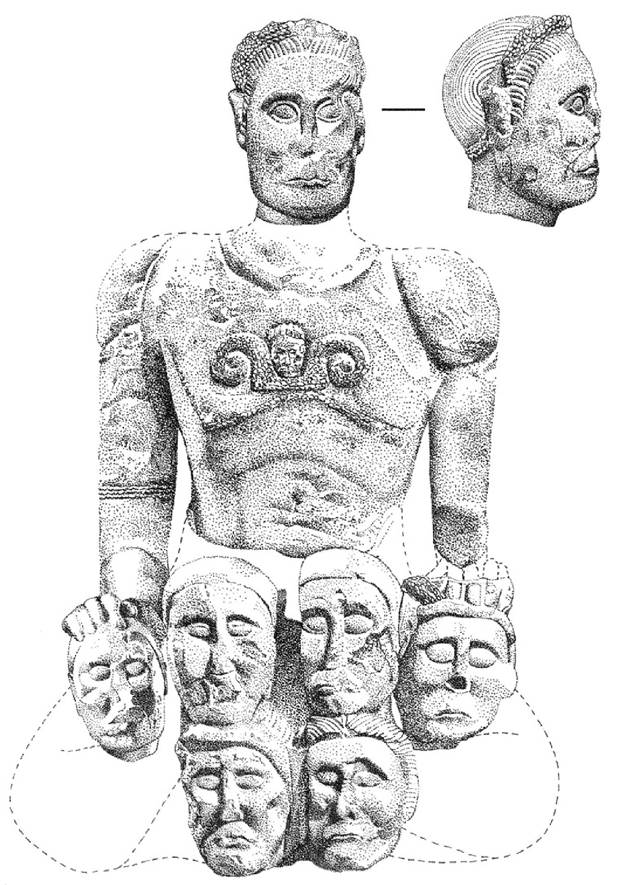
Figure 21.i Reconstruction of one of the third-century bce warrior statues from Entremont, Provence.
The figure is a composite assembled from numerous fragments.decapitated within the Sculptor's Cave, in north-eastern Scotland, a site which had been used as a place for excarnation of the dead during the Late Bronze Age.[917]
Conclusion
Archaeological evidence suggests that ritualised violence was core to Iron Age cosmologies. Violence against individuals was instrumental in securing benefits for the group, whether that be through the taking and curating of heads from enemy communities, or the scapegoating of marginal individuals who might be killed and staked down in peat bogs, buried under hill fort ramparts or in house foundations. Violence involving larger corporate groups was also endemic and had direct social, economic and political impacts for Iron Age societies across the Continent.
The celebration and commemoration of violence is a major feature of Iron Age archaeology, whether it be in the elaboration beyond functional necessity of hill fort defences, or the transformation of sword scabbards and shields into entrancing artworks. As in many non-state societies, the capacity to defend one's community, and potentially to attack others, was highly valued and became a core component of individual and group identities. In the absence of overarching authorities, competition over land and resources would have led inevitably to inter-communal conflict and cycles of tit-for- tat violence. In such societies it becomes important to engage in displays of strength, both to deter potential enemies and to cement intra-group feelings of security and autonomy. The embellishment of personal weaponry in particular hints at what can be called ‘cultures of honour', ‘where the ability to deal out violence in response to perceived slights, or in defence of one's economic interests, was essential to success in societies lacking any wider institutions capable of regulating conflict'.[918]
A further persistent and pervasive theme in the archaeology of Iron Age violence is the desire to prevent certain individuals from undergoing normative funerary rites, whether by removing their heads from their bodies, or by placing their bodies in the suspended animation of the peat bog.
Since funerary rituals are essentially a means of enabling the souls of the dead to traverse to the next world, however that might be conceived, the deliberate interruption of these rites appears to reflect a strategy to trap souls in limbo.[919] These practices are reflected in the locations that so often form the focus for these violent acts. Peat bogs lie at the boundaries between the inhabited lands of the living and the wild world of the supernatural; caves form a physical link between the human world above and the underworld of spirits, gods and ancestors. Many settlement deposits, though less transparently liminal in character, are similarly placed at boundaries, where the domestic meets the outside world.Strategies of dehumanisation and objectification of the victim appear also frequently to have been employed to make the process of killing more palatable. This is most obvious with bog bodies, where victims could be stripped naked, have their heads shaved and be subjected to protracted torture before their eventual killing, often by multiple individuals. Through such violent performances groups could achieve catharsis, reassert their moral rectitude within their own cosmological understanding of the world and reinforce group solidarity through common action against marginal individuals.
More on the topic Headhunting:
- Ritual Violence and Headhunting in Iron Age Europe
- Bibliographic Essay
- Building organizational commitment of generation Y at workplace: A theoretical perspective
- Boon Andrew. The Ethics and Conduct of Lawyers in England and Wales. Hart Publishing,1999. — 808 p., 1999
- Griffiths-Baker Janine. Serving Two Masters: Conflicts of Interest in the Modern Law Firm. Hart Publishing,2002. — 227 p., 2002
- Grisso T.. Evaluating Competencies: Forensic Assessments and Instruments. 2nd edition. — Springer,2002. — 564 p., 2002
- Luban David. Legal Ethics and Human Dignity. Cambridge University Press,2007. — 350 p., 2007
- Ayupova Z.K.. Theory of state and law: textbook. - Almaty: Kazakh University,2015. - 192 pages., 2015
- Allen Danielle, Benkler Yochai et al. (eds.). A Political Economy of Justice. The University of Chicago Press,2022. — 416 p., 2022
- Barnes Rudolph C.. Military Legitimacy: Might and Right in the New Millennium.Frank Cass,1996. — 198 p., 1996
- Bedner Adriaan (ed.).. Real Legal Certainty and its Relevance: Essays in Honor of Jan Michiel Otto. Leiden University Press,2018. — 261 p., 2018
- Fridson M., Alvarez F.. Financial Statement Analysis. John Wiley & Sons, Inc.,2002. — 413 p, 2002
- Banking, Finance, and Accounting: Concepts, Methodologies, Tools, and Applications. IGI Global,2014. — 1593 p., 2014
- Hare C., Neo D. (eds.). Trade Finance: Technology, Innovation and Documentary Credit. Oxford University Press,2021. — 417 p., 2021
- Fligstein Neil. The Banks Did It: An Anatomy of the Financial Crisis. Harvard University Press,2021. — 334 p., 2021
- Cline W.. The Right Balance for Banks. Peterson Institute for International Economics,2017. — 281 p., 2017
- Alsharari Nizar Mohammad (ed.). Banking and Accounting Issues. ITexLi,2022. — 175 p., 2022
- AAP. Guidelines for Air and Ground Transport of Neonatal and Pediatric Patients. 4th edition. — American Academy of Pediatrics,2015. — 488 p., 2015
- Ancha S., Auberle C., Cash D., Harsh M., Hickman J., Kounga C.. The Washington Manual of Medical Therapeutics, 37th edition, LWW, 2022. —1250p., 1250
- Alexander M.A., Matthews D.J.. Pediatric Rehabilitation: Principles and Practice. 4 th. еd. — New York: Demos Medical Publishing,2010. — 540 р., 2010