Imperial Pageantry in Ottoman Kostantiniyye
Even after the city’s sacking and occupation by the Crusaders (1204-1261) and its conquest by the Ottomans (1453), the hippodrome and its remaining monuments continued to exert symbolic power as the principal arena for publicly displaying the imperial authority of the sultan in his new capital Kostantiniyye.
The ceremonial life of the Ottoman city featured a set cycle of imperial processions for Friday prayers and religious holidays, movable celebrations associated with victories, and the more occasional weddings and circumcision festivals. The latter two were arguably the most lavish, and the hippodrome (At Meydani or “Horse Square”) served as their primary venue. On the occasion of circumcision festivals, the imperial entourage, consisting of the sultan, his sons, and representatives of his janissary and military corps, processed from the Topkapi Palace to the hippodrome, where, according to contemporary accounts, silence and order prevailed until the sultan arrived. His appearance then transformed the mood to festive as he was acclaimed by the troops and hailed with music.[488] As noted at the beginning of the chapter, the Ottomans adopted a policy of imperial seclusion that limited the sultan's physical participation in the public life of the city. This restricted access, in turn, served to heighten his physical presence at those select public celebrations in the hippodrome, where the festivities were carefully choreographed to proclaim his supremacy and, by extension, that of the Ottoman Empire.[489]The rich textual and visual evidence for circumcision festivals focuses less on the prince and the circumcision itself, which took place in the privacy of the Topkapi palace, than on the public celebrations prompted by the rite of passage. The circumcisions themselves, in other words, were mere pretexts for the lavish displays that ultimately showcased the sultan's largesse.[490] With over 50 days of receptions, banquets, processions, and performances, the 1582 circumcision festival of Murad Ill's son Mehmed was unparalleled in terms of expense and impact.
No one could mistake this festival for a mere family affair. Its significance was political and its intended message was global in scope: the festival showcased to a decidedly international audience the supremacy of the Ottoman Empire—the diversity of its people and its products, and the sophistication of its military and technological expertise.In terms of its people, the empire's multi-confessional constituency was fully integrated into the festivities. On the third day of the festival, religious leaders processed to the sultan to pay their respects. First, Muslim dignitaries holding the Qur'an and pilgrims who had been to Mecca bestowed blessings upon the sultan and his son, then came Christian representatives of the Greek and Armenian communities, namely the patriarch of Constantinople and Antioch, respectively, who soberly offered gold and silver vases as gifts.[491] Later in the festivities, there was a grand processional masquerade of Jews, many refugees from Spain after 1492, and later still, Greek performers from Pera enacted an elaborate wedding procession.[492] The diverse ethnic makeup of the performers more generally is a consistent trope in the descriptions of the festivities.[493]
The material diversity of Ottoman dominion was expressed in clear ceremonial terms by the procession of more than 150 guild representatives, each showcasing abundant furs, textiles, spices, and more so as to make clear the impressively vast
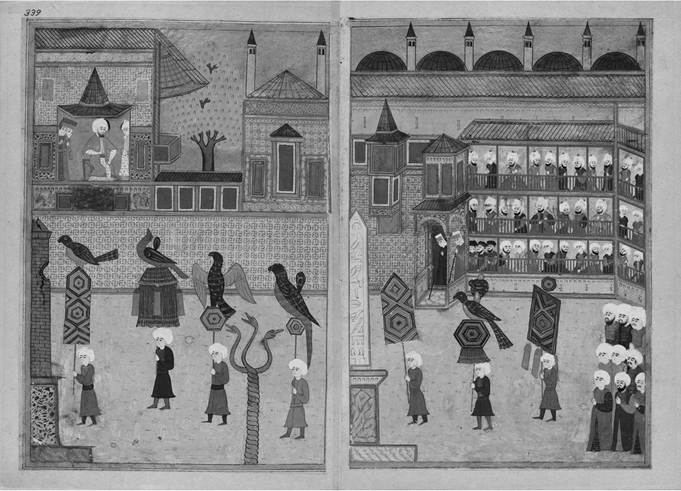
Figure 6.15. Pe§tamal-makers at the 1582 Circumcision Festival, Ottoman Imperial Festival Book, Surname-i humayun, Topkapi Sarayi Muzesi library H 1344 (338b-339a). Photo: Topkapi Sarayi Muzesi.
market controlled by the sultan. Unlike traditional European guild pageantry, in which skills and crafts competed with each other but were unified in a larger allegorical or religious purpose, Ottoman guild pageantry was designed to please the sultan and his guests by boasting the expertise of the imperial capital across all strata of society.[494] The illustrated manuscript commemorating the 1582 circumcision ceremony known as the Surname-i humayun in the Topkapi museum clarifies the entertainment value of this guild parade.
[495] In the miniature of the textile merchants or Pe§tamal workers (that is, those who made the textiles for the hamman), for example, we see the procession of cloths hung on poles both as flags and also in the form of oversized magnificent birds, which by means of mechanical devices on their interior, we are told, could flap their wings to the delight and awe of the audience (Figure 6.15). The procession of the sugar makers too exhibited the wealth of the empire's sumptuous products with impressive artistry. In the corresponding Surname-i humayun illustration, a variety of sculptural confections are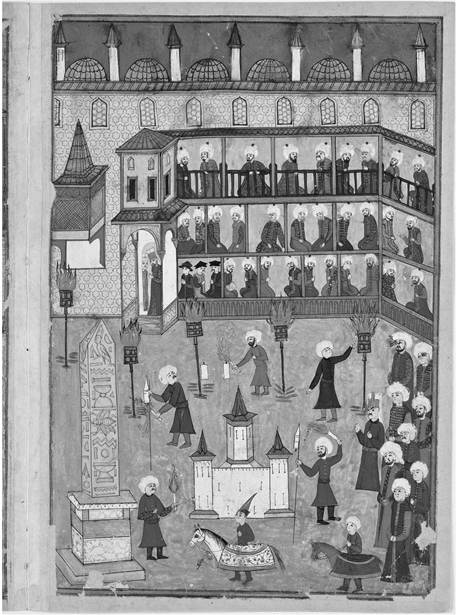
Figure 6.16. Night spectacles of the 1582 Circumcision Festival (launching of fireworks and mock battle), Ottoman Imperial Festival Book, Surname-i humayun, Topkapi Sarayi Muzesi library H 1344 (28b).
Photo: Topkapi Sarayi Muzesi.
carried through the hippodrome: life size geese, an immense elephant, and mythological figures such as the harpy and the phoenix-like simurg.[496]
Beyond the processions themselves, the list of festivities that similarly extolled imperial supremacy through ceremonial means is virtually inexhaustible. Elaborate feasts for both esteemed guests and ordinary people showcased the sultan’s hospitality and command of seemingly infinite resources. Sweet deserts were served in abundance, even as the price of sugar was 20 times more than that of meat.[497] A menagerie of confectionary animals was paraded at a banquet as the night sky was lit by elaborate fireworks displays (Figure 6.16). Especially impressive for their beauty, fireworks also showcased the military technology that earned the Ottomans prominence in the age of gunpowder empires.[498] In addition to displays of “real” military and athletic prowess in the form of wrestling matches, archery contests, equestrian performances, and others, mock battles added a theatrical evocation of empire.
On a stage in the hippodrome, Ottoman forces won spectacular mock battles over Persians, Hungarians, Germans, French, and other Christian infidels. A series of miniatures in the Topkapi surname elaborate these tournaments: using artillery fire, Ottoman forces storm Christian castles, then replace the battle standards, and even display severed heads of the vanquished.[499] The fiction of these war games was thin, as some of the “performances” re-enacted were relatively recent, real Ottoman victories. Overall, the lavish scale and ambitious scope of the 1582 celebration and its not-so-subtle subtext of dominion must be understood as a clear demonstration of Ottoman power bolstered by a posture of intimidation.[500]All of these events were staged directly before the sultan, who watched from an imperial kiosk above. His elevated exclusive space and privileged vantage point was analogous to the kathisma of the former Byzantine emperor. The sultan's imperial box, despite being situated across the hippodrome from the former kathisma (rather than in its place), can be seen as an appropriation of Byzantine imperial precedent.[501] Both Ottoman and Byzantine boxes were understood as extensions of their respective palaces and sites for the spectacular framing of imperial presence. Of the vast literature on Ottoman-Byzantine cultural connections, Gülru Necipoglu has offered key insights into the Ottoman cultural negotiation of the Byzantine past in tandem with the European and Islamic present.[502] For the purposes of this chapter, however, a more local framework is in order: the space of the hippodrome. Throughout the pages of the Topkapi Surname-i hümayun the 1582 festivities are anchored by the hippodrome's monuments.[503] The games, banquets, receptions, and processions, that is to say, are all pictured among the three monuments of the Byzantine hippodrome—the masonry obelisk, the serpent column, and the Egyptian obelisk on its Theodosian base.
The foreground of virtually every miniature of the manuscript includes reference to at least one of these monuments, which serve to localize the activity.The pre-Ottoman monuments were woven into the Ottoman festivities of the hippodrome seamlessly. The celebrations of the 1530 circumcision festival featured an acrobat walking across a rope tied between two of the hippodrome's ancient columns.[504] The illustrated history commemorating that earlier festival depicts
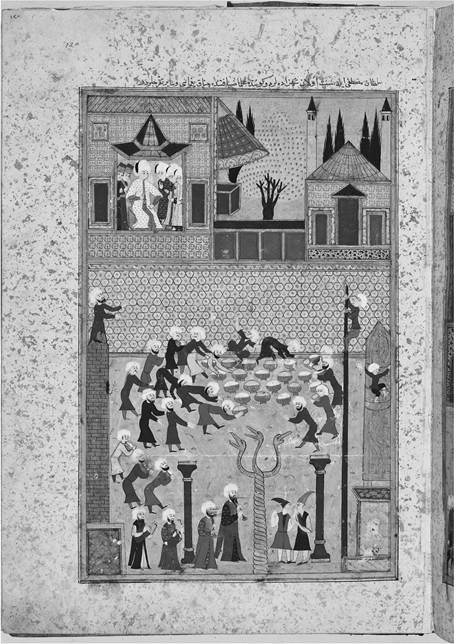
Figure 6.17. Circumcision Festival of 1530 (scramble and acrobats), Hunername II, Topkapi Sarayi Muzesi library H 1524.
Photo: Topkapi Sarayi Muzesi
a figure scaling the Egyptian monolith (Figure 6.17).[505] Diagonally in the upper left corner of the page, the sultan, enclosed within his imperial box, is shown surveying this feat. Climbing the tallest monuments of the hippodrome was an especially daring challenge for which acrobats were rewarded by the sultan; at least one such attempt, during the 1582 festival, resulted in death.[506]
Curiously, the depictions of hippodrome’s monuments in Ottoman miniatures consistently reproduce the hieroglyphs of the Egyptian obelisk itself, while leaving the pictorial program of its Byzantine base entirely blank. Some have explained this discrepancy as an Ottoman representational preference for schematization over the relative naturalism and modeling of the reliefs.[507] But the omission of the Byzantine imagery may also signal a more ideologically charged message: the city’s ceremonial nexus was no longer the Byzantine hippodrome but the Ottoman At Meydani, an important component of which was the past embodied by the monuments of previous emperors; but they were just that—the past. And this point raises a critical distinction between the pageantry performed there and its permanent visual commemoration. The elaborately painted Ottoman miniatures stand as the permanent commemorative component of the lavish but fleeting imperial festivities. By preserving the hieroglyphs but omitting the visual effigies, the miniatures' designers were not privileging Egyptian over Byzantine history, but choosing how to most effectively commemorate current authority in permanent pictorial terms. In the real ceremonial space of the hippodrome, there was no ambiguity surrounding imperial authority: with every aspect of the festivities underscoring the sultan's authority, the lithic emperor of the past was no competition for the living authority ensconced in his imperial kiosk surveying the action. Moving into the realm of representation, however, there was only room for one imperial effigy, the sultan who constituted the cause and source of the ceremonial program.