Indigenous peoples of the Coral Sea
Europeans ‘discovered’ the Pacific Islands slowly between the fifteenth and twentieth centuries, finding them inhabited by a mix of maritime and agricultural peoples speaking more than a thousand languages.
Two fairly distinct indigenous peoples live round the Coral Sea. In Australia the Aborigines are an ancient people who migrated out of Asia in several waves beginning upwards of 50,000 years ago. Before British settlement, Aborigines formed quite a dense coastal population, largest in the north. Hunters and gatherers, not agriculturalists, they fully utilised the resources of the land and coast. Within Queensland’s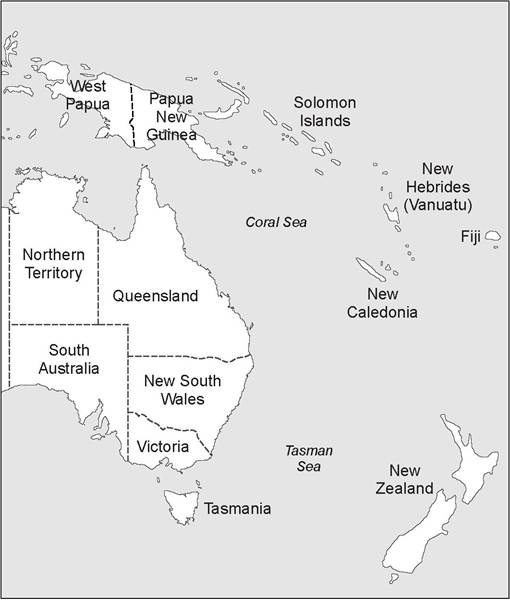
Map 10.1 The Coral Sea and its surrounding nations.
northern border dwelt the people of Torres Strait with a shared heritage between the mainland and New Guinea, the second largest land mass bordering the Coral Sea. The time depth of settlement in New Guinea and island Melanesia varied; some New Guineans are descended from the same migrations as populated Aboriginal Australia while others arrived from Asia as recently as 3,000 to 4,000 years ago. The agricultural Highlanders of New Guinea lived in huge high valleys isolated from the coastal peoples, who had more in common with those of island Melanesia.1
Before colonial partition, one million Aborigines lived in Australia and three million people lived in New Guinea and island Melanesia. None of these indigenous societies had hierarchical leadership of a type that Europeans could easily recognise; they consisted of hundreds of small-scale social groups based loosely around languages. European scientists seeking to classify racial order placed the peoples of Australia, New Guinea and island Melanesia as the lowest of humans, based on skin colour and lack of hierarchy, which meant that chiefly leaders could not be identified or co-opted into colonial processes as in more hierarchical Polynesia. There was very limited use of technology familiar to Europeans. Today we realise that Aborigines possessed methods of shaping the land, that Highland New Guineans were some of the first agriculturalists in the world and that coastal and island people had sophisticated navigation systems. The same qualities which made them successful over thousands of years also made them easy prey for imperial expansion.
More on the topic Indigenous peoples of the Coral Sea:
- The British in the Coral Sea: Fiji
- The Australian colonies and the Coral Sea
- This chapter examines from a comparative perspective the experience of European empire by indigenous peoples of the Atlantic and Pacific Ocean worlds.
- Introduction
- Aldrich Robert, McKenzie Kirsten (eds.). The Routledge History of Western Empires. Routledge,2014. — 542 p., 2014
- RELATIONS AMONG INDIGENOUS SOCIETIES22
- Ancient Peoples of West Africa
- IMPACTS ON COLONIZED PEOPLES AND TERRITORIES
- TYPES OF COLONIES