Introduction
For all of its undoubted significance, the Kushan Empire remains one of the least known of all the ancient Afro-Eurasian empires. Between ca. 50 and ca. 250 ce the Kushans dominated the political, cultural, and economic landscape of a vast region of Inner Eurasia, including extensive parts of modern Tajikistan, Uzbekistan, Turkmenistan, and Xinjiang in China; the whole of Afghanistan and Pakistan; and much of northern and central India.
Along with their direct political and military control of this enormous realm, the veritable “crossroads of Eurasia,” the Kushans also exerted significant cultural and economic influence upon much wider regions and other peoples, including the Saka, Xiongnu, Sogdians, Han Chinese, Parthians, Sasanians, Guptas, and indirectly the Greco-Romans.Because they were able to maintain relatively cordial relations with neighboring states, and also with the various steppe nomadic confederations that were active in the region, the Kushans played a crucial role in facilitating the extraordinary levels of cross-cultural exchange that characterize what I will call the first Silk Roads Era (ca. 50 BCE-ca. 230 ce),1 the period when most ofthe cultures, states and empires of Afro-Eurasia were, for the first time, connected together into a single system of exchanges. For two centuries the Kushans were one of the key powers of their era during a period in which much of Afro-Eurasia was controlled by just four dynasties: those of the Han, the Romans, the Parthians, and the Kushans. So crucial were they to this dynamic and interconnected period in world history that the First Silk Roads Era could justifiably be renamed the “Kushan Era.”
Yet the Kushans remain the most mysterious of all the major empires because, despite their undoubted significance, evidence for their history is sparse and inconclusive. The biggest problem is that, like the Sasanians and a handful of other Inner Eurasian empires, the Kushans produced no body of literature.
Given the pastoral nomadic origins of their ancestors this is understandable, but the fact that written Kushan evidence is limited to coin legends and a small number of inscriptions, some complete, most fragmentary, is a serious hindrance to historians. But undoubtedly the inscriptions (notably from Surkh Kotal and Rabatak, see later discussion in this chapter) have been crucial to our understanding of Kushan history.Fortunately, despite this lack of significant Kushan written material, the Kushans were well known to a wide range of contiguous societies whose literature does contain references to both the Yuezhi (the tribal confederation from which the Kushans
1 Benjamin 2018.
Craig Benjamin, The Kushan Empire In: The Oxford World History of Empire. Edited by: Peter Fibiger Bang, C.A. Bayly,
Walter Scheidel, Oxford University Press (2021). © Oxford University Press. DOI: 10.1093/oso/9780197532768.003.0011.
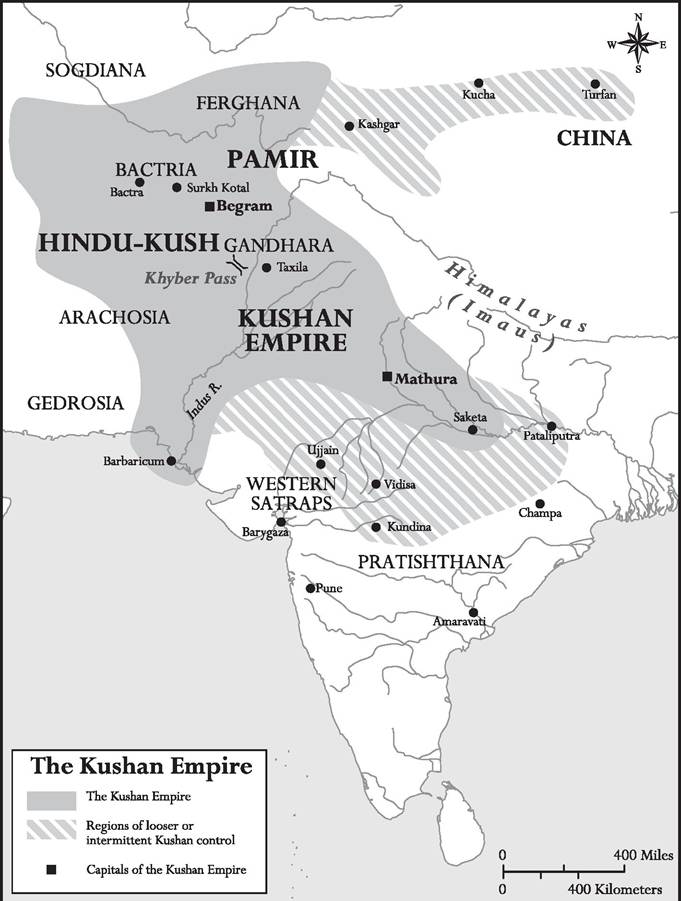
Map 11.1. Kushan Empire in the Second Century ce. Copyright: Oxford University Press.
were descended) and to the Kushans themselves. The Yuezhi and Kushans are frequently mentioned in Chinese historical annals, for example, notably the Hanshu, Shiji, and Hou Hanshu; also in Indian, Tibetan, Persian, Manichaean, and Sogdian sacred and administrative texts; in several Greco-Roman sources; and in a handful of Arabic geo-histories written after the conquest of Central Asia by the Arabs. These external and often incidental references have been crucial to the reconstruction of the history and legacy of the Kushan Empire.
An additional problem is that few examples of Kushan monumental architecture have survived the past two millennia, although numerous later Chinese sources attest to Kushan construction of palaces, Buddhist stupas, monasteries, and dynastic sanctuaries. Fifth-century Chinese Buddhist pilgrim Faxien, for example, in his account of his journey through former Kushan territory, offers “eyewitness” testimony that the Kushan monarch Kanishka (r.
ca. 127-153 ce[931]) hadraised a stupa... more than forty chang (400 feet) high and adorned with all precious metals. Of all the stupas and temples ever seen (by Faxien and his companions) there was none that could be compared with this one for beauty and majesty. It is said that of all the stupas in Jambudvipa, this is the highest one.[932]
If the Chinese sources are to be believed (many are blatantly propagandistic), the stupa was apparently still standing 200 years later when the great Tang Dynasty pilgrim Xuanzang passed through the same region:
At the side of the Pippala tree there is also a stupa built by king Kanishka. Its height is 400 feet; its base measures one li and a half in circumference and is 150 feet high. On top of it he has erected (a shaft with) twenty-five discs of gilded copper one above another, and inside the stupa there is one hu (measure) of relics of the Tathagata.[933]
Fourteen hundred years later, Soviet, Central Asian, British, and French archaeologists began to search scientifically for remnants of the sort of Kushan structures that Faxien, Xuanzang, and other travelers had described. Between the 1930s and 1960s, archaeologists did indeed uncover striking evidence of substantial Central Asia urban, cultural, and irrigational development that occurred during the Kushan Era. Explorations began with an expedition sponsored by the Moscow Museum of Oriental Cultures in 1926-1928 to the area around Termez on the Amu Darya, which uncovered Buddhist monuments in the region dated to the Kushan Era. M. Y. Masson's 1933 excavation of the ancient town site of Ayrtam (east of Termez) yielded Kushan stone reliefs, pottery, and a coin of Kanishka. Expeditions in the late 1930s surveyed tepes and ancient monuments in the area around Bukhara and Samarkand, and also in the region of ancient Khorezm, which led to the unearthing of more Kushan period sites. These pioneering pre-war efforts resulted in the discovery of numerous settlements, mounds, burial sites, and artifacts, and perhaps more importantly helped determine the place of the Kushans in the complex history of the region.
Immediately following the end of the “Great Patriotic War,” three Soviet groups began to work systematically in different regions of the former Kushan realm. S. P. Tolstov undertook a systematic five-year excavation of Toprak-Kala in Khorezm (1945-1950); A. I. Terenozhkin spent five years excavating the vast town site of Afrasiab (ancient Samarkand), revealing the extent of Sogdian wealth and Silk Roads trade during the period (1945-1949); and an investigation of the town site of Varaksha in the Bukharan oasis revealed evidence of that town's long history, including its apparent founding during the Kushan Era. Throughout the 1940s and 1950s, further excavations conducted by B. A. Litvinsky, Y. A Davidovich, E. Gulyamova, and T. I and Y. V. Zeymal were carried out in the southern regions of Tajikistan, Uzbekistan, and Turkmenistan. Collectively these expeditions discovered remains of Kushan monumental structures (including stone column bases), coins, artifacts, and traces of ancient irrigation systems. A 1948 exploration of sites in the Surkhan Darya valley headed by L. I. Albaum discovered early evidence of Yuezhi/ Kushan fortresses in the valley, along with pottery, terracotta figures, Kushan coins, and a Roman coin of Emperor Nero.
One of the most important investigations in terms of the light it has shed on Yuezhi/Early Kushan history was that led by G. A. Pugachenkova between 1959 and 1963, also in the Surkhan Darya Valley. Pugachenkova discovered the remains of what she believed was a Yuezhi dynastic sanctuary (complete with superb wall frescoes and terracotta figures) at Khalchayan; and also a Kushan Buddhist temple at Dalverzin Tepe that yielded clay sculptures of the Buddha and what appear to be local elites. The Khalchayan sanctuary depicts what might be interpreted as the decisive battle between a group of resident Saka (Scythians) and the invading Yuezhi military to gain control of the valley, and indeed of the entire Greco-Bactrian kingdom to the south.
While Pugachenkova was busy at Khalchayan, B. Y. Stavisky spent much of the 1960s investigating the site of Kara-Tepe in Old Termez, where he uncovered a number of temples, stone reliefs, Buddhist objects, Kushan coins, and inscriptions using the Kushan “Bactrian” script, which used the Greek alphabet to convey the language of the Kushans (see further discussion later in the chapter).[934]Further south in Afghanistan, meanwhile, at the site of Surkh Kotal, 18 kilometers north of the city of Pul-i Khumri, Daniel Schlumberger and the Delegation Archeologique Fran^aise en Afghanistan excavated a major Kushan dynastic sanctuary between 1952 and 1966. The French team uncovered monumental constructions, including Zoroastrian fire temples, statues of Kushan rulers (including an impressive statue of Kanishka), and a 25-line inscription using the same Bactrian script discovered at Kara-Tepe. The most impressive artifacts were transferred to the National Museum of Afghanistan, where many, including the iconic statue of Kanishka, were destroyed by the Taliban in early 2001. French conservationists have since restored the statue.
Elsewhere in Afghanistan, and further south again in Pakistan, French and British teams excavated what seem to be Kushan royal palaces at Taxila (near Islamabad) and at Kapisa (Begram). Beginning in 1913, British archaeologist Sir John Marshall conducted excavations over a period of 20 years at Taxila. As he slowly uncovered the huge site, Marshall (and his successor Sir Mortimer Wheeler) was able to identify the remains of three distinct cities, each belonging to a different time period. The oldest, Hathial, dates from the late second millennium bce, with the Bhir Mound representing the remains of a sixth-century bce city. The second, Sirkap, was built by Greco-Bactrian kings in the third century bce; and the third city, known as Sirsukh, was constructed by the Kushans as one of their royal palaces.
French archaeologists began excavating the site at Kapisa near Begram in central Afghanistan in the late 1930s, and identified the remains as another palace of the Kushan kings.
In a storage room within the complex they discovered a cache of magnificent luxury goods that were at first interpreted as comprising part of some Kushan royal “art museum,” but are now understood to be a cache of luxury tradegoods that were being shipped along the Silk Roads during the Kushan Era. Among the discoveries in this high-end “warehouse” were Roman bronze sculptures, Han Chinese lacquer boxes, superbly painted Egyptian glass vessels depicting scenes such as the lighthouse at Alexandria and an African leopard hunt, and more than a thousand pieces of Indian carved ivory and bone sculptures of placidly smiling women and mythical river creatures.The output of major Kushan-sponsored art workshops in Mathura in northern India, and Gandhara in northern Pakistan (including Buddhist and secular art from both centers, including another dynastic portrait gallery at Mathura), and the spread of the distinctive sculpture produced in the two regions along the Silk Roads, has constituted another significant type of material evidence, as will be explored further in the following.
As important as these archaeological discoveries have been, however, by far the most substantial evidence for the Kushans is numismatic. Kushan coins have been discovered in their thousands throughout the great extent of their territory, and their interpretation over more than a century by numismatists like Alexander Cunningham, James Princeps, Robert Gobl, Osmund Bopearachchi, David MacDowell, and Joe Cribb, to name but a few, has been absolutely fundamental to our understanding of the Kushans. Kushan coins provide evidence of early cultural influences on the empire; of Kushan military and political expansion; the genealogy of royal succession; religious and ideological beliefs; their economic domination of the region; and of the eventual dissolution of the Kushan Empire in the third century ce at the hands of the Sasanians. Much of the account that follows here is utterly dependent on numismatic evidence, supplemented where possible by references to the Yuezhi and Kushans in contemporary and later literature, by Kushan inscriptions using the Bactrian language, and by material evidence gleaned from archaeology and art history. This often frustratingly inconclusive evidence is nonetheless sufficient for a reconstruction of the history of the Kushan Empire, which is unfolded here in four distinct periods; the migration of the Yuezhi to Bactria, the Early Kushans, the Great Kushans, and the Late Kushans.