Introduction
The academic discovery of various “empires” in medieval West Africa played an important role in the emergence of the discipline of African Studies as a “scientifically” valid field of inquiry.
Racist attitudes about the purported “primitiveness” and “ahistoricity” of Africa, once described by Hegel as “the land of childhood,”1 could be refuted by the fact of such apparently large and sophisticated empires as Kanem- Bornu, Meroe, Ancient Ghana, Ancient Mali, and Songhay. The Muslim scholarship that developed in the town of Timbuktu, we are told, rivaled or surpassed the great medieval Middle Eastern and European universities.2 But such redemptive uses of “empire” in the writing of African history have tended to obscure the nature of large-scale polities in Africa, putting them always in implied comparison with empires elsewhere.Nonetheless, the Songhay Empire would appear to be one of the most “imperial” of all large-scale polities in Sub-Saharan African history. It was spatially extensive, territorially defined in relation to neighboring states, and may have possessed a linguistic coherence unusual in Sub-Saharan Africa. The Songhay Empire properly describes a state which dominated the Niger Bend region of West Africa from 1464 to 1591. The “imperial” phase of this state began with the reign of Sunni Ali Ber (r. 1464-1492), and ended when a successful Moroccan military expedition crossed the Sahara from the north and destroyed the state 127 years later. Although relatively short lived, the Songhay Empire marked some important historical changes in West Africa in terms of state formation, incorporation of Islam as a core state ideology, and international relations.
The history of the Songhay Empire is relatively well-known for a pre-colonial African state, largely because it became the subject of a new genre of writing in SubSaharan Africa in the seventeenth century, the historical chronicle.
Of the two main chronicles that historians have relied on, only the Ta’rikh al-Sudan is an authentic seventeenth-century text,3 but even this provides a very rich and detailed view on1 Hegel 1956, 91. Cited by Kuykendall 1993, 572.
2 Mazrui 2005, 71-72.
3 Nobili 2020, and Nobili and Mathee 2015, have shown that the other chronicle, called the Ta’rikh al- Fattash, was in fact authored in the nineteenth century, not the seventeenth century as it claims. The English translation of the Ta’rikh al-Sudan is published by Hunwick 1999.
Bruce S. Hall, The Mali and Songhay Empires In: The Oxford World History of Empire. Edited by: Peter Fibiger Bang, C.A. Bayly, Walter Scheidel, Oxford University Press (2021). © Oxford University Press. DOI: 10.1093/oso/9780197532768.003.0023.
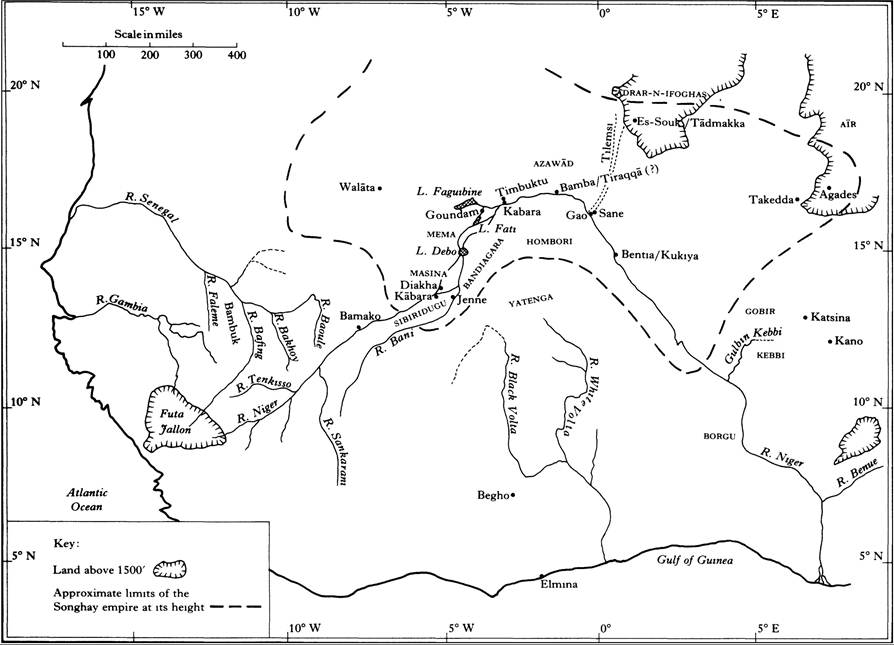
Map 23.1. The Middle Niger.
Source: Hunwick, 1985. Shari'a in Songhay: The Replies of al-Maghili to the Questions of Askia al-Hajj Muhammad, p. 2. Copyright: Oxford University Press.
THE MALI AND SONGHAY EMPIRES 649
the history of the empire. As P. F de Moraes Farias has argued, the chronicle genre was a highly original form of writing in West Africa:
The chroniclers introduced synthetic historical narrative to Timbuktu literature.
They did so for a topical purpose. Their histories gaze on the past from a new and holistic point of view required by a novel type of political project. This project could not have emerged in earlier centuries, and became pointless in the century that followed. One central feature of the project was the representation of the [Songhay] state as a continuous thread running across three successive dynasties, and as a legacy of authority inherited by the “puppet” Askyia rulers reinstated after the Moroccan invasion of 1000AH/1591AD.[1662]
The detail provided by the chronicles has led to a heavy reliance on these sources.
This in turn has resulted in a tendency by historians to approach the chronicles somewhat uncritically, despite its very clear political purposes of accommodation with the new Arma state which was set up by the Moroccan invaders after the defeat of the Songhay Empire, and which quickly became completely autonomous. The chronicles' insistence on a continuity with earlier “Songhay” state projects in the Niger Bend sometimes leads to a representation of the Songhay Empire as the natural expression of a longer, quasi-ethnic Songhay identity and history. This view is difficult to sustain given the limited scope of our knowledge beyond the chronicle itself, in archeology and historical linguistics for example.There is a richer set of written sources for the history of the Songhay Empire than just about anywhere else in Sub-Saharan Africa at the same time, except for certain coastal areas which came into sustained contact with Europeans. Some archeological work has been carried out in the eastern Niger Bend heartland of the empire, as well as in the Adrar-n-Ifoghas region to the northeast, through which much trans-Saharan trade passed.[1663] There are also a substantial number of epigraphic sources derived from stelae and tombstones which date from the eleventh to the fifteenth century; Moraes Farias has transcribed and translated 250 of these texts.[1664] Among the other written sources which make it possible to know much more about Songhay than other earlier empires in West Africa is a text which records a series of legal and political questions posed by the Songhay ruler Askia Muhammad Ture (d. 1529) in 1498 to a resident North African Islamic scholar named ‘Abd al- Karim al-Maghili (d. 1505), together with this scholar's detailed answers. This is the earliest extant jurisprudential text written in West Africa, touching on questions of Islamic authority, kingship, booty, slavery, and the legitimacy of Islamically authorized holy war (jihad) in different West African contexts. It was well known and often referred to by subsequent generations of Muslim West African scholars.[1665]
The history and character of the Songhay Empire will be analyzed in five sections. The first section deals with the broader question of large state formation in SubSaharan African history. The second section focuses on the early history of political complexity and trade in the Eastern Niger Bend. Section Three is about the rise of the Songhay state in the era of Sunni Ali Ber. This is followed by a section on the Askia Dynasty and then a section on Songhay society, and a conclusion.
I—
More on the topic Introduction:
- 1 Introduction
- Introduction
- Introduction
- 19 Introduction
- Introduction
- Introduction
- INTRODUCTION
- Introduction
- Introduction
- Introduction
- Introduction
- Introduction: Hegel, Marx and the Dialectic