Introduction
Danzig, Free City of
(Polish: Gdansk) A historically and commercially important port city on the Baltic Sea. In 1919, the Paris peacemakers made Danzig politically independent as a ‘free city' under the League of Nations in order to give the new state of Poland free access to the sea.
However, the vast majority of the city's inhabitants were Germans. The return of Danzig to German sovereignty was thus a key issue for German nationalists between the wars. Hitler exploited the Danzig question as a pretext for his attack on Poland in 1939.see Map 8.1
Hitler’s war began on 1 September 1939. At 4.45 a.m., the old German cruiser Schleswig-Holstein shelled a small Polish army installation at Danzig known as the Westerplatte. At the same time, the bulk of the German army, well over fifty divisions, including five tank formations as well as eight other lightly armoured and motorized units, began to cross the Polish frontier. The campaign was brief. The Wehrmacht, with a superior war-fighting doctrine that stressed aggressive movement and encirclement, exploited its numerical advantages in numbers of men, tanks and aircraft to break through the Polish defences. On 17 September the Red Army joined in by occupying eastern Poland. Warsaw fell to the German army ten days later.
Over the next twenty-one months the war expanded, combining the conflicts of Europe and Asia. The principal driving force behind this step-by-step process of escalating violence was relentless Nazi aggression. Between September 1939 and December 1941, Hitler wilfully added to the number of Great Powers arrayed against the Third Reich, but despite stunning successes on the battlefield in the early years of the conflict, he and his generals could not bring the European war to a victorious conclusion. Part of the explanation for this failure lies in the fact that Hitler’s opponents resolved to fight on even after suffering the severest of military setbacks. This determination did not stem simply from a fear of
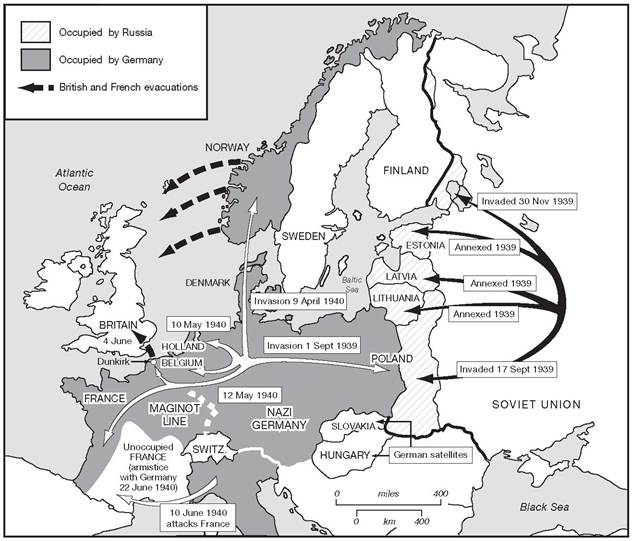
Map 8.1 German expansion in Europe, 1939-40
Source: After Nye (1993)
Germany's growing power, but more significantly from a widespread belief that Nazism, fascism and Japanese militarism stood for a new form of global barbarism that had to be stamped out before it was too late.
see Chapters 3 and 7
More on the topic Introduction:
- 1 Introduction
- Introduction
- Introduction
- 19 Introduction
- Introduction
- Introduction
- INTRODUCTION
- Introduction
- Introduction
- Introduction
- Introduction
- Introduction: Hegel, Marx and the Dialectic
- INTRODUCTION: OVERVIEW OF COMPLICATIONS ASSOCIATED WITH HIV THERAPY