On 1 January 1930, a new company was incorporated in London under the name of Palestine Potash Ltd (PPL).
The company had been given exclusive rights by the Colonial Office to extract mineral salts from the Dead Sea in Palestine for a period of fifty years. Over the next eighteen years, before British rule in Palestine was abruptly ended in 1948, PPL came to be viewed by British imperial enthusiasts as a valuable colonial asset.
Its principal products, potash and bromine, were vital components in the newly emerging fertiliser and motor fuel industries, which Britain had previously had to import from Germany and France.1 On a day-to-day basis PPL was run as a private company, managed by Moshe Novomeysky, a Zionist Jew from Siberia, but the British government retained the right to control the company’s exports in ‘times of emergency’.2 This was most vividly demonstrated during the Second World War when German and French supplies became unavailable, causing the Ministry of Supply in London to redirect PPL exports in line with imperial exigency. By 1944 the Dead Sea was providing the United Kingdom with over half of its potash and 75 per cent of its bromine, with similar levels recorded elsewhere in the British Empire.3This chapter examines the way in which this unique natural environment came to be viewed in Western colonial thought as an economic resource that could be put to the service of imperial economies. In particular, the chapter looks at the long-term origins of the Dead Sea development, viewing the PPL’s incorporation in 1930 as the culmination of a much older process by which the Dead Sea was gradually appropriated as a Western- owned, ‘colonial estate’.4 As a result, the bulk of the attention here falls on the nineteenth century. This was a period in which explorers, scientists and colonialists from all over Europe and North America visited the Dead Sea in increasing numbers, measuring its physical qualities and proposing schemes to render it commercially profitable.
These early investigations provided the essential platform upon which the development of the British Mandate period (1920-1948) could take place.Studying the Dead Sea development in its long-term context allows a fresh perspective on Western colonial involvement in the Middle East, as well as on the wider connections between science, religion and empire. First and foremost, the existence of a Dead Sea industry during the interwar years is almost totally absent from histories of British rule in Palestine. Studying the creation of this industry alerts us to Palestine’s significance in wider
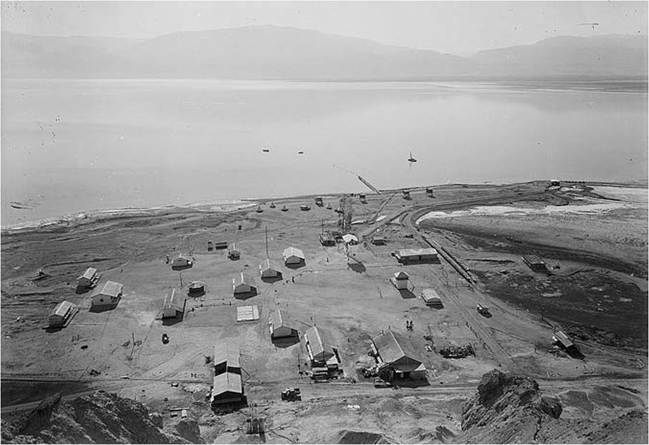
Figure 11.1 Palestine potash camp at Usdum, Dead Sea, between 1934 and 1937. Source: Matson Collection, Library of Congress, Washington D.C.
British colonial thinking. For too long, historians have described British rule in Palestine purely in terms of its importance to the emergence of the Arab—Zionist conflict. When its relevance to the bigger imperial picture is mentioned it is usually only in terms of its status as a ‘strategic buffer zone’.5 But Palestine, as with the Middle East more widely, was frequently viewed as a promising arena for colonial expansion in its own right. Looking at the excitement the Dead Sea generated among the British political classes in the nineteenth and early twentieth centuries helps redress this imbalance and highlight the imperialistic agenda that informed much of the debate on British rule in Palestine.
Equally importantly, the project to establish a Dead Sea industry compels us to consider Britain and France’s interwar rule over the Middle East as the product of a much longer- running colonial project. Historians of the mandate period are prone to separating the post-First World War period from that which preceded it. The switch from Ottoman to European rule, combined with the newly created mandates system administered by the League of Nations, has led scholars to treat this as an entirely new era of Middle Eastern history.
But, from a European colonial perspective, a great deal of continuity marks the transition from Ottoman to mandate government. In the nineteenth century, British and French companies enjoyed growing domination over the region’s import-export trade, they increasingly controlled public works concessions, and the consuls who represented them reached ever deeper into local political affairs.6 All of these activities were distinctly colonial in character and they form a crucial part of the historical backdrop if we are to properly understand the British and French mandates that followed the First World War. In this sense the Dead Sea project, underpinned as it was by various waves of Western exploration in the nineteenth century, proves a case in point. None of the development of the 1930s and 1940s would have been possible without what is described here as a ‘Western canon of expertise’ that had been accumulated over the previous century.Finally, the history of Dead Sea exploration also speaks to broader debates concerning the interaction between Western empires, scientific discovery and religious discourse. A great deal of recent historiography on empire has focussed on the attempts of European scientists to objectify nature and the ways in which this was put to use in the colonial world.7 The quest for empirical knowledge of the natural environment was a consistent feature of European expansion and was frequently employed as a means of justification in episodes of colonial subjugation.8 While historians of the Middle East have been slow to examine these dynamics, the Dead Sea serves as a useful case study. Implicit in all the research carried out there was the belief that only Westerners could contribute to the canon of expertise as it was only Westerners who were capable of a rational, detached measurement of the environment.
Scratch the surface of these accounts, however, and a more complex picture emerges. Often the most detailed knowledge of the Dead Sea was possessed by the communities who had for centuries been living and trading on its shores.
Rather than passive bystanders, these local actors also frequently expressed their interest in running a Dead Sea mining concession—a fact wilfully ignored by the British Colonial Office in the 1920s.9 Without having time to analyse these local ambitions, this chapter instead looks at the overlap between scientific and religious discourse among the Western explorers themselves, suggesting that binary models of European objectification versus indigenous subjectivity are inadequate when explaining the colonial appropriation of a natural resource such as the Dead Sea. As will be seen, the Dead Sea was rich in symbolic meaning for Western visitors. For Christians and Jews, the Book of Genesis describes how God ‘rained down burning sulphur’ on the cities of Sodom and Gomorrah as punishment for their immorality, thus creating the Dead Sea.10 In Europe, from the Middle Ages onwards this image of a corrupted and fallen wasteland translated into a view of the Dead Sea as a danger to any creature that approached it, with monsters lurking beneath its waters.11 While the explorers of the nineteenth century brought new empirical methodologies to the Dead Sea, they did not break from the older view of the Dead Sea as the product of biblical destruction. Virtually all of those who imagined its industrial transformation were enthralled by the prospect of ‘redeeming’ a natural environment whose very physical features were viewed as morally degenerate. As a result, it is a central contention of this chapter that, in the minds of those who worked at the Dead Sea, there was usually no tension between the empirical and the spiritual; rather they were constituent and complementary parts of their wider worldview.In order to describe this process in all its complexities, the chapter is divided into two sections that roughly cover the chronological scope of the ‘long nineteenth century’. The first section looks at the heightened interest in the Dead Sea that formed part of a wider Western re-engagement with the ‘Holy Land’ in the wake of Napoleon’s landing in Egypt in 1798. This part of the chapter examines some of the principal characters who initiated the Western canon of expertise, emphasising the continuities that ran through their work. The second section then looks at the ways in which, from around the mid-nineteenth century onwards, visitors to the Dead Sea increasingly speculated on the possibilities of acting upon this knowledge in order to render the lake commercially profitable, culminating in the British and Zionist planning that took place around the First World War. In this way, some of the connections between the exploration of the nineteenth century and the colonial development of the interwar years can become more apparent, contributing towards a more rounded picture of European colonialism in the Middle East.