Mediterranean Piracy
Piracy in the Mediterranean goes back deep into the mists of time. For the ancient Egyptians, Phoenicians and Greeks, seaborne raiders were either divine scourges or folk heroes, depending on which side you were on, but it was assumed that travelling at sea or living near the coast would eventually expose you and your loved ones to marauders.
The word ‘pirate' derives from the Greek word peirates, or ‘sea bandit'. Direct retaliation was only replaced by policing, albeit inconsistently, with the rise of the Roman Republic. By the first century bce, destroying ‘pirate nests' such as Cilicia in Anatolia became the preserve of generals such as Pompey the Great. Other locally rooted sea raiders were tolerated or co-opted in order to maintain a desired balance of power, usually with the hope of keeping other landed rivals on their heels. Throughout the ancient Mediterranean, pirates typically stole people and sold them into slavery if they could not be ransomed. This pattern of seaborne violence would persist throughout the region into the early nineteenth century.[712]With the decline of Rome it seems the Mediterranean reverted more or less to its old ‘lawless' ways, with no state strong enough to proclaim much less hold a monopoly on violence. Raiders of many sorts took advantage of this situation, including the Vikings, but most piratical raiding was local or endemic to a few rugged coasts and choke points. With the expansion of Islam in the seventh century, a new dynamic emerged. Religious differences between Christians and Muslims could be used as a new and compelling pretext for raiding, now as an extension of land-based crusade and jihad. The resulting emotions produced new levels of violence, although much of this battling remained on land, at least at first.[713]
Eventually, an economy of interfaith captive exchanges emerged, sparing many infidels a quick beheading.
It is true that luxury goods were always in demand as well, and these could always be disposed of in a sea of competing marketplaces, but Muslim-Christian raiding seems to have ratcheted up the long-traditional Mediterranean trade in captives, most of them ransomed for cash. Jihad or crusade-inspired acts of pillage thus led not to mutual annihilation but rather to mutual imprisonment or enslavement: the enemy was worth more alive than dead. By late medieval times a surprisingly intimate, symbiotic kidnapping/ransoming relationship thus emerged, complete with professional translators, go-betweens, scribes and eventually diplomats.[714]It was the fall of Constantinople in 1453 that marked the beginning of a new era in which seaborne violence filled the Mediterranean. Venetian and
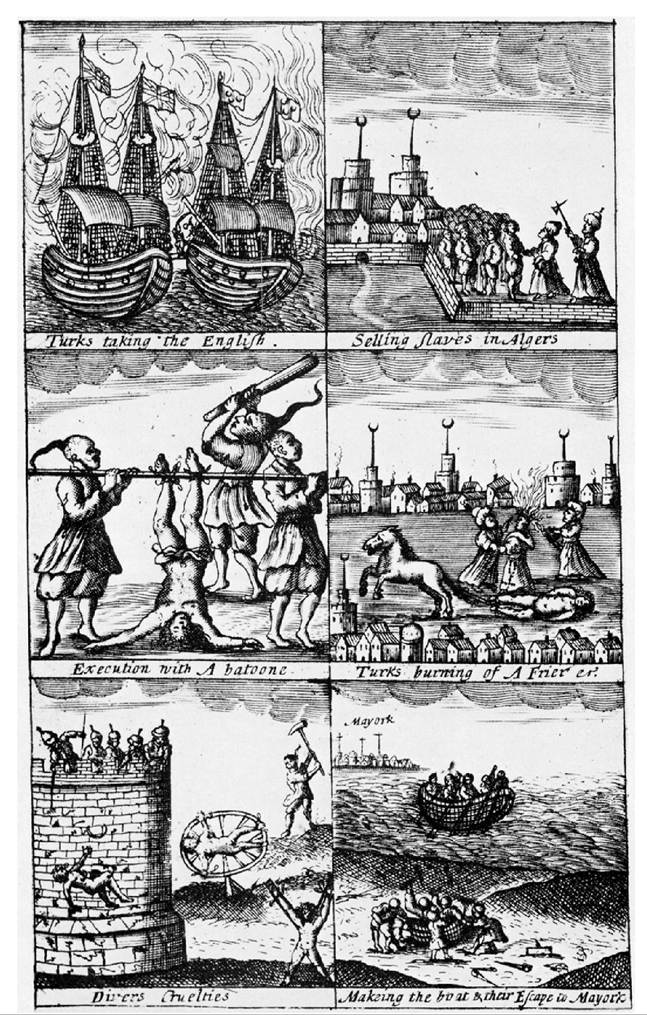
Figure 23.3 Dangers of Mediterranean seafaring, from William Okeley's Eben-Ezer, or a Small Monument of Great Mercy, 1675.
Genoese merchants had already learned to defend themselves against Muslim corsairs but they, too, engaged in captive-taking raids. The Knights of St John and St Stephen soon extended the crusade at sea under papal and imperial sponsorship. The competing Ottoman and Habsburg Empires, the first since the Romans to advance serious claims over waterways, both sponsored and disclaimed maritime attackers. Hostage-taking for ransom and slave trading continued to be the principal aims of both the so-called Barbary corsairs and their Christian counterparts in Malta and Livorno, but smaller ‘pirate cultures' such as the Uskoks of Senj (in Dalmatia) also persisted, in this case sapping the strength of once mighty Venice.[715]
By the mid seventeenth century a kind of equilibrium developed in which corsairs of all faiths and nationalities entered into long-term alliances or at least treaties and more formalised ransoming mechanisms. Extortion or payment of protection money became a typical means of dampening losses to corsairs and diminishing violence. Even so, the Mediterranean corsairs' victims - Christian, Muslim and Jewish - continued to face unprovoked attacks, followed by punishing conditions in jails and slave markets.
Despite much howling about the enslavement of ‘white' Christians at the hands of ‘Blackamoors' and ‘tawny Saracens', documents from the period suggest a more complex story in which Barbary corsairs were often renegade Europeans and captives included sub-Saharan Africans. The Barbary corsairs' deeds were partially offset by the Knights of St John, who raided for captives with similar abandon, taking Orthodox Greek merchants hostage simply because they were living under Ottoman rule. The Maltese capital of La Valetta in the sixteenth and seventeenth centuries was a pirate slave mart.[716]