Models of Piracy
Historians of piracy have long sought to make sense of this seemingly random species of violent crime. Writing in the 1920s, Philip Gosse described ‘pirate cycles' that seemed to swell and ebb in times of great political instability, as happened in the aftermath of wars.
As targets grew, so did pirate agglomerations, only to break apart again as shares diminished. More recently, political scientist J. L. Anderson identified three types of piracy: episodic, parasitic and intrinsic. Pirates of the first type matched well with Gosse's cyclical raiders, the second were more free-floating, and the third constituted veritable pirate cultures, ‘sea peoples' like the Caribs or Sulu Zone cultures whose livelihood depended on raiding nearby islands or plundering vessels passing close to their territory.[706]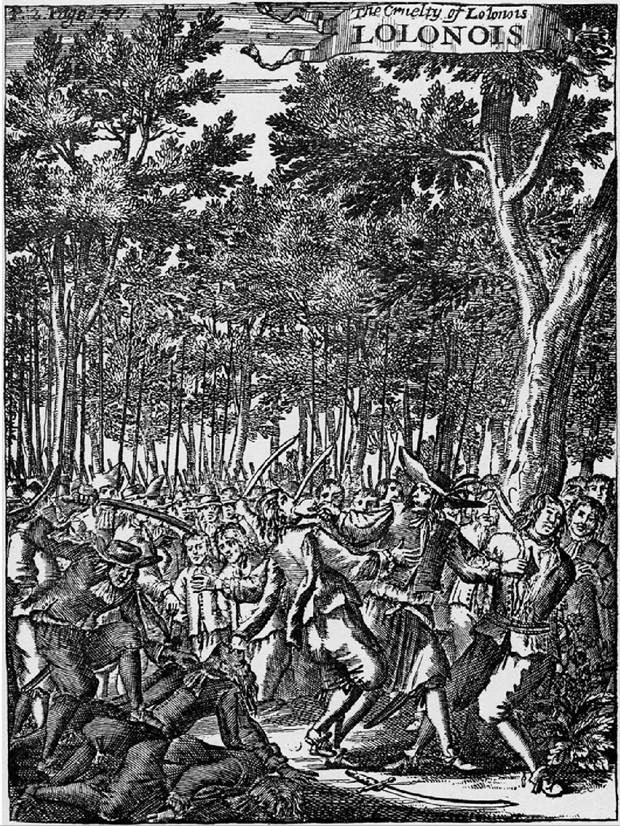
Figure 23.2 The cruelty of L'Olonnais, 1668, from Exquemelin's Bucaniers of America.
Other historians have focused on the sea as a lawless space, or one over which claims of sovereignty proved difficult to enforce. In Weberian terms, how could one claim a monopoly on violence in such a vast and liquid space, some two-thirds of the world's surface? One answer was to imagine ships as floating islands, their banners indicating the primary loyalties of passengers and crew, and by extension, the sovereign protectors of their persons and cargo. From a prince's or sultan's perspective, an attack by another's subjects or one's own subjects at sea ought to be tried at court. By the same logic, all sovereigns ought to be responsible for their vassals, including those gone rogue at sea. Mutiny, then, was to be punished severely by the officer to whom princely authority had been delegated.
Could more be claimed than the ship as an island of law or princely domain in a watery void? Legal historian Lauren Benton distinguishes between claims of sea sovereignty vs maritime jurisdiction, the result of mutual attacks by the Dutch, Spanish, Portuguese and others in distant seas.
The Dutch disputed Iberian claims of sea sovereignty citing ancient authorities such as Cicero even as they asserted their own jurisdiction over sea lanes in South East Asia. Violent despoliation, usually labelled as piracy, sparked heated discussion.[707] [708] In this vein, Martine van Ittersum offers a detailed examination of the watershed legal writings of Hugo Grotius, author of Mare Liberum (1609), origin of the optimistic and modern-sounding notion ‘the freedom of the seas'. Ittersum shows that Grotius was far from a dispassionate legal theorist. Instead, he made every effort, especially in the earlier De Jurae Praedae, to justify the violence of officers of the Dutch East India Company or VOC in trade zones claimed by the Portuguese and Spanish. Most directly, Grotius's motivation was to give legal cover to Dutch subjects exacting revenge in distant waters. Despite his later reputation, he was not interested in promoting peaceful global trade but rather in justifying something awfully close to piracy.16 Weak English competitors said as much at the time, although Great Britain would later embrace similar principles.More primitive standards of retaliation had of course long been in place. In late medieval Europe, a letter of marque and reprisal allowed one prince's subjects to plunder another's to the extent of damages incurred in the initial raid. With the rise in commercial traffic this system proved untenable, leaving the door open as it did to piracy under false cover, with the letter of marque serving as blank check. European states grappled with this ‘eye for an eye' system well into the modern era, constantly claiming their enemies engaged in acts of piracy. In the West such practices were called privateering, which in many ways was simply a legal form of piracy (especially to the victims). Privateering, or more generally state-sponsored maritime raiding, in fact, was a universal practice all around the globe.[709] [710] [711]
It was hard to let go of the old ‘exact revenge' model in part because piracy in places like the English Channel fostered primitive accumulation even as it destabilised emerging trade regimes.
Yesterday's pirates could be tomorrow's imperialists, and indeed current scholarship often emphasises piracy's role in the rise of merchant empires. For emerging or cash-strapped states, including principalities but also behemoths like Habsburg Spain or the Ottomans, outsourcing violence at sea was gratifyingly cheap.18Piracy in eastern seas was no less troublesome or contested, and yet with a few notable exceptions Asian states and princes proved less assertive than European ones in their claims of maritime sovereignty or jurisdiction beyond rivers and estuaries. Colonialism and imperial ambitions were at the heart of this fraught story, but it is important not to project later imperial power imbalances back to the early modern period when Europeans were vastly outnumbered interlopers in a maritime zone of extraordinary commercial complexity and legal custom. Historians remain divided as to whether European maritime expansion after c. 1492 gave rise to piracy in much of the world, or if the practice was simply transformed and reframed as a result of the violent staking of overseas claims in a new era of gunpowder and sturdy ships.19 One thing is clear: European sailing and weapons technologies changed the nature of the game.