The Violent Nature of Piracy
Piracy is by definition the violent despoliation of goods and persons made vulnerable by their waterborne isolation or location along some unprotected stretch of coast. Seaborne attackers have long been a spectral menace, romanticised or demonised in the popular culture.
Yet from a criminal's perspective, piracy is armed robbery with the added prospect of drowning, a less romantic vocation than landlubbers imagine. What makes it attractive, despite the risks, is the continued lawlessness of the world's oceans. Like cyberspace, the seven seas are deep and murky, belonging to all and ruled by none. If not caught in the act, pirates rarely pay for their violent actions.It is not difficult to explain why piracy might be violent, since taking another's things or person is rarely achieved without a howl. So what, then, is the historian's task? A look at piratical attacks across the globe over several millennia suggests some patterns of continuity amid structural or geopolitical changes. Aside from the continuity of violence as necessary to effect theft, pirates have justified the violence of their attacks on various grounds. Pretexts for violent despoliation at sea include: (i) survival, (2) personal or family revenge, (3) national or ethnic rivalry, (4) religious or confessional difference, (5) class antagonism, and (6) cultural imperatives, such as the call for youths of a given chiefdom to perform a violent seaborne act as a rite of passage.
From the perspective of piracy's victims, most considering themselves randomly selected, suffering seaborne violence and despoliation cannot be legally or socially justified, although it might be accepted as divine punishment. From the victims' angle, pirates appeared as little more than predatory animals or ‘sea-wolves'. States whose subjects suffered piratical violence frequently adopted the language of extermination when organising pirate suppression campaigns.
It was normal practice for governments to inflict the most severe punishments on captured pirates: in China ‘death by slicing' for the most notorious pirates, and in England executed pirates often were ‘gibbeted', whereby the dead body of the convicted pirate was hung in a cage or in chains for public display to discourage others. Thus, state terror, sometimes out of proportion with the threat, was the flipside of piratical violence. Pirate suppression, too, has had its innocent victims.Survival piracy may be among the oldest forms known, and it persists, especially in zones where livelihoods like fishing have been disrupted. Whereas history is dotted with examples of good Samaritans, or generous persons extending a helping hand, one finds more often a conservative hostility at sea, that is, a tendency to rebuke the needy in order to conserve one's own resources. Ancient to early modern accounts of sea travel are filled with chance encounters in which plunder - often denounced as piracy - was driven by the search for victuals. It is difficult to say whether survival piracy has been less violent than other kinds. Certainly it has been no less desperate.
A typical incident of this sort was related by the German gunner Hans Staden, whose 1557 account of captivity in Brazil included reference to an encounter with people he called pirates, presumably French corsairs, off the Azores in August 1548. Staden and his Portuguese crew mates ‘got the upper hand', he says, despite the fact that they were starved after 108 days' sailing from Brazil.
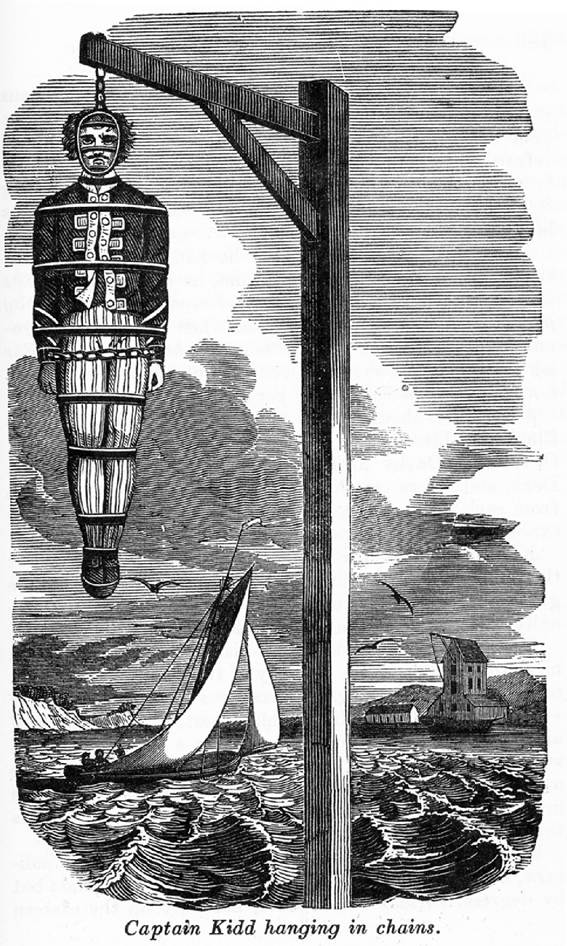
Figure 23.1 Captain Kidd hanging in chains, 1701.
Staden summarises: ‘The pirates escaped in the boats, rowing towards the islands. The ship contained lots of wine and bread, which refreshed us.' It is difficult to know in this instance who the real pirates were when booty consisted only of comestibles.1 In China, and likely elsewhere as well, natural disasters and especially famines often brought about upsurges in piracy and other acts of violence.[693] [694]
Revenge is another recurring theme in the history of piracy.
A violent act by some seaborne marauder was assumed to deserve retaliation. From at least the time of Homer, some asked: ‘Shall I win back my honour as well as my treasure?' Others sought revenge against princes or other state actors who had done them ill, and still others found entire classes of people worthy of despoliation for their misdeeds or undeserved high status. For the early modern era, a good example of a person engaging in piracy for revenge was the Elizabethan corsair Francis Drake, whose early slaving voyages to the Spanish Caribbean with his uncle, John Hawkins, led to a violent showdown with a Mexican viceroy at Veracruz in 1568. Alleging a betrayal that is not much supported by surviving records, Drake vowed to ‘singe the king of Spain's beard' for the rest of his life, mostly by plundering Philip II's civilian subjects unawares.[695] Another corsair famous for his Caribbean exploits, Diego de los Reyes, aka Diego el Mulato, was said to have plundered Spanish subjects in repayment for harsh treatment as a slave in Havana. De los Reyes sailed for the Dutch in the 1630s.[696]Nation, class, religious profession: these have also been pretexts for attack and theft at or by descent from the sea. Drake sometimes played the role of Protestant iconoclast, as did some French and Dutch peacetime raiders (i.e. corsairs acting on their own without wartime commissions or letters of marque and reprisal). Whereas ideas of national or ethnic belonging must be traceable to early human history, religious or confessional differences as pretexts for piracy seem to be somewhat more modern, certainly best documented for the Common Era. With the rise of Christian and Islamic gunpowder empires in the mid fifteenth century, such confessional differences were often brought to the fore when parties clashed at sea, just as they did on land. Violent despoliation when done to ‘infidels' or ‘heretics' could be justified by scripture, but then so again could mercy.
Miguel de Cervantes, who spent several years as a corsair's captive in Algiers in the late 1570s, gave Spanish theatre-goers characters like the memorable Warden Pasha, who enters act one of The Bagnios of Algiers with the following words: ‘Hey! Get to work, Christians! Nobody stay inside; ill or hale, don't delay, for if I go in there, these hands will get you on your feet. I want everyone, priest or nobleman, to work. Hey, dirty swine! Must I call you again?' With an economy of threatening words, the Algerian jailer calls out class, religion, even medical condition. In opposition, and for comic relief, Cervantes gives us the Spanish sexton, whose insults of his captors cover a similar range: ‘O son of a whore, grandson of a great cuckold, nephew of a rogue, brother of a great traitor and sodomite!' Manhood, sexuality, religious affinity, even nation are here. Of particular interest for Cervantes and his audiences were pirate captives who ‘turned Turk', the so-called renegados or renegades. They disrupted any simple ‘us-vs-them' narrative of Mediterranean piracy.[697]
Piracy (or corsairing) as an extension of crusade or jihad swelled in the sixteenth century, just as Christian schisms provided a similar pretext for violent despoliation. According to the Spanish, ‘pirate heretics' were legion. Sailors of emerging nations added punch to epithets such as ‘Englishman', ‘Spaniard', ‘Frenchman' and ‘Hollander' by adding ‘Papist' or ‘Lutheran'. Europeans often used vague terms such as ‘Turk' or ‘Moor' to label whole cultures as nothing but ‘bloodthirsty pirates', even as far afield as South East Asia.[698] In an increasingly globalised world, such blanket mislabelling also made room for considerable selffashioning. Indeed, the history of piracy shows that as states grew more centralised or culturally homogeneous, their subjects formed new identities when they went abroad. Distant seas, like colonial frontiers, allowed for considerable fluidity and dissimulation.
Confusion over identities went both ways. In some waters, all European interlopers might simply be called ‘Franks', or, less generously, dongnosed barbarians', assumed to be pirates as much as merchants or missionaries.Compared with religious or proto-national affiliation, class identities or labels might be regarded as more modern still, perhaps only recognisable after the mid seventeenth century. Could class hatred inspire piratical violence? Historians Peter Linebaugh and Marcus Rediker have emphasised the prevalence of class insults and claims of injustice among early eighteenthcentury Anglo-American pirates, but evidence of such resentments is almost as clear among Dutch sailors and other seafaring commoners of an earlier era.[699] Many such men were left destitute and physically disabled following multi-year, world-encompassing corsairing voyages. They were among the early modern 99 per cent who got small beer and the lash when well-heeled Amsterdam shareholders got dividends of silver and gold.
Ritual piracy may be the form we know least about, in part because it was usually misunderstood by its victims. Certainly Western pirates developed rituals or rites of passage much like other mariners, but it is in non-Western cultures that one finds distinct practices that may be confused with the more strictly pecuniary aims of ‘ordinary' pirates. If, as in the case of certain native groups in the Caribbean and South China Seas, pirates took trophy heads along with goods and captives, what might this mean in terms of the history of violence? Was piracy uniquely ritualised or simply an extension of landbased cultural prerogatives? Did it matter if an inscribed dagger made from an enemy's femur had been won at sea?
The Caribs who raided from islands such as Dominica and St Lucia in the sixteenth and seventeenth centuries appear to have treated the violent seizure of captives and booty as rites of passage as well as ‘war by other means'.
Young raiders were initiated and captives transformed, possibly into spiritually nourishing meals.[700] The Sea Dayaks of Borneo were renowned ‘headhunters' who went on raids for slaves and heads that they could use in religious ceremonies. Raiding was so central to their society and culture that young warriors were expected to prove their manhood - a coming of age - by capturing or slaying enemies and taking heads.[701] As James Warren has shown, sea raiders in the ‘Sulu Zone' of South East Asia also developed what J. L. Anderson has labelled ‘intrinsic' pirate cultures marked by ritualised violence.[702] Similar arguments could be made for certain corsairing groups of early modern North Africa. Writing at about the time of Cervantes, Alonso de Sosa noted the sacrifice of lambs aboard corsair galleys setting out from Algiers.11 Likewise, on the south China coast in around 1800 raiders made blood offerings of pigs, dogs or chickens before setting off on raids.In some cases pirates took ritualised violence to extremes. In south China there were numerous stories about pirates who cannibalised victims, both for revenge and for magico-religious efficacy. It was a common belief in China that blood - especially human blood taken from live victims - was a cure-all for diseases and a prophylactic for warding off demons. When pirates tortured, dismembered and then drank the blood and ate the hearts and livers of their victims, they did so to acquire for themselves power, courage, longevity and good fortune.[703] [704] In The Bucaniers of America (first published in Dutch in 1678), Alexander Exquemelin detailed the ‘unspeakable atrocities' of French pirate Francois L'Olonnais, who cut open the chest of a captured Spanish soldier, ‘tore the living heart out of his body, gnawed at it, and then hurled it in the face of one of the others [i.e. captives]'.[705] Although such tales of bloodthirsty pirates may not be true in every detail, nonetheless they were well accepted and widely believed as true.
More on the topic The Violent Nature of Piracy:
- The Violent Nature of Piracy
- Piracy in the Indian Ocean
- Models of Piracy
- Piracy in the Americas
- Mediterranean Piracy
- Pirates
- China was no less violent than any other society in the early modern age. Like Europe, late imperial China had its fair share of wars of empire and peasant rebellions, as well as violent crimes of murder, assault, rape and robbery.
- ‘The Violent against Themselves'
- Friend or Foe: Small Soldiers Toy Tie-Ins and Protests of Violent Toys
- Antony Robert, Carroll Stuart, Pennock Caroline D. (eds.). The Cambridge World History of Violence. Volume 3: AD 1500-AD 1800. Cambridge University Press,2020. — 710 p., 2020