Mesopotamia and Syria encomipass a wide area of the ancient Near East.
Both regions have independent historical trajectories but, at the same time, they are linked to each other by cultural, religious and political relationships across the millennia.
It is, in fact, nearly impossible to find a precise border between the two regions. Although it is important to distinguish local features, common traits are significant when outlining links that explain cultural and political transmissions and exchanges between Mesopotamia and Syria. Moreover, the birth of Near Eastern archaeology in northern Iraq in 1842 led to the favouring, in the past, of the conviction that there existed a centrality of ancient Mesopotamia that led to the phenomenon of Mesopotamia-centrism. In contrast, archaeological researchers in Syria not only showed the political and cultural independence of Syrian cities and reigns, but also pointed out how cultural transmission, rather than having an exclusively Mesopotamian origin, possibly had a Syrian root and Syrian development phase.1Mesopotamia consists of the portion of land between the Euphrates and Tigris rivers, although its borders expand, culturally, to north-eastern Syria (Jezirah) up to southern Anatolia. In this context, scholars usually speak of Greater Mesopotamia. Ancient Syria mostly corresponds to the modern [1177]
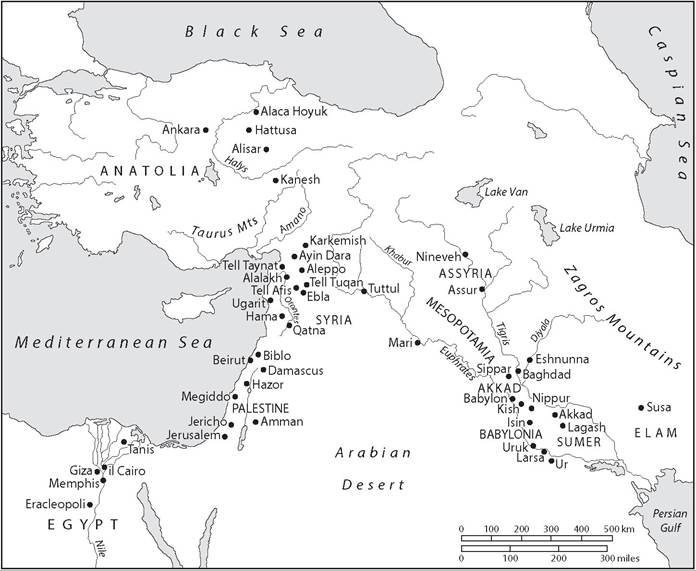
Map 31.i The ancient Near East.
Representations of Violence: Ancient Mesopotamia and Syria country, although cities with Syrian culture extend over southern Turkey, Lebanon and the southern Levant.[1178]
As far as the representation of violence is concerned, it is possible to recognise what could in fact be labelled a canon of representations of violence in Mesopotamia and Syria from the fourth to the first millennia bce, from the moment of the origin of the first cities and ancient states up to the time of the large empires.
Cultural interchanges and quotations can be easily identified, establishing a continuous common thread among typical pictures of violence in different contexts and in different visual documents. It thus seems that violence follows a specific code and language that highlights how violent behaviour is one aspect of human nature, and for that reason we are able to share and understand the signs of violence both when it is performed and when it is suffered (according to one's perspective and point of observation). Violence thus becomes a cultural element, an essential feature that lays the foundations of other fundamental acts, transformations and innovations in the history of humanity.Is this the reason for the large diffusion of violent pictures on different media across the history of ancient Mesopotamia and Syria? Probably yes, but there are, of course, other reasons for the necessity of representing violence and the political and/or religious situation. The context where those pictures were displayed might change the original meaning and perception of how violence was used, assimilated and fostered. It is, however, interesting to focus on how violence has been represented in Mesopotamia and Syria, showing the many common aspects and references. The representation of violent scenes and actions follows a pattern, and scholars could indeed easily draft a diachronic atlas of pictures that encompasses the selection and classification of scenes that show the gestures, attitudes and feelings the images suggest and foster. Beyond the iconographical aspects of the pictures of violence (that is, how violence has been treated and represented in visual media), it is interesting to investigate why violence has been represented and what implications such representations had in the ancient societies of the Near East. In this respect, not only the content but also the context of the representations must be evaluated. Taking only the content of those pictures into account, one might run the risk of simplifying the message.
Conversely, the context of use of those pictures (the place where they were eventuallydisplayed) points to their real significance within the space (the geography of violence) of people's daily lives (if those images were thought to be addressed to a wide audience). As a direct consequence, the visibility of the scenes of violence will necessarily imply a re-evaluation of the visual support: in both Mesopotamia and Syria, representations of explicit acts of violence or indirect references to aggression and killing can be found on different types of media, with a clear intention of creating a monument to violence.
Violence can be an unavoidable consequence of the use of strength, or it might be an intentional choice to achieve specific objectives. In this respect, representations of violence in war in Mesopotamia and Syria follow a similar visual canon, with recurrent figurative themes of violence where the environment (cutting of trees) and parts of the enemy's body (head and limbs) are affected. In both cases, we can speak of a physical violence against different kinds of bodies. It seems that dismemberment both increases and exalts the power and effectiveness of violence, aiming as it does at annihilating victims' complete shapes. At the same time, single parts of the body are used to establish a new reality - this is clear in religious contexts where the bodies of deities and divine figures are specifically reassembled for the creation of the world. On the other hand, rulers and kings replicate, on the human side, the actions of gods, focusing on single parts of enemy bodies that are then recontextualised and receive a special treatment (this occurs with the severed heads of enemies killed on the battlefield, which receive very special attention in pictures with a real intention for exhibition). As a consequence, the display of violence encompasses both large monuments (stele, bas-reliefs) and small objects such as cylinder seals. The use of cylinder seals is particularly intriguing, given their dimensions and apparent unsuitability for propaganda. The public visualisation of violence is often discussed, specifically when dealing with imperial political systems, but the example of cylinder seals suggests a need for the reconsideration of existing theories. The visibility of violence therefore affects its concrete use in daily life as pictures must be first put in their original context to evaluate the effect and meaning of violent scenes on the audience. Conversely, if no (public) audience was explicitly meant to see those images, then scenes of violence must have been used differently towards a targeted and educated audience who knew how to interpret and combine them.