Methodology
Following the approach described above, we present our methodology separated into several steps that facilitate automatic generation of intelligent agent crowds, where agents generate goals depending on physiological modifiers and plan their actions depending on their personality and in accordance with social norms.
14.3.1 Step 1: Design the Base Population
Base population represents the initial group of agents used to generate the rest of the crowd. This population has to define the fundamental visual properties of the resulting crowd. Therefore, for each ethnic group that will be generated, there must be at least one couple of avatars, where both individuals maintain the ethnicity-specific visual traits (e.g. asian eyes), while all other non-specific features (e.g. head shape)
are varied. Following this approach, during genetic reproduction, ethnicity-specific features are carried on to the following generations (Trescak et al. 2012), while diversity within ethnicity is assured.
This process requires a significant effort, as designers have to define all avatars with distinctive appearance and a library of related textures, clothing and attachments in order to ensure high variety. In order to reduce the effort, we propose to design and use parametric avatars (Lewis 2000; Trescak et al. 2012), which are avatars with visual features that can be modified using parametric values. For example, parameter “height” and “body fat” would modify the corresponding parameters of avatar body. Such parameter values of an avatar form genes combined in a chromosome used to reproduce children with diverse appearance.
To better understand how the diversity is achieved—we need to explain the process of genetic reproduction. In this process, an agent’s appearance, motivational modifiers (in our case physiological modifiers), and its personality are encoded into “genes”.
As a result, these three groups of genes form three chromosomes, depicted in Fig. 14.1.During reproduction, we take two parents and combine each of the three pairs of related parent chromosomes to produce the child’s chromosome. We decide how many genes are inherited from the father and how many from the mother using a father-mother ratio. A crossover operator is responsible for combining chromosomes. Theory of genetic algorithms defines several crossover operators, i.e. split operator, but for our purposes, we define a specific fuzzy operator, that imitates the biological crossover using two pairs of chromosomes (Vieira et al. 2010).
Definition 1 Given mother’s chromosome cm consisting of genes cm =... gm,
the father’s chromosome c consisting of genes cf = gg... gn, the parent gene selector function sf : 2G {0,1} which for position i, where 0 < i < n, selects either mother or father gene depending on probability given by the father-mother ratio rfm and the fuzzy function f : D R which for gene on position i selects a random value in the interval given by f(i) = [s(i), (gm - g. )/2], we define a fuzzy crossover operator 0 : C x C C as cm 0 cf = f(1) ·f(2)...f(n).
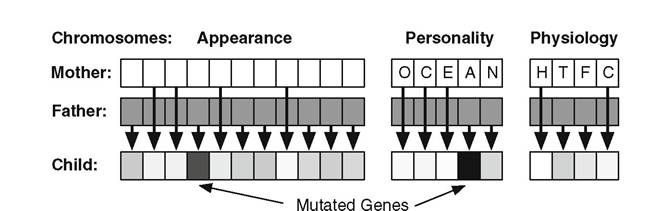
Fig. 14.2 Using genetic operators to form an agent’s chromosome
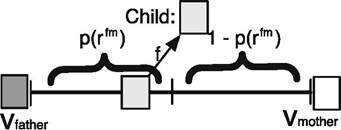
Fuzzy operator creates a new gene value by selecting a random value from the interval defined by the gene values of the parents and depending on the specified father-mother ratio takes this value closer to father or mother gene. This process is depicted in Fig. 14.2, where rfm means father-mother ratio and p(rfm") means probability of selecting value from the interval, depending on rfm.
Another important process of the biological reproduction is mutation, which is the driving mechanism of evolution and novelty in species.
We mimic the mutation process by modifying the value of pre-defined number of genes to the value from outside of the previously mentioned interval. The result of genetic manipulations is a new chromosome using which we can reconstruct a new child, its appearance, physiological needs and a personality.Once the appearance of the avatars representing the base population has been specified in a parametric fashion—a diverse crowd of a desired size can be automatically generated following the aforementioned genetic principles. The agents in the crowd will have diverse appearance, while at the same time the important ethnic features of their appearance will be preserved. In order to introduce diversity of their behaviour—further steps of the methodology need to be completed starting with the configuration of motivational modifiers.
14.3.2 Step 2: Configure Motivational Modifiers
Genetic approach is also used to diversify agent behaviour. For this purpose, motivational modifiers are encoded into genes of the chromosome. Therefore, in this step, for each member of the base population the motivational modifiers are specified. In case of physiological motivation, these modifiers relate to hunger, thirst, fatigue and comfort, and represent the decay rate in which agents are getting hungry, thirsty, tired and sleepy. To avoid an impression that every single agent follows the same day cycle and performs the same set of actions at the same time, these values must be different for every agent from the base population. The more diverse these values are in the base population, the more diversity will be present in the circadian rhythms of the resulting crowd.
14.3.3 Step 3: Specify Personality Traits
While diverse motivational modifiers assure execution of actions at various times, agent personalities determine the kind of actions the agents will execute. In this step, for each member of the base population its personality is specified using the popular OCEAN model (Goldberg 1990), which captures five personality traits: openness, conscientiousness, extroversion, agreeableness and neuroticism.
Openness relates to imaginative, creative aspect of a person. Consciousness captures the ability to be organised and careful. Extroversion defines, how social and outgoing a person is. Agreeableness relates to ability to cope with people, friendliness and generosity. Neuroticism defines tendency for negative emotions and instability.Combination of the OCEAN values defines a specific character. Explaining, how to define a specific character is out of scope of this work, therefore we regard interested reader to existing publications (Bartneck 2002; Steunebrink et al. 2009). For the purposes of this methodology, it is important that agents forming the base population have different personality values, so that during genetic reproduction their children will have new, emerging personalities. In Sect. 14.6, we present how the diversity of parent personalities affects their children, and how it determines which actions they select as the result of having a certain personality type.
In order for agents to be able to select an action that is most relevant for their personality, such action has to be annotated by following personality facets (Howard and Howard 1995): temptation, gregariousness, assertiveness, excitement, familiarity, straightforwardness, altruism, compliance, modesty and correctness. Using values of personality facets, the agent selects an action that provides the highest utility for its personality type (Bartneck 2002; Howard and Howard 1995). See Table 14.1 for an example of annotations for work, beg, steal and search actions.
Often, actions such as “work” have various meaning in the context of different social groups. Working for fishermen means to catch fish, while for pot makers it means to make pots. Therefore, in the next step of the methodology, the institution is specified, which defines all the social groups, their interactions and also defines the meaning and parameters of specific actions, e.g. determines how quickly a particular object satisfies hunger.
Table 14.1 Personality facets of agent actions
| Tempt. | Gregar. | Assert. | Excitement | Famil. | Altruism | Compliance | Modality. | Corr. | |
| Beg | 0 | 0 | -0.5 | 0 | 0 | 0 | 0.5 | 0 | 0.5 |
| Work | 0 | 0 | 0.5 | 0 | 0 | 0 | 0 | 0 | 1 |
| Search | 0.5 | 0 | 0.75 | 0.5 | 0 | -0.25 | -0.5 | 0 | -0.5 |
| Steal | 1 | 0 | 1 | 1 | 0 | -1 | -1 | 0 | -0.75 |
14.3.4 Step 4: Formalise Social Norms and Roles
To define social groups, their actions and interactions, an Electronic Institutions (EI), a well established Organisation-Centred Multi-Agent System (OCMAS) is specified. EI establishes what agents are permitted and forbidden to do as well as the constraints and the consequences of their actions (Esteva 2003). In general, an EI regulates multiple, distinct, concurrent, interrelated, dialogic activities, each one involving different groups of agents playing different roles.
Definition of an EI consists of the following four components:First, a dialogical framework specifies social roles involved in the simulation and their hierarchy. Figure 14.3a depicts the role structure of the simulation of Uruk 3000 B.C and Fig. 14.3b depicts the one of Aboriginal simulation (see Sect. 14.6). Apart from the role structure, the dialogical framework defines ontology, a common language for communication between agents.
Second, a performative structure isolates specific activities (also called scenes) that can be performed within an Electronic Institution. It defines how agents can legally move among different scenes (from activity to activity) depending on their role. Furthermore, a performative structure defines when new scene executions start, and if a scene can be multiply executed at run time. A performative structure can be regarded as a graph whose nodes are both scenes and transitions (scene connectives), linked by directed arcs (See Fig. 14.4). The type of transition allows to express choice points (Or transitions) for agents to choose which target scenes to enter, or synchroni
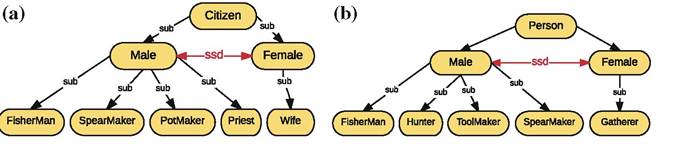
Fig. 14.3 Role hierarchy. a Uruk 3000 B.C. b Australia
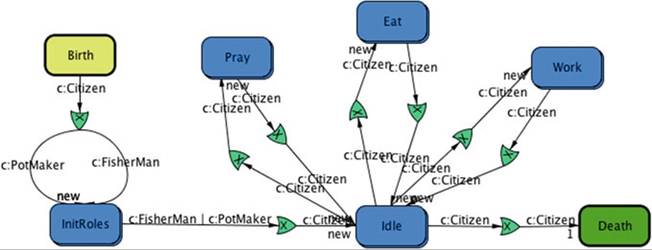
sation/parallelization points (And transitions) that force agents to synchronise before progressing to different scenes in parallel. The labels on the directed arcs determine which agents, depending on their roles, can move between scenes to transitions.
Third, for each activity, interactions between agents are articulated through agent group meetings expresses as scene protocols, which follow well-defined interaction protocols, whose participating agents may change over time (agents may enter or leave). A scene protocol is specified by a directed graph whose nodes represent the different states of a dialogic interaction between roles (See Figs. 14.5 and 14.6). Its arcs are labelled with illocution schemes (whose sender, receiver and content may contain variables) or time-outs.
Definition of EI is fundamental to agent reasoning and our dynamic planning algorithm that constructs a list of actions to fulfill the current goal by finding a path (sequence of actions) that make the agent go into the desired scene and reach a desired state within this scene.
An institution provides agents with knowledge about possible actions that can be performed. The next step of the methodology provides means of visualising these actions in the virtual world.
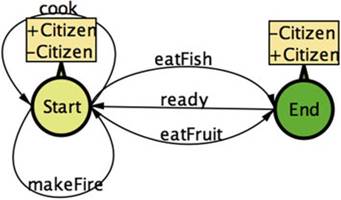
Fig. 14.5 Eat scene protocol
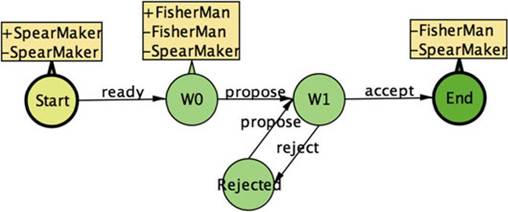
Fig. 14.6 Trade scene protocol
14.3.4 Step 5: Adaptation and Annotation of the Environment
For purposes of visualisation, institutional actions must have corresponding objects, animations and scripts. In this step, objects of the virtual world related to such actions are created and annotated with specific meta-data, so that agents know that a connection between institutional illocutions and objects is established. Agents use annotations in their planning, which is affected by the current state of the environment. Therefore, interactive objects have to contain information on what action they provide and what are the action parameters (Trescak 2012).
Adaptation and annotation of the environment is the last step that requires manual input. In this last step we generate the population of the simulation and make it act within the simulated virtual environment.
14.3.5 Step 6: Generating the Population
Generation of population is a fully automatic process, where the desired number of “children” is generated from the base population using genetic approach described in Sect. 14.3.1. Initially, children are only sets of chromosomes and their appearance has to be reconstructed in a given virtual world. Once connected to the virtual world, they start automatically generate goals and act upon them.
14.4
More on the topic Methodology:
- Zimbabwe Village Savings and Loan Associations
- Easteal Patricia (ed.). Justice Connections. Cambridge Scholars Publishing,2014. — 322 p., 2014
- Conflict is ubiquitous in human affairs.
- Bui Ngoc Son, Malagodi Mara (eds.). Asian Comparative Constitutional Law, Volume 1: Constitution-Making. Hart Publishing,2023. — 495 p., 2023
- Harker C., Horschelmann K. (Eds.). Conflict, Violence and Peace. Springer,2017. — 456 p., 2017
- Qatar
- Former Child Soldiers and the Motorbike Taxi Industry in Sierra Leone
- Hare C., Neo D. (eds.). Trade Finance: Technology, Innovation and Documentary Credit. Oxford University Press,2021. — 417 p., 2021
- The Epidemiology of BTB in Malawi