RELATIONS AMONG IMPERIAL POWERS
Phase 3 thus experienced more empire builders, more widely dispersed, than phase 1. One might infer that interstate competition became more intense, hence more liable to erupt into warfare.
But such an inference would be off the mark. To be sure, competition was often vigorous, especially after 1870. The two most important actors, Britain and France, vied for control of the Suez Canal, Egypt, and Morocco, for territory in West Africa’s interior, and for influence at royal courts in Siam and Madagascar. Their most serious crisis, at Fashoda on the upper Nile in 1898, threatened for a time to become a casus belli. It is also true that newspapers and journals reached large audiences with unabashed jingoistic appeals, giving late nineteenthcentury imperialism an unprecedented degree of popular involvement and appeal. This made it difficult for political leaders to moderate aggressive stands once their commitments became matters of public record. All the more surprising, then, that rivalry among imperial powers so seldom took a violent turn.The century between the end of the Napoleonic Wars and the start of World War I was by far the most peaceful in European history. Not a single war was fought among the five original imperial powers, and only one—the Franco-Prussian War of 1870-71—between one of the original five and a new state. This conflict was not over the disposition of overseas territory. Indeed, after the war the victorious Germans encouraged France to intensify empire-building activities abroad to compensate for losing Alsace and Lorraine at home.
In phase 3 west European metropoles devised workable diplomatic mecha-
nisms to resolve disputes about overseas claims. The most prominent instances of the new “international regime”13 were the Berlin Conference of 1884-85, the Entente Cordiale of 1904, which settled a wide range of issues between Britain and France, and the Algeciras Conference of 1906 on Morocco.
Imperialism appears to have functioned as a substitute for intra-European war in this period, instead of being the cause or consequence of war, as in phase 1. The connection Lenin drew between imperialism and war in Imperialism, the Highest State of Capitalism was more applicable to the early years of capitalist development than to the finance-capital stage about which he wrote. It was only after imperial powers had virtually run out of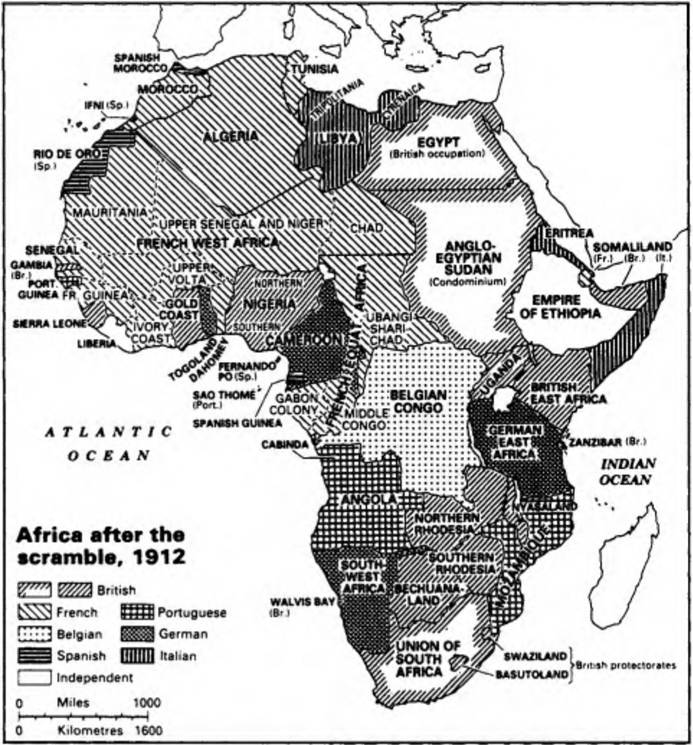
territory abroad that new international tensions unconnected with overseas scrambles set off World War I.
Diplomatic mechanisms were less operative or effective, however, where the expansionist powers not in western Europe were involved. They were more inclined to follow the long-standing practice of settling conflicting claims by resort to war. The United States fought Spain in 1898; Japan fought Russia in 1904-05. A third war reflected west European concern over Russian territorial aspirations. As Russia’s presence in the Black Sea area increased, British diplomats and military strategists grew alarmed that the tsar’s navy might gain access to the Mediterranean, where it could challenge British preeminence. In the Crimean War (1854-56), British, French, and Ottoman forces combined to deal a severe blow to Russian naval capabilities.
Once the Suez Canal was opened in 1869, control of the eastern Mediterranean became even more vital to the British. Suez was the strategic and commercial lifeline between the metropole and a large number of possessions stretched along the Indian Ocean’s shores. Still concerned about a possible resurgence of Russian naval power, Great Britain and several other European powers tried to contain tsarist ambitions by shoring up the Ottoman Empire. This was most vividly demonstrated at the Congress of Berlin in 1878, which in essence annulled a Russian victory over the Turks.
Queen Victoria expressed what British officials were thinking when she wrote, “It is not a question of upholding Turkey; it is a question of Russian or British supremacy in the world.”14 Several European states acquired portions of the Ottoman Empire most distant from Moscow.
But they made sure that equivalent Russian acquisitions were thwarted by prescribing just enough diplomatic medication for Turkey that the “sick man of Europe” retained a tenuous hold on life.15Russian expansion into Central Asia generated an equally concerned response from Britain, but one with very different consequences. The containment policy that called for shoring up the Ottoman Empire argued for weakening and bypassing the Mughal Empire. The British countered what they perceived as a threat to their Indian possessions by more directly controlling affairs in the Mughal domains. They also attempted, with mixed results, to control the small states and stateless societies lying athwart Himalayan mountain passes.
Much further east, Russian acquisition of territory and of railroad and Pacific port rights from China may have predisposed European powers to employ what might be called an Ottoman strategy toward the Ch’ing dynasty. Europeans preferred to administer medication to the “sick man of East Asia”—even if it was on occasion the bitter medicine of military expeditions to Peking (in i860 and 1900)—rather than formally challenge the Beijing court’s authority over a vast land. A China that did not have to mobilize against the threat of European invasion by sea was presumably better able to halt Russian advances in northeast Asia by land.16
Japanese officials felt directly threatened as Russia moved into what they regarded as their country’s sphere of influence. The response was to intervene directly on the Asian mainland, somewhat as the British had done in India. Japan’s defeat of China (1895) gave it treaty-port rights there and enabled it to assert growing influence in Korea. Scarcely had the Russians completed the Trans-Siberian Railroad than the Japanese challenged them head-on. The result was a resounding defeat of a peripherally European power by a purely Asian power. The war’s outcome caught European diplomats by surprise. It was an unmistakable sign that the era of European global hegemony was drawing to a close.
The policies of west European metropoles toward the three great mainland Asian empires of the nineteenth century—Ottoman, Mughal, Ch’ing—were driven in large measure by a consistent strategy on the part of the world’s leading maritime powers to counter the world’s leading land-based power. Similarly, Japan’s behavior during the last two decades of phase 3 was the nervous response of a maritime state on the periphery of Eurasia to Russian consolidation of control over the Eurasian heartland. The containment policy the United States adopted toward the Soviet Union in phase 5 is a direct descendant of strategies Europeans and Japanese developed in phase 3 to counter tsarist ambitions.
More on the topic RELATIONS AMONG IMPERIAL POWERS:
- One of the characteristics of British Imperialism 1688-2000 written by PJ. Cain and A.G. Hopkins is the emphasis put on China as an area in which the working of British imperial policy propelled by gentlemanly capitalism was clearly discerned.1
- Conclusions
- Constituent elements and underpinnings
- Conclusion
- Conclusion
- Conclusion
- The British Protestant missionary movement was as diverse in its implementation as it was ambiguous in its effects.
- A CLASSIFICATION SCHEME: FIVE PHASES
- Conclusion
- Conclusion