Relations with Indians
Claiming the discovery of Brazil after what was by then nearly a century of exploration and intrusion along Africa's western shores, Portuguese mariners
and traders had long experience dealing with those who looked, thought and acted differently from themselves.
The South Atlantic adventurers quickly elaborated a vocabulary that set themselves apart from those they encountered, a theologically based, racially inflected classificatory system which judged white European Christians superior. They extended notions about the inferiority of Iberia's Jews and Moors to sub-Saharan blacks. Also by extrapolation, they applied these prejudices to the native inhabitants of the New World. The consequence was a legitimation of violence based on prejudices about native behaviour thought to stem from physical, social and cultural disparities.Across Iberia, by the late medieval period, the Spanish and Portuguese words raza and raga (race), casta (caste), and linaje and linhagem (lineage) ‘were part of a complex of closely associated terms, which linked both behavior and appearance to nature and reproduction with reference to the animal as well as to the human world', Giuseppe Marcocci explains.[76] Race as a biologised concept did not yet constitute a formal theory. Nor was it reinforced by the rationalist, pseudoscientific bulwark it acquired in the eighteenth and nineteenth centuries. It had not yet become the primary way to refer to the human diversity increasingly evident as the Portuguese explored the coast of Africa, rounded the continent's southern tip, and reached India. Nevertheless, racism, understood here as the derogation of others based on heritable physical characteristics, emerged in Iberia well before Columbus sailed to the New World in 1492, followed by his Portuguese counterpart Pedro Alvares Cabral in 1500.
To be labelled negro in Portugal implied enslavement, a connotation that deepened as Portuguese merchants pioneered the systematic export of enslaved Africans to Iberia and Africa's Atlantic islands in the fifteenth century. The association of blackness with enslavement considered legally and morally acceptable, legitimated by crown and church, carried over to the colony.[77]The famous letter announcing Brazil's discovery, drafted by Pero Vaz de Caminha, a scribe aboard Cabral's fleet, described the coastal Tupi speakers as ‘dark, somewhat reddish'. They had ‘good faces and good noses, well shaped'. Naked, evidently lacking all religion, they were at once ‘bestial', ‘timid' and ‘good and of pure simplicity', inclined to have ‘stamped upon them whatever belief we wish to give them'. His references to indigenous women focused on their exposed ‘shame' or genitals.[78] [79] From the first Portuguese observations of Amerindians, in short, came intimations of latent conflict suppressed by assertions of tropical harmoniousness. Resting on a hierarchy of human types, this equation would centuries later contribute to Brazil's paramount nationalist myth.
As a pilot accompanying one or possibly two Portuguese expeditions ordered to follow up on Cabral's landfall, Amerigo Vespucci pronounced on another aspect of native behaviour, which more than any would be used to justify collective violence. In contrast to Caminha's sanguine images of innocents eager for conversion, Vespucci described acts of cannibalism, including one in which a member of his landing party was ambushed, bludgeoned, hacked to pieces, roasted and consumed ‘before our eyes'.11 Sceptics quickly challenged the veracity of this claim. Later, some scholars cast doubt upon the very existence of Brazilian cannibals. No reputable specialist familiar with the colonial archives, however, still maintains that the practice was a mere invention of Europeans in search of a rationale for conquest.
A potent rationale it was, but also a reality. In a highly ritualised practice, the Tupinamba, Tupinikin and other groups ate captives seized in warfare as part of a cycle of vengeance they believed preserved their cosmic order.[80] Thoroughly documented by Jesuit missionaries and others, cannibalism became the behaviour, par excellence, invoked to condemn Brazil's natives as savage others, legitimating their slaughter and enslavement. Portuguese America came to be associated more than any other colony with cannibalism. For more than a century scenes of man-eaters became the emblematic ethnographic image illustrating Brazil on European maps. The colony served as the source of best-selling, first-person accounts depicting cannibal feasts, including those authored by Jean de Lery, Hans Staden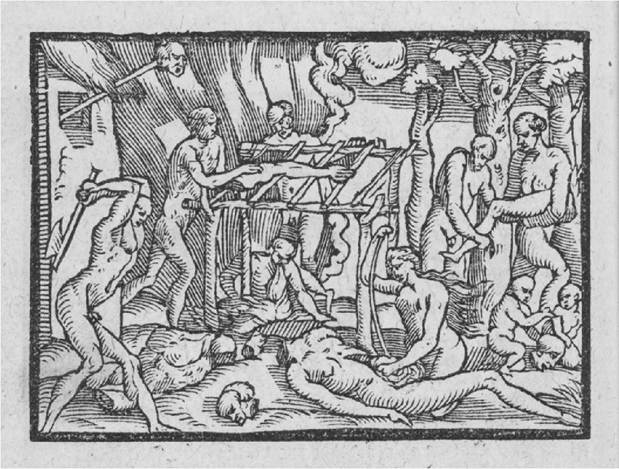
Figure 3.1 European witnesses to cannibalistic rituals condemned Brazil’s coastal Indians as savage others, legitimating their slaughter and enslavement.
and Andre Thevet. To varying degrees, these images and texts emphasised the alterity of Brazil’s indigenous inhabitants. Their subordinate status in nature’s hierarchy of human populations was assumed. ‘They are fierce and savage people far removed from any courtesy or humanity and quite different from us in their way of life and upbringing,’ Nicholas Durand de Villegagnon, leader of a failed French effort to establish a Huguenot colony at Rio de Janeiro, wrote to John Calvin. ‘It even entered my thoughts whether we had fallen among beasts wearing a human aspect.’ Many commentators considered the coastal Indians outside of nature, aberrant and bestial inhabitants of a hellish Torrid Zone, fatally corrupted by their environment and deserving of enslavement because of their supposed inhuman cruelty.[81]
Encountering semi-sedentary peoples who did not produce agricultural surpluses, lived in impermanent villages and possessed no treasure in gold or silver, the Portuguese devised practicable, non-military means to extract wealth from their tropical colony.
Few in number and overwhelmingly male, the first colonists mixed extensively with the coastal Tupi-Guarani Indians. Among the most famous of these individuals, Diogo Alvares, renamed ‘Caramuru' (Eel) by the natives he befriended, fathered children with various women, married a chief s daughter, mastered the Tupi language and became a valued intermediary sought out by Portuguese traders and planters. The children born of these liaisons became the colony's first biracial mestizos or mamelucos (from the Arabic mamluk, meaning ‘slave soldier'), as the offspring of Europeans and Indians were called. For the first half of the sixteenth century, such alliance-building through kinship and barter predominated, essential for the production of the first profitable export commodity, Brazil wood (Caesalpinia echinata), a dyewood cut from the forests, hauled to the shore and loaded aboard ships by native labourers in exchange for European cloth, tools and other goods.[82]Given their long experience enslaving blacks, the Portuguese were quick to connect indigenous alterity with skin colour, and skin colour with the suitability for enslavement, especially as export agriculture expanded after the 1530s. Taking stock of the social structure emerging in the north-eastern sugar plantation complex as it came to depend on Amerindian labour, one early chronicler observed, albeit with evident exaggeration, ‘there was no white man, however poor... who did not have twenty or thirty of those negros that serve him as slaves, and the rich had whole villages'.[83] Early settlers commonly referred to the natives as negros da terra (native blacks). The descriptors differentiated them by their place of origin from negros da Guine (African blacks), also called pretos (another term for black), but it simultaneously linked both populations to slavery as a consequence of their inherited physical traits. The connection was further fortified by an alternative practice established long before the Portuguese reached the Americas of describing sub-Saharan Africans as Indians or indios.
And both were demeaned as gentios (heathens), people outside the normative world of the Catholic Church.More aggressive means of disciplining workers proved necessary as sugar cultivation accelerated, with its voracious appetite for land and labour. Arriving in the colony in 1549, assisted by Caramuru's diplomacy, Brazil's first governor, Tome de Sousa, established his seat of authority on the fertile north-eastern shores of the Bay of All Saints. Salvador, the city that flourished at the site, would serve as the colonial capital until 1763. Sousa carried orders emblematic of a bifurcation that characterised Portuguese indigenous policy throughout the colonial period. King Joao III (r. 1521-57) commanded him to ‘treat all who are peaceful well, favour them always, and do not consent to any oppression or insult being done to them'. In this way, the king hoped to curtail slaving operations targeting Indians, which he acknowledged explained mounting hostilities. For those natives who failed to accept ‘subjection and vassalage', however, the king demanded punishment, to be effected by ‘destroying their villages and settlements, and killing and enslaving whatever part of them you consider sufficient to act as a punishment and an example to them all'. Even if they sued for peace, headmen implicated in uprisings against the Portuguese were to be executed in their villages as a vivid warning to potential rebels.[84] The didactic imperative here was unmistakable. Settlers were to rein in their depredations, except in cases in which the crown instructed them that such actions were permissible. Simultaneously, through exemplary violence, Indians were to be taught a lesson about subordination. In the process, benevolent intentions and instances of cooperation could be hailed alongside official support for ruthless retaliation.
The Jesuit missionaries who accompanied Sousa to Brazil questioned the practice of Indian slavery more forcefully than secular officials.
Yet they accepted the forced labour of natives taken captive in ‘just wars' based on medieval theological precedents. The difficulty of drawing a clear line between justifiable and illegitimate forms of warfare and slavery became evident almost immediately. In 1556, for instance, the first bishop of Brazil, Pedro Fernandes Sardinha, was cannibalised by the Caete Indians. Called back to Lisbon to answer for his criticism of the Jesuits, Sardinha met his fate, together with more than a hundred crew members and passengers, after his ship ran aground north of Salvador. The atrocity led Brazil's third governor Mem de Sa to proclaim a just war against the perpetrators, unleashing anRace and Violence in Portuguese America assault by settlers that decimated the Caete and other groups, including many living in Jesuit missions who had nothing to do with the bishop's demise.[85]
Both a lawyer and a military man, Mem de Sa personified the two faces of royal indigenous policy: a legalistic insistence on humane treatment for those who converted to Christianity and laboured in the plantation economy, and a merciless determination to punish those who did not. He considered military action a necessary corrective for the recalcitrant. Personally leading multiple campaigns against those who resisted submission, he set out ‘to subjugate them and make them appreciate the only path by which they can arrive at an understanding of the Creator,' as one Jesuit approvingly wrote. The fear he instilled left natives more ‘able to hear the word of God'.1[86] An account of a night-time ambush the governor led against the Tupinikin south of Salvador explained his tactics for achieving the change of heart he sought: ‘When those wild savages considered themselves most secure, our men charged in and fell upon them, beheading, wounding, and throwing to the ground every living being, men, women and children.' The account continued, ‘The forests burned for many leagues and the night was turned into clear day... Following trails of blood, parents found their children, husbands their wives.'[87] According to his rationale, educative violence made humane treatment possible.
At first wary of such logic, the Jesuits eventually came to embrace it as they grew frustrated with the slow pace of evangelism. They supported just war declarations, even while they maintained that persuasion was the preferred method to re-educate Indians. The eloquent sermons and letters they drafted reassured elites that everything possible was being done to establish the colony on humane footings. This was especially true after they prevailed on the crown to ban the practice of enslaving Indians. King Sebastiao (r. 1557-78) declared it illegal in 1570. His proclamation denounced the expanding use of ‘heathen' slaves as morally and socially corrosive, and contrary to the service of God and the monarchy. Yet the just war loophole remained. Crown-sanctioned military and paramilitary operations continued to support the capture and enslavement of indigenous groups deemed intractable. Their enslavement, laden with associations of insuperable inferiority given their status as negros da terra, remained widespread. As a result, in the most
dynamic north-eastern plantation zones the coastal indigenous population collapsed by the end of the century, hastened by a combination of conquest, oppressive labour demands and deadly epidemics.[88]
From the onset of Portuguese colonisation in Brazil, in sum, crown and church not only sanctioned but effectively taught violence as a means to contain the perceived threat of human difference while speeding the consolidation of imperial rule. Laws, edicts, sermons, episcopal dispatches and other pronouncements and communiques counselled settlers to limit warfare against the coastal native population when less coercive means could achieve the same ends. Yet officials continuously authorised military and paramilitary conquest as necessary and just in asserting their European, Christian primacy. The enslavement of Indians survived, ensuring that the bloodshed visited upon those who resisted in the forests metamorphosed into the brutality imposed on those who succumbed on the plantations. Amid a discourse of temperance and toleration, violence flourished as an instructional tool. As first or last resort, it conveyed the lessons of subordination thought necessary to make the colony productive and profitable while contributing to the rapid decline of native populations. Increasingly, colonists turned to Africa, whose denizens the Portuguese had long since cast as less than fully human.