Roman Britain
The colonisation of Britain in terms of the military is frequently discussed but other forms of violence remain under-explored, although the lengthy process of establishing and maintaining a stable, economically productive province would have utilised violence.
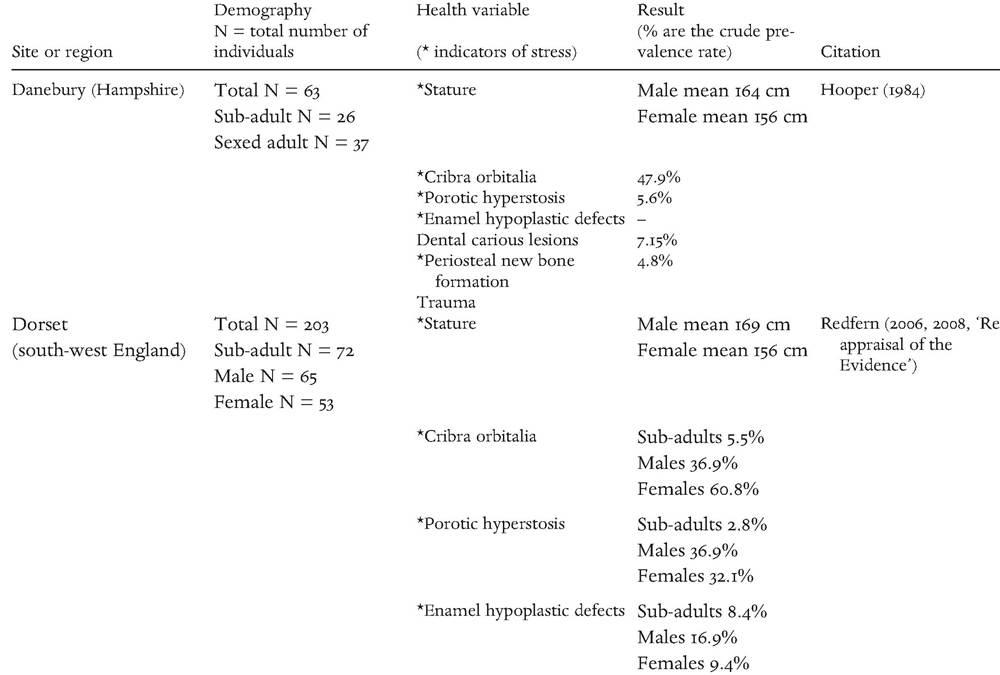
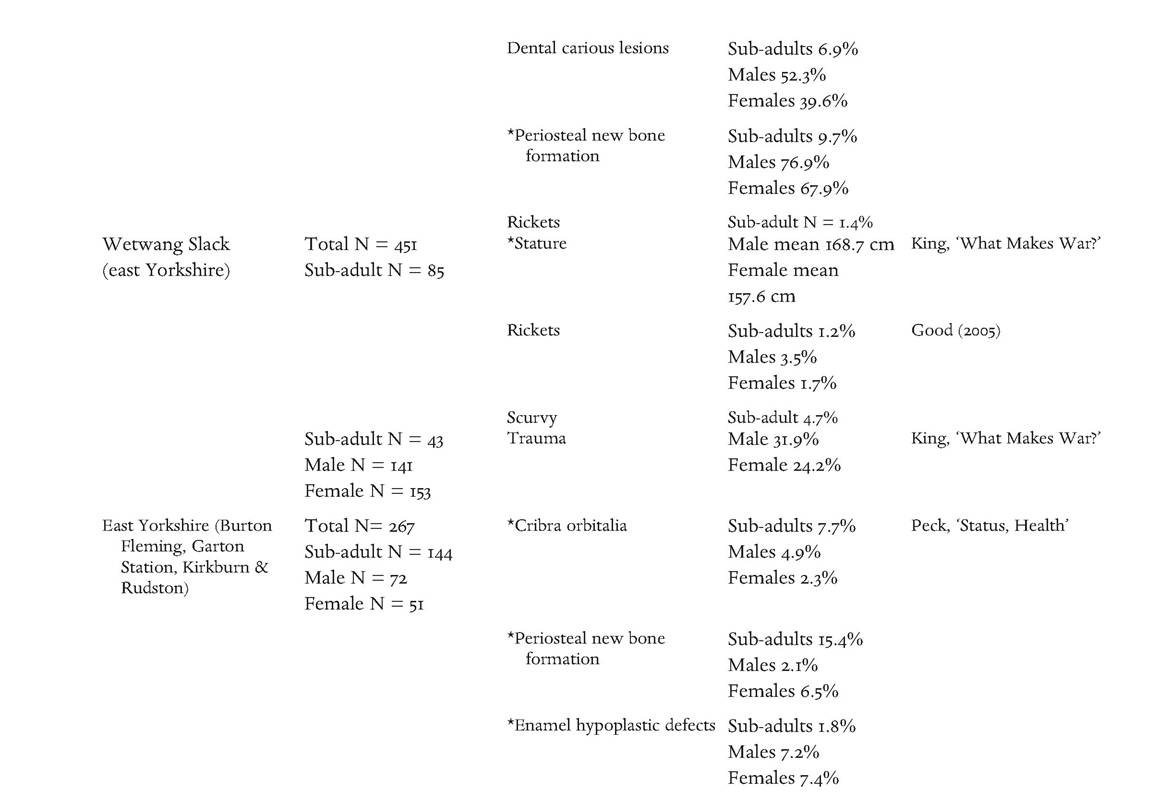
Many communities had existing, strong relationships with Rome before the Claudian conquest, and the impact of the Caesarean invasions would have remained powerful in southern England. However, such relationships are quite different from subjugation and colonisation.Table 15.2 Summary of health parameters
Violence against indigenous communities was both powerful and subtle. New urban centres were created whose architectural structures, organisation and decoration would have changed the way people moved around, and community structures created new age and gender restrictions on movement and access to resources, both reinforcing Rome's imperial power.[642] The experience of invasion, combined with the fragmentation of communities, because of military conscription and relocation to new settlements, enslavement and colonisation, would have created psychological and physical trauma, which research has demonstrated can resonate down the generations.[643] The imperial perspective on the gaining of this province is captured by a carved marble panel from a temple in Asia Minor (Figure 15.2), where Claudius is depicted as a semi-nude hero, clenched fist upraised, who is subjugating a female Amazon figure representing Britain - Britannia - who is being pulled up by her hair. Such a depiction has multiple layers of imagery. The province is shown as a woman, and in the Roman world women's bodies were considered to be less valuable.
The partially nude Britannia, whose body is carved in a submissive position and manipulated by the conquering hero, has overtones of sexual violence and beatings (we should also remember that these images would have been painted,[644] which may have exaggerated the fear on Britannia's face, and potentially added soft-tissue injuries).The evidence for military activity is twofold: distinctive architecture and the creation of physical boundaries (e.g. Hadrian's Wall), and military behaviours designed to impose imperial will on the province. In life, the distinctive dress of soldiers marked them out in civilian contexts, with their military insignia and wearing of swords. In death, their enacting of imperial might was depicted on their tombstones, with soldiers from auxiliary units shown holding trophy heads. Letters from the fort of Vindolanda (Northumberland) reveal their contempt for indigenous people and the creation of ‘Roman' microcosms in contested, often liminal spaces.[645] The bioarchaeological evidence for military
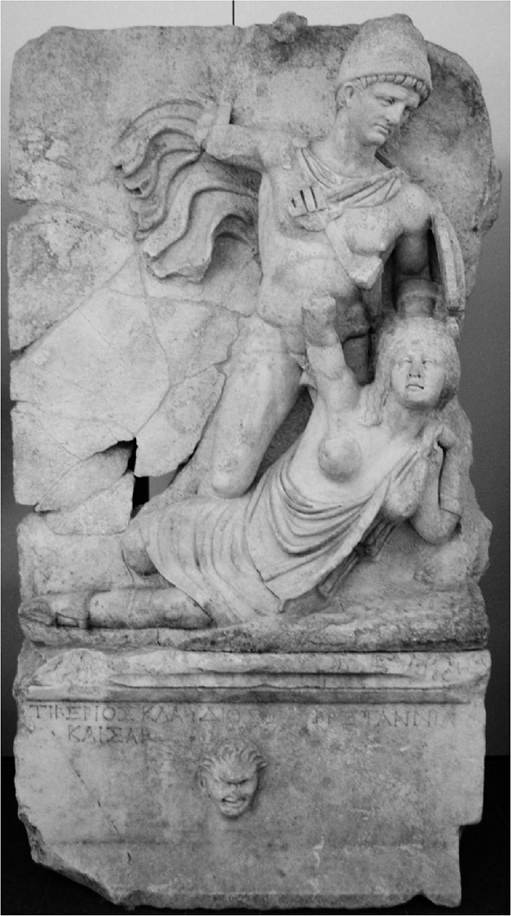
Figure 15.2 Relief depicting the conquest of Britannia by the Emperor Claudius from Sebasteion at Aphrodisias in Turkey.
activity falls into three groups: potential victims of the Claudian invasion, the Boudican rebellion, and trophy body parts. In comparison to the archaeological evidence for weaponry and burnt settlements, there is sparse evidence in the bioarchaeological record for the invasions and rebellion.
Human remains associated with the 43 ce Claudian invasion have been uncovered at a few of Britain's hill forts, one of the most famous being from Maiden Castle hill fort. The burials in the eastern entrance are likely to reflect episodes of conflict in the LIA and the conquest period. The majority of the individuals buried in the so-called ‘Belgic War Cemetery' are young adult males, a result which is known as a catastrophic demographic profile, and the highest perimortem evidence is for sharp and blunt force weapon injuries.
These include disfiguring bladed injuries to the face and head, injuring people to prevent them running away, and some males had injuries reflecting their attempts to protect themselves from their attacker before succumbing to multiple lethal blows suggestive of overkill.Evidence for the Boudican rebellion (61 ce) from Camulodunum (Colchester) and Londinium (London) are scarce. The primary sources tell of the rebels mutilating the bodies of indigenous women who had married Roman men, and giving no quarter to women or children.34 It is worth noting that on the Continent the Roman army committed acts of genocide, and routinely killed the women and children who waited on the sidelines of battles. Destruction layers excavated at Camulodunum contained burnt human remains, and a mandible with a sharp force weapon injury has been recovered from a post-Boudican clearance layer, remains most likely to be inhabitants who were unable to escape the massacre.35
The majority of evidence for post-conquest military activity is the display and/or disposal of trophy body parts in military settlements. These consist of disarticulated crania or limbs, usually recovered from pits within the settlement or in external defensive ditches. Examination of the remains from the legionary ditch at Camulodunum suggests the display of heads and other body parts in the fort. At Vindolanda, a young adult male cranium excavated
Bowman, Life and Letters on the Roman Frontier. Vindolanda and its People (London: British Museum Press, 2004).
34 Dio Cass. 62.1-12; Tac. Agr. 1.16.31.
35 See note 19. For evidence from Camulodunum see Colchester Excavation Committee, ‘Telephone Exchange Site and Dr Williams Garden' (1966), Record ID COLEM 2001.5. B24; Philip Crummy, ‘Colchester: Death by the Sword in Boudicca's War?', Colchester Archaeologist (2014), www.thecolchesterarchaeologist.co.uk/?p=13560. from a ditch has multiple fractures, a sharp force weapon injury and evidence of being mounted on a pole for display.[646]
Urban centres have evidence for group or isolated killings during the Roman period, with body parts deposited in pits, ditches or wells, often located in liminal spaces.
The context for these events is not always clear, as often they do not date to periods of instability. Regardless of this, they show that in contrast to rural areas, local people and people not local to Britain were routinely killed, often in large groups, perhaps reflecting judicial executions or as victims of the arena.[647]Indigenous voices in the primary source material emphasise enslavement, violent oppression and sexual violence, and these actions most likely represent the tip of the iceberg in terms of people's suffering. This is captured by Roman bodies, with bioarchaeology providing evidence for abuse. In this period there are many more females with healed assault and sharp force weapon injuries, whose distribution and patterning conform to assault and IPV; injuries which reflect the lower status of many women and their subjugation. For example, at Corinium Dobunnorum (Cirencester) females with multiple rib fractures and a healed weapon injury to the cranium were found.[648]
Rebecca Gowland's research has identified several cases of elder abuse in older females, including one individual who had sustained multiple perimor- tem blows to her face.[649] A. Rohnbogner's detailed analysis of many hundreds of sub-adults, although identifying many examples of accidental injuries, only found one potential case of child abuse - a rib fracture in a young child (today, such fractures are considered to be the ‘gold standard' of identifying child abuse). Rohnbogner also observed a healed humeral shaft fracture in an 11- year-old child, judged to be accidental. However, such fractures are also produced by physical abuse. Absence of evidence is not evidence for absence, particularly as the primary literature records the beating of children and slaves, and because no fracture is pathognomic of child abuse,[650] we should expand our criteria to include neglect that may be evidenced in other ways, such as health inequalities and the presence of metabolic diseases.
As normative funerary practices are recorded in the primary sources, it is easier to identify non-normative burials than it is for the preceding period. There are many instances from a variety of site types which conform to the forensic definition of clandestine burial, but potential ritual behaviour should not be discounted. For example, an individual was buried in a trench associated with the construction of a bridge in Northamptonshire, and human remains have also been recovered from well deposits, such as at Brading villa, on the Isle of Wight, where an adolescent recovered from a well has evidence for canid gnawing, indicating that their body had not been immediately disposed of. There is also evidence for the ritual manipulation of human remains, such as the adolescent cranium from a religious site in Hertfordshire, which shows evidence for their murder, the removal of soft- tissue and mounting.[651]
In this period decapitation is a frequently encountered burial type most typically for adults, with rates varying between different cemeteries.[652] At Dunstable (Bedfordshire) an infant aged 3-6 months was decapitated, with their head placed on their legs, and an adult female was also decapitated but unusually their lower legs had also been severed and placed by the upper arms. A recent review of the evidence has found that many cases were more like executions, with many poorly placed multiple blows delivered to severe the head. Defensive injuries to the hands have been identified, suggesting that in many cases these were not judicially sanctioned killings or a normative funerary practice. This seems to be the case with the burial ground excavated from 3-6 Driffield Terrace (York), where the majority of the sample is dominated by the burials of decapitated young males: examination of the human remains also identified evidence of healed assault injuries to the face and hands, and a carnivore bite mark to the pelvis of one adult male - the first in Britain.[653]
Evidence for the enslaved remains nebulous in this period, despite the greater archaeological visibility for this practice.
Mobility isotopes of an early Roman mass grave from Gloucestershire reveal the presence of continental migrants, who could perhaps reflect the forced movement of workers to expand the rural economy. When the bioarchaeological criterion outlined in the IA section to identify such people is applied, more individuals are present with evidence for injuries produced by assaults (which increase post-conquest), as many scapulae and rib bone fractures are observed, which some authors posit as indicative of beatings. However, in terms of health inequalities this is far from clear cut, as shown in the comparison of the Gloucestershire mass grave with the normative cemetery population from the same burial area, where no health disparities were observed. This is likely to reflect the fluid and rapidly changing social statuses of this period, whereby people could experience many contrasting social statuses over a lifetime, and also the huge variation within the enslaved with respect to occupation.[654]Dietary deficiency diseases increase and, although many cases can be explained by the use of elite Mediterranean childcare practices such as swaddling, they may also potentially reflect child neglect - withholding of foodstuffs, and failure to provide sufficient care. Stable isotope analyses of diet have failed to identify a clear relationship between diet and status (as evidenced through burial type). However, regardless of burial type, individuals with increased nitrogen values have an increased mortality rate, suggesting that they experienced greater levels of stress compared to their peers, from which no amount of cultural buffering could sufficiently protect them. This result may also provide evidence for fluid status identities in this period, whereby acquired socio-economic buffering in adulthood was unable to protect against the consequences of earlier hardships.[655]
In the Roman life course, infancy and childhood were distinct periods accompanied by social and legal rules, the experience of which was strongly governed by an individual's gender, with women living and learning a domestic world in contrast to men who had more socio-economic and political freedoms and education. Post-conquest, it is hypothesised that women's status declined, making them (whether married or not) reliant on family, particularly the men, for access to resources and security; but the archaeological and bioarchaeological evidence varies regionally and between rural and urban settings. Evidence from Dorset shows that contrary to expectations, males had a higher mortality risk, there were significant sex differences in health profiles, and there were significant differences in rural versus urban health patterns. The evidence of sub-adults reveals that compared to the LIA, they had an elevated risk of death and of suffering from metabolic and infectious diseases, with urban sub-adults having the highest risk. This evidence reflects key changes in child-rearing, especially changes in the duration of breastfeeding and weaning practices, which decrease and involved the use of specific diets, changes which would increase morbidity and mortality risks.[656]
However, health, demography and mortality evidence for adults is not clear cut, reflecting the mixing of indigenous and migrant health experiences, as many of the indicators relied on by bioarchaeologists are formed in childhood, and for many individuals their childhoods were spent outside of Britain. This is supported by studies of urban cemeteries in southern Britain, which have identified differences between large and small towns,[657] revealing that life-ways in Britain were more complex and diverse than often proposed by scholars, and that the post-conquest impact of mass migration to Britannia, the creation of urban centres and expansion of the rural economy led to health inequalities that were reinforced by systems of structural violence such as poverty, enslavement and a reduction in status for many people.