Iron Age Britain
Across Britain, the evidence for status inequalities is not clear cut due to variations in the funerary record. In East Yorkshire, the Arras cemeteries allow for the division of burials between non-elite and elite individuals.
Joshua Peck's examination of health suggests that non-elites may have experienced greater stress during childhood and participated in labour-intensive activities, but failed to identify marked health differences between these two groups. This result suggests either that hierarchies did not negatively impact health or else they are masked by the funerary rite. Dietary stable isotope analyses of these populations also failed to find status differences between burial types.13Sex inequalities in health appear to be absent, as a male-female data comparison from East Yorkshire for indicators of stress failed to reveal marked differences, supported by a statistical analysis of data from Dorset that did not find a sex difference in mortality risk.14 However, for intentional trauma, particularly those caused by sharp force weapon injuries, statistically significant sex differences have been reported by S. S. King in her study of the Wetwang Slack population (East Yorkshire), where a number of individuals have healed fractures associated with assault or intentional blows, such as a healed scapula body fracture in one male and the nasal bones of another male.[627] [628] [629] Nationally, IA data show that both sexes sustained injuries caused by interpersonal violence, such as depressed cranial fractures, potentially from sling stones, and sharp force weapon injuries, such as a young adult male with a perimortem stabbing injury to the inner surface of the left ilium and multiple sharp force weapon injuries to the cranium; there are also canid gnawing marks suggesting that his body had not been immediately buried after death.16 Human remains are often encountered at hill forts, revealing evidence for episodes of inter-community warfare.
Excavations at the main inner gateway at the entrance of the Kemerton Camp hillfort (Bredon Hill) revealed a massacre layer of human remains which have been AMS C14 dated to the mid second to mid first century bce, and are believed to reflect an episode of inter-tribal conflict. Analysis of the material has shown that the majority are from young adult males aged between 18 and 34 years old but adult females and sub-adults are also present, many of whom have evidence for sharp-force weapon and blunt- force injuries. There is also evidence for dismemberment and disfigurement to the skull and limbs, with taphonomic evidence for animal scavenging showing that the bodies were left in the open.17 The data show that there are significant differences at the intra- and inter-cemetery level in the frequency and patterning of trauma, leading to the suggestion that our perspective is biased by the minority inhumation burial rite, and because many hill forts have not been excavated at all or in their entirety.Based on available data, there is an absence of evidence for injuries associated with child and elder abuse, and intimate partner violence (IPV). The latter may be difficult to reliably discern because there is no difference in patterning between assault and IPV injuries. Females have evidence for rib, scapula and nasal bone fractures but there are only a handful of such females throughout this period. Taken in context, the lack of wider evidence for gender inequality in this period suggests that many of the social factors which contribute to this violence are not present, or at least have yet to be identified in the archaeological record.[630] This does not mean that individuals of both sexes with healed assault injuries were not victims of IPV rather than other types of interpersonal assault.
Overall, analyses show that males, particularly young adults, provide the majority of the evidence for violence; but there is also evidence for female engagement.
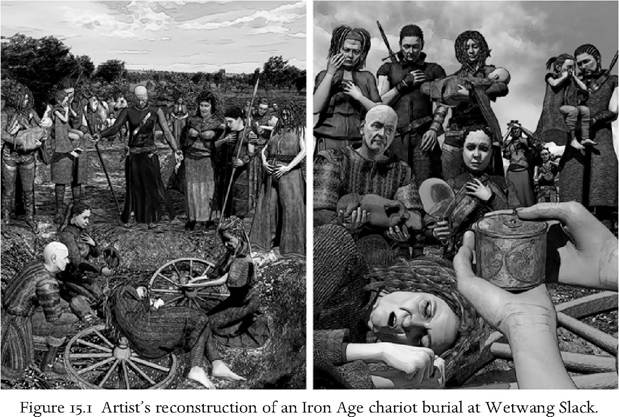
The trauma suffered reflects the use of a variety of blunt and sharp force weapons, which were particularly aimed at the head and torso areas, emphasising their lethal intent; there is also evidence for ‘overkill’ - violence exceeding that necessary to kill someone - and mutilation.1[631] The range and patterning of injuries observed in these individuals reflect violence operating at many scales, between individuals but also communities. Many are buried with weaponry, but it is not the case that everyone buried with weaponry has skeletal evidence for violence; often these weapons are broken or bent, leading to the suggestion that funerals were used as performances to create ‘martial capital’ for the community (Figure 15.1). The majority of these individuals are aged between 17 and 35 years, and their formal burial often away from their place of death strongly suggests that these are the remains of the warrior class.[632]In contrast, articulated skeletons and disarticulated bones of sub-adults and adults from non-cemetery locations have evidence for perimortem injuries that tell of overkill, dismemberment and decapitation, as well as evidence for their limbs being restrained that strongly suggests their
involvement in performative violence. At Wandlebury hill fort, in Cambridgeshire, one pit contained the upper half of a sub-adult skeleton which was buried in a sack, chest down, with their head turned to the left, indicating that the torso and head were still in articulation. There is evidence for perimortem weapon injuries to the pelvic girdle, suggesting that the lower half of the body had been removed by force. The people whose bodies were chosen to be manipulated in these ways have been rarely considered and when they have, are proposed to be ‘others', of lower status and victims of ritual violence.[633]
Another form of ritual violence which is believed to have taken place is human sacrifice.
This practice is recorded in the Roman primary sources during the Roman invasion of Britain, and for other communities in Iron Age Europe, as for example, when the Roman army fought a battle at the Isle of Mona (Anglesey), an island off the Welsh coast sacred to the Druids.[634] In Britain, the most compelling evidence comes from the bog bodies that, like others found in Ireland and northern Europe, appear to be remains of people who were purposefully killed in a highly performative manner. Examination of the stomach contents of several of these bodies suggest that they had consumed a ritual meal before death, most notably, Grauballe Man from Denmark.[635] The most famous example from Britain is Lindow Man, who was buried in a peat bog between the third century bce and the first century ce. Analysis showed that he had been garrotted, sustained multiple blows to his head, his neck had been broken, and he may have also been stabbed in the neck.[636]These damaged and manipulated bodies could also represent the captured and enslaved, and it has been suggested that any status group could be captured or enslaved in Iron Age Britain, which was renowned for this trade preConquest. There are numerous finds of shackles and gang chains in ritual deposits in liminal locations, elite burials and at hill forts, often close to the Channel coastline. No data are available for Britain but in first-century bce Gaul it is estimated that 300,000 slaves had been transported to Rome and a further 15,000 would be required every year.[637] This trade and the taking of captives in Iron Age Britain also served a purpose for indigenous communities, allowing them to import luxuries from the Continent but also to fulfil their own social and religious obligations, as described in the Roman primary sources, a trend also identified on the Continent. Anthropological research offers alternative paradigms, including their value in gift exchange and as knowledge holders of different languages, locations and cultural practices.
Only at Llyn Cerrig Bach, in Wales, in the 1940s were human remains believed to have been found in direct association with slaving equipment, but these appear to have been lost.[638]Bioarchaeological studies of the enslaved and captured from the pre- and post-contact Americas highlight general health inequalities, stable isotope evidence for dietary stress, and the presence of healed and unhealed injuries produced by assault and punishments.[639] As skeletal changes generally reflect long-term health outcomes, these indicators are tentatively examined. Comparing the individuals from Danebury hill fort and formal cemetery populations from Britain, it can be seen that there are differences in stature, age at death and other health indicators (Table 15.2), but none of these are distinctive enough to differentiate between the two burial types - as observed in the New World studies. The same is also true of the dietary stable isotope analysis of bone collagen from cemetery populations versus partially articulated or disarticulated deposits of human bone, where no differences between the two groups were found.[640] As outlined above, at present the only discernible differences are the injuries sustained shortly before death and how the body was subsequently treated. This suggests that ‘difference' resided in how individuals' bodies contributed to acts of performative violence, particularly in times of social upheaval such as that evocatively described in the Roman sources after the Island of Anglesea, in Wales, had been captured by the Roman army in 61 ce: ‘The next step was... to demolish the groves consecrated to their savage cults: for they considered it a duty to consult their deities by means of human entrails.'[641]
More on the topic Iron Age Britain:
- Iron Age Britain
- Bibliography
- CHAPTER TWO Foreign Conquest and Shifting Identities New cults and old traditions
- Fagan Garrett G., Fibiger Linda, Hudson Mark, Trundle Matthew (eds.). The Cambridge World History of Violence. Volume 1: The Prehistoric and Ancient Worlds. Cambridge University Press,2020. — 756 p., 2020
- 17 Tin Traders
- CHAPTER FOUR Town and Country Urban devotions and rural rituals
- Violence and the Archaeological Record
- Bredholt Christensen Lisbeth, Hammer Olav, Warburton David. The Handbook of Religions in Ancient Europe. Acumen,2013. — 456 p., 2013
- Violence in the Mesolithic
- GODS AND GODDESSES