Violence in the Mesolithic
The Mesolithic is often described as a period when evidence of violence is rising.[110] Sometimes this proposed rise is thought to be related to a higher level of organised inter-group conflict and violent interactions in general, as well as to a rise in population in certain areas, resulting in a higher level of territoriality, causing stress and more potential for conflicts between groups.25 In a recent report of a discovery near Lake Turkana, in Kenya, a case of potential inter-group violence is described.
The remains of twentyseven individuals were excavated along a sandy ridge and on a small mound at a site called Nataruk. Although fifteen skeletons were exposed and fragmentary, twelve fully articulated skeletons were found.26 The human remains were embedded in sediment from an ancient lagoon which was dated to around 9,500 to 10,500 years BP. A major difference to Jebel Sahaba is that these bodies were described as impiously deposited. They include male and female adults that were lying on their backs sometimes face down or in unnatural crouched positions. Trauma is described as blunt and sharp force; perforations and projectiles were found in body cavities and embedded in cranial bones. The location of the injuries is clearly concentrated on the head, and in a few instances the neck, thorax, knees and feet were affected. Another disturbing fact is that in four cases the hands of the victims seem to have been bound. This might not only indicate fighting with bow and arrow as well as blunt and sharp implements, but also the possibility of the execution of captives. The interpretation of the site has not remained undisputed, however; doubts have been raised about the existence of some of the perimortem skull trauma, the dating of the site and the claim that the bodies were not buried.27 The amount of violence present and the interpretation of Nataruk therefore has to remain open. Hopefully, a more detailed description of the find circumstances and the trauma will provide more and clearer information for this site in the future.The question of an intensification of violence in the Mesolithic compared to the Middle and Upper/Final Palaeolithic is difficult to prove based on the skeletal remains. An important aspect is the state of preservation concerning not only the quality but also the quantity of remains. The higher levels of
Conflict in Europe', British Archaeology 52 (2000): 9-12; S. Vencl, ‘Stone Age Warfare', in J. Carman and A. Harding (eds.), Ancient Warfare: Archaeological Perspectives (Stroud: Allan Sutton, 1999), pp. 57-73.
25 C. Meiklejohn et al., ‘Socioeconomic Change and Patterns of Pathology and Variation in the Mesolithic and Neolithic of Western Europe: Some Suggestions', in M. N. Cohen and G. J. Armelagos (eds.), Paleopathology at the Origins of Agriculture (New York: Academic Press, 1984), pp. 75-100.
26 M. Lahr et al., ‘Inter-Group Violence among Early Holocene Hunter-Gatherers of West Turkana, Kenya', Nature 529 (2016), 394-8, https://doi.org/10.1038/nature16477.
27 C. M. Stojanowski et al., ‘Contesting the Massacre at Nataruk', Nature 539 (2016), E8- E10, https://doi.org/10.1038/nature19778. fragmentation in the Palaeolithic, on the one hand, and the high level of preservation in Mesolithic human remains, on the other hand, lead to a noncomparable situation. In the European Mesolithic at least 1,700 burials are preserved.[111] Recent discoveries, re-dating mostly ‘Palaeolithic' human remains, and the fact that there is a considerable number of isolated human remains in the Mesolithic context has increased this number to well above 2,000 individuals. As a result, the number of traumas recorded in the Mesolithic is higher than in any other previous phases. According to a study by V. H. Estabrook[112] there are seventy-seven traumatic incidents recorded for the Mesolithic to date.
The comparison between blunt force trauma on the skull and post-cranium versus projectile injuries gives a surprising result. The number of injuries caused by projectiles (n = 17) is indeed higher than in the Upper Palaeolithic (n = 3), which is plausible due to the well-documented use of the bow and arrow. However, the percentage of projectile injuries in comparison to blunt force trauma is quite similar, with 28 per cent in the Mesolithic and 23 per cent in the Palaeolithic.It is less clear whether most of the cranial and post-cranial trauma is related to violent interactions or to accidents. Studying the injuries, the location on the body, and the taphonomic context might help to clarify the cases. As in modern forensic cases, most injuries related to violence tend to be located on the cranium, mostly on the frontal and parietal, the face (nasal bones, maxilla and mandible), as well as the lower arm (radius and ulna), resulting in so- called parry fractures of the ulna.
Some studies deny an increase of violence for the Mesolithic when comparing the evidence to other groups of sedentary or semi-sedentary hunter- gathers.[113] Even in coastal areas described as densely populated, as in the Portuguese shell middens, the rate of violent injuries recorded is very low. Most of the pathological lesions related to trauma from the region were linked with daily activities (injuries, accidents) and not with violent encounters between or within groups.[114]
In the Iron Gorge area, namely from the sites of Lepenski Vir and Vlassac, only six individuals with mostly healed lesions were identified. The injuries were mostly blunt force trauma, located on the frontal area, and indicating face-to-face fighting. On the post-cranial skeleton, a fracture of an ulna with an unhealed but survived fracture (pseudo articulation) and an embedded projectile in a pelvic bone were recorded. Due to the absence of bone remodelling the projectile injury indicated a fatal wound that was not survived for more than two weeks.
According to radiocarbon dates, most of these cases can be related to a horizon earlier than the contact between Mesolithic groups and early farmers. As a result any possible increase of violence caused by an interaction between these groups and early farmers is chronologically excluded.[115]At Schela Cladovei, where a number of individuals (15 per cent of all examined) show signs of trauma, radiocarbon dates indicate the late pre- contact/early Neolithic contact period.[116] At this site, the injuries reported are blunt force trauma, parry factures and embedded projectiles (flint tips and bone points).[117] Most of the information concerning traces of violence is, however, restricted to Area III. The radiocarbon dates here seem to group between 8,300 and 8,600 BP, that is, the period before the arrival of early farming communities. According to the pattern of injuries, these burials showing signs of violence that could represent either a single episode of group violence or a series of related events within a short time span. As both sexes were victims of violence it might be plausible to think of a whole group being targeted, indicating inter-group conflict that may be called warfare or raids. Especially, the occurrence of projectile injuries seems to cluster in the Late Mesolithic of the area. Violence seems to have occurred variously during the Mesolithic at the Iron Gorge; these violent encounters within or between groups cannot be associated with early farming communities.
A unique scenario is represented by the Dnjepr Rapids cemeteries Vasilyevka I—III in the Ukraine, dating to the transitional period between the Final Palaeolithic and the Epipalaeolithic, between 10,800 and 9,980 BP. In total, the three sites contain eighty-two burials in mostly flexed positions. In six cases, several projectiles were found in close association with the skeletons, without damaging any bone. Some of the individuals were hit by several projectiles.[118] This might indicate an ambush situation similar to the Late Neolithic case at Eulau from Saxony-Anhalt.[119] According to the evidence from Vasilyevka III, it seems plausible that younger adults aged 18-35 years were targeted.
The loss of reproductive males and females from a fisherhunter-gatherer community might have had a serious impact on this population.The evidence of violence in northern central European and Scandinavian regions is mostly limited to burials from the Kongemose and early Ertebolle culture (c. 8,400-5,400 BP), but one case dates to the earlier Maglemose culture (c. 10,800-8,400 BP).[120] In southern Sweden and the eastern part of Denmark in particular, a large numbers of burials are represented, including those from cemeteries (Vedb^k-Bogebakken and Skateholm). In total, there are twenty-one individuals from Denmark and Sweden with definite and possible injuries caused by blunt instruments and projectiles. Most injuries, especially skull traumas, were healed. The location of the injuries on the frontal and parietal bones makes it likely that all these injuries were caused by violence. Only two victims were female, with a severe case from Vedbx’k- Gongehusevey showing a deep impression.[121] Only three cases show evidence for projectile injuries from arrows, in two cases with bone points.[122] All injuries were fatal shots, in two cases in the pelvic area (Stora Bjers, Skateholm I, grave 13) and in one case (Vedb^k-Bogebakken 19A) between the lower cervical vertebrae of the neck. In total the percentage of individuals with fatal injuries from burials in Denmark and Sweden is below 3 per cent. Individuals showing blunt force trauma is 12 per cent for Denmark and 6.5 per cent for Sweden.
A different story are the so-called ‘skull nests' from the Ofnet Cave in Bavaria, southern Germany. Excavated in 1907 by Robert Rudolf Schmidt, these finds represent an extraordinary feature. The skulls have been radiocarbon dated to the Late Mesolithic, between 7360 ± 80 bp and 7560 ± 110 bp (OxA 1571,1572,1573,1574,1575).[123] Deposited in two pits at the entrance of the cave, thirty-four skulls with mandibles and cervical vertebrae were found in anatomical connection, indicating a quick deposit after death.
In nine cases, the third or fourth cervical vertebra exhibit cut marks from the separation from the trunk. Together with the heads of twenty children (mostly below 6 years of age) and fourteen adults (mostly between 20 and 30 years of age), personal ornaments were deposited.[124] One hundred and eighty-eight perforated red deer canines and 3,773 perforated snail shells are preserved.[125] Together with their careful placement and the use of red ochre, these ornaments indicate a deliberate burial of the heads. Despite the fact that only the heads were deposited, the feature matches Mesolithic burial traditions. A ritual treatment of the heads and a deliberate burial seems plausible.Quite early on, after the first morphological analyses of the skulls at the beginning of the twentieth century, signs of violence were recognised by Mollison while re-analysing the remains.[126] He assumed that axe-like weapons were responsible for the lesions and the fragmentation of the skulls. In the 1990s two independent studies were carried out focusing on the trauma of the Ofnet skulls.[127] The results differ in several aspects, but it became clear that a minimum of eight individuals show traumatic lesions caused by fatal blows
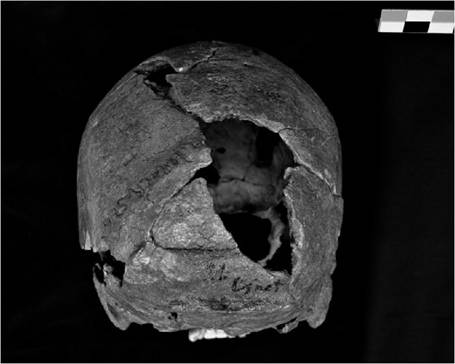
Figure 2.3 Ofnet, Germany, occipital view of skull 21 of a young adult male with various lethal traumas.
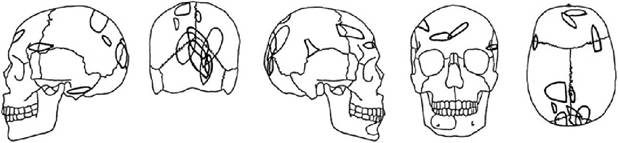
Figure 2.4 Ofnet, Germany, location of blunt force trauma on at least eight individuals from the large head deposition.
to the head. In several cases, the traumatic character of the lesions could not be clarified. The reason is the fragmented nature of several skulls, especially those from children and the intensive reconstruction that has been carried out with plaster and other materials. In most cases the outline of the impact is unambiguous although variable, which might be the result of the use of different weapons and/or different angles in which the axes penetrated the skulls (Figure 2.3). Looking at the location of the injuries it becomes clear that most (eight) are located in the occipital (posterior) part of the skull. In two cases four injuries are located on the frontal and the parietals (Figure 2.4). Injuries located in these areas seem to be restricted to male individuals. This might point to a scenario where males opposed the attackers while women and children tried to flee from the attack but were struck from behind and killed. It remains, however, an open question if and how the remaining individuals whose skulls do not exhibit any kind of trauma were killed.
The skull nests and their interpretation are a highly debated topic. There are two basic questions, Is Ofnet a single event, or did the heads accumulate over several hundreds of years? In addition, is there a connection between the violent death of these individuals and the fact that the heads were cut off and only then were buried? AMS measurements of bone fragments from five Ofnet skulls give a Late Mesolithic age. The dates have a range of about 600 years between 6100 and 6700 bce. This allows for an interpretation of a simultaneous burial event, as well as a successive deposition of the heads. The heads were placed within two pits, a larger and a smaller one. This might indicate that the structures have a differing age. In order to answer that question, a new joint project in which all of the skulls will be reanalysed concerning trauma and AMS dating, including the use of Bayesian modelling, is being carried out at the Universities of Berlin, Hamburg and Oxford.[128]
Similar to Ofnet is the find from Hohlenstein-Stadel. There we find a deposition of three heads in a pit filled with red ochre: an adult male, an adult female (20-30 years) and an infant aged 11-2 years were discovered in the entrance area of the Stadel cave. Twelve perforated teeth of Rutilus meidringeri, a cyprinid fish, were found associated with the female skull. The fish teeth probably belonged to some kind of ornament placed around the neck or head of the deceased woman. The skulls were placed carefully within the small pit, with the male in front and the female close behind. The small child's head was found beside the female individual. An AMS date of the male individual gave an age of 7835 ± 80 bp (ETH-5732) or 6743 ± 139 bce placing the deposition of the heads in the Late Mesolithic. The vertebrae of both adults show cut marks resulting from a careful separation of the head from the body. The skulls of the adult individuals also show signs of perimortem blunt force trauma, which led to the death of both individuals. The skull of the infant did not reveal clear signs of trauma but showed the pathological indication of hydrocephalus, a disease with variable causes and very heterogeneous aetiology, resulting in an enlargement of the skull by an increase in volume of skull fluid.[129] Additional finds of isolated skulls associated with mandibles and upper cervical vertebrae such as Kauftersberg, Lkr. Donau-Ries and the skull from Oberlarg, Mannlefelsen, in Alsace show several similarities to the Ofnet and Stadel skulls. Direct AMS dates are missing from both sites and a number of differences are evident in comparison. Only the skull from Mannlefelsen shows cut marks related to skinning/scalping and signs of burning, but a fatal blunt force trauma is also evident.[130] The occurrence of fatal skull injuries at Ofnet, Hohlenstein-Stadel and Mannlefelsen raises the question of an increase of violent behaviour during the Late Mesolithic of central Europe. A recent study of ornaments (perforated shells and red deer canines) from the Ofnet skull nests not only revealed a complex acquisition pattern but also an active large-scale exchange network in the Late Mesolithic.[131]
Conclusion
The question of whether violence within and between groups played an important role in the Palaeolithic and Mesolithic is still difficult to answer. Recent publications clearly indicate that it has gained more and more importance. Earlier approaches to the interpretation of trauma in the Palaeolithic and Mesolithic in comparative studies by Fergusson and Estabrook were limited by various factors.[132] Besides the fact that preservation and the incomplete osteo- logical record limit diagnosis and quantification, another problem is evident: in cases where a clear trauma is diagnosed, distinguishing between accident and interpersonal violence seems problematic.
During the older Palaeolithic from the Middle Pleistocene onwards, only a few finds seem to point to isolated cases of violent behaviour. None of them seem to have been fatal with the exception of the individual represented by cranium 17 from the Sima de los Huesos at Atapuerca, which might be the first evidence of intra-human killing. In the Middle Palaeolithic the lesions found on the remains of Neanderthals are mainly located on skulls and upper extremities. A major focus of recent studies has been on Neanderthals, resulting in a number of published reports. Several injuries can be related to interpersonal violence but might also be the result of risky hunting strategies. Violence seems to have played a role in the formation of this pattern of trauma; however, this pattern of traumatic lesions is not only restricted to Neanderthals but is also found in later hunter-gatherers of the Upper Palaeolithic and in Homo sapiens. Human remains from the Gravettian, which are more numerous, show a number of healed trauma wounds on the skulls that did not penetrate the bone.
The Sunghir I burial provides striking evidence for lethal violence in the Upper Palaeolithic. The impact of a projectile is found in one of the thoracic vertebra. This first case of a killing with a spear projectile is followed by other cases in the Final Palaeolithic and Epipalaeolithic in Europe and the Near East where the first lethal and survived injuries from arrow projectiles are documented. Further evidence for projectile injuries and for blunt force trauma is documented for the European Mesolithic or the post-glacial Epipalaeolithic in other regions. Sites like Nataruk, at Lake Turkana, Kenya, and Jebel Sahaba in Sudan seem to indicate a new dimension in intra-human violence. These sites present the first conflicts of a larger scale at the end of the Palaeolithic or the transition to the Epipalaeolithic. The question of an intensification of violence in the Mesolithic compared to Palaeolithic times cannot be proved based on skeletal remains. The good state of preservation and the numerous burials with about 2,000 individuals preserved is certainly the reason why this period is often described as a violent one. Sites like Ofnet, however, do show that the potential for conflict was present in the Mesolithic, and violent encounters sometimes resulted in an intentional killing of individuals or even groups of people. Another aspect, however, is that besides violent behaviour there is also sporadic evidence for treatment and care of injured and impaired individuals. The cases of Saint-Cesaire, Shanidar 3 and Qafzeh 11 show that Neanderthals and early modern humans took care of injured people, whether they survived trauma caused by accident or interpersonal violence or other diseases. Neanderthal individuals like Shanidar 1, who suffered a number of degenerative diseases, trauma, atrophy of the right arm, probably blindness of the left eye as well as hearing loss, were able to reach an age of about 40 to 50 years.[133] Without the help of their group, including treatment of their wounds and daily support, these injured or impaired people would have been unable to hunt or collect food and would have been vulnerable to larger carnivores, which were ubiquitous in their habitats. Although the degree of support that would have been necessary for their survival remains unclear, the presence of social support for Pleistocene and early Holocene hunter-gatherers is undisputed.
Due to the increase in interest in the topic of violent behaviour among prehistoric hunter-gatherers, it seems plausible to suggest that more cases from the Palaeolithic and Mesolithic will be diagnosed in the near future. Besides all the restrictions that have been mentioned, it seems clear that violence does not occur more often in Neanderthals than in later and probably earlier times. Violence seems to play a significant role not only in recent hunter-gatherers and nomadic groups, but also among Palaeolithic and Mesolithic hunter-gatherers.[134]
More on the topic Violence in the Mesolithic:
- Violence in Palaeolithic and Mesolithic Hunter-Gatherer Communities
- Mesolithic Geopolitics
- Violence against the Self, State Violence and Interpersonal Violence
- Within the world history of violence the Bible is relevant for our reconstructions of the lived experience of violence among ancient Israelites and Judeans;
- The theme ‘religion and violence' or ‘religious violence' gained worldwide attention after the terrorist attacks on the Twin Towers and the Pentagon in 2001.1
- The Interwar Moment: Violence versus Non-Violence
- Violence and representations of violence abound in the literature of ancient and late antique Judaism and Christianity.
- The advent of the Early Historic period in northern India in the sixth and fifth centuries bce saw the emergence of monarchical and oligarchic states and the beginnings of a sustained discussion of the relationship of kingship with violence and non-violence.
- Chapter IV Growing Up with Violence in Northern Ireland: Making Meaning of Institutionalized Violence
- The archaeological evidence for violence and for the symbolic representation of violence in Iron Age Europe is abundant and complex.
- Violence, Non-Violence, the State and the Nation: India, 1858-1958
- Imperial Chinese society accepted and even lauded certain types of violence. Fundamental views of sanctioned violence developed in reaction to that culture's particular views of masculinity.
- This chapter examines the diverse communities of Britain from the ninth century bce to the early fifth century ce, and uses a Web of Violence model to examine the archaeological and primary source evidence for violence in both periods.
- Werner Reiss, author of the most detailed recent discussion on the subject of violence in the Greek world, defined violence as ‘a physical act', stating further that it is a ‘process in which a human being inflicts harm on another human being via physical strength’.1
- To ask what state-sanctioned violence meant in medieval Japan (1185-1615) is to be confronted with two attendant questions: what counted as violence; and what counted as state-sanctioned?
- Kingship, Violence and Non-violence in Indian Thought, c. 500 bce to 500 ce
- Towards a Theory of Violence
- Examples of Violence
- Sexual Violence