The Interwar Moment: Violence versus Non-Violence
The after-effects of the First World War led to a substantial escalation in nationalist activity in India. The Rowlatt Satyagraha was called by Gandhi in protest at the extension of wartime powers to peace, and it was these protests that led to the Jallianwalla Bagh massacre in 1919.
The Non-Cooperation Movement in 1921-2 foregrounded the state's extreme violence as a show of weakness: state violence actually worked to strengthen the moment of Gandhian ‘non-violence'. Their mutual dependence is clear from the circle of events: and the Non-Cooperation Movement cited ‘the Khilafat wrongs' (the post-First World War treatment of Turkey by the Allies) and ‘the Punjab wrongs' (the collective abuses following the declaration of martial law in the province in 1919) as the basis of the movement. Yet Gandhi abruptly withdrew from the movement just as it was building momentum, following an incident in a small town in the United Provinces in 1922, when protesters retaliated against police violence in Chauri Chaura, killing twenty-three Indian police officers. Gandhi was promptly arrested, and upon his release spent much of the next six years in his ashram, to concentrate on what he saw as his constructive programme to reform a community of Indians who would be worthy of independence. Crucially, the power of non-violence relied upon state violence, as was clear from Gandhi's emphasis on martyrdom (through the deaths of activists following state imprisonment or confrontation); otherwise the staging of a moral confrontation did not work.[107]Gandhi re-emerged onto the political scene in late 1928, at a time when anticolonial violence had begun to dominate both nationalist and state attention. A revolutionary movement came to the fore of national politics in late 1928 in north India, following the assassination of a British policeman who had taken part in an attack on a non-violent protest against the Simon Commission in Lahore, which led to the death of a prominent Congress leader.
Acts of colonial police brutality, the assassins declared, would not go unavenged; non-violence could not be taken for granted. A sharp rise in political violence directed at Britons followed, as lone individuals followed the example of revolutionary organisations who aimed to use violence to galvanise nationalist opinion in their favour. This violence was seen by its protagonists, a rather articulate group of young men who wrote and published in defence of their actions, not as individual acts of heroism, which they ultimately considered futile, but as the basis for a wider mass organisation that was unwilling to compromise with British rule. A number of these revolutionaries were reading the literature of a spectrum of leftist thought, relating their own life-worlds and politics to these ideologies. This included a nascent communist movement, which the government sought to define and isolate as foreign-funded and alien to India, in the process ironically drawing more attention to Marxist thought.[108] Moreover, many revolutionaries, and some ostensibly on the side of non-violence, understood that for non-violent agitation to be effective, its alternative, violence, had to be existent.[109] The public celebration of those accused of political violence prompted the British to craft a special ordinance under emergency provisions to allow for ‘terrorists' to be tried in absentia and away from the scrutiny of the media, denying them the publicity they had enjoyed, and enabling them to be sentenced to death or awarded life imprisonment.The Civil Disobedience Movement (1930-4), often thought of as Gandhi's second non-violent mass campaign, can therefore be seen as his strategy for reorienting political energies away from anti-colonial violence. The presence of violence on the political spectrum in the interwar years served to highlight Gandhi's desirability as a political opponent and interlocutor. In 1931, he emerged as a viable political leader (as opposed to the leader of a seditious movement), eligible to meet and to ‘parley on equal terms' (as Winston Churchill indignantly scoffed) with the Viceroy, and later with the King himself.
This is starkly highlighted by poems and cartoons published at the time of Gandhi's visit to London for the second Round Table Conference, in which he was depicted toothless and shirtless; a stark contrast to his European radical or fascist contemporaries, arrayed in shirts marked black, brown, red and green (Figure 3.1). The British endorsement of Gandhi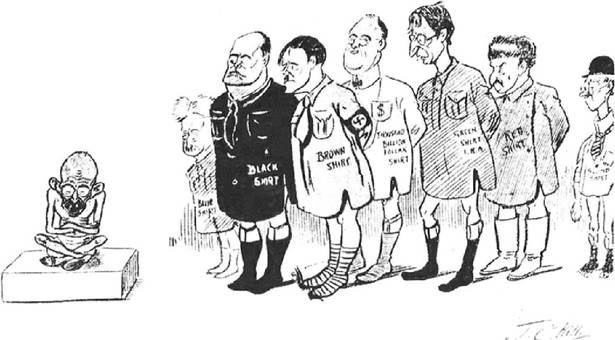
THE SHIRTED AND THE SHIRTLESS
Figure 3.1 J. C. Hill, ‘The Shirted and the Shiftless', Auckland Star, New Zealand, 1931.
as a mediating figure, and of non-violence as a legitimate form of anti-colonial action, rendered political violence all the more illegitimate. In this respect, during the interwar years, the government of India and Gandhi seem indistinguishable in their insistence on non-violence.
The importance of appearances and visibility is crucial in understanding the operation and the limits of state violence in British India. The success of nonviolence as a political strategy in the interwar years can in some measure be explained by the performativity of satyagraha, crucial to which was the concept of a global audience for the media. A peaceful protest of Sikhs at Guru Ka Bagh in Amritsar in 1922 was met with police brutality, captured on film by an American cinematographer, A. L. Varges - a testament to photography’s capacity to ‘poison’ the state by producing devastating images of evidence.[110] The Salt March, which concluded with the clubbing of Indian volunteers by police in Dharasana, was covered by an American journalist, Webb Miller; his coverage is generally credited for winning American sympathy for Gandhi’s politics.[111]
The Indian National Congress - formerly a loose organisation that accommodated a range of political opinion - substantially tightened in the interwar years, as Gandhi sought to dominate the movement while increasingly organising along essentially religious lines. Gandhi, compelled to include in his movement persons of lower-caste origins, referred to in a patronising manner as ‘harijans’ or ‘children of god', was unable to include Muslims within a Hindu-inflected rhetoric of belonging. Many of his movements made conditions of everyday life, even survival, difficult or impossible - akin to upper-caste denial of water and food to lower castes - making the claims of non-violence difficult to justify.[112]
More on the topic The Interwar Moment: Violence versus Non-Violence:
- Intra-societal Violence versus Warfare
- Violence against the Self, State Violence and Interpersonal Violence
- Within the world history of violence the Bible is relevant for our reconstructions of the lived experience of violence among ancient Israelites and Judeans;
- The theme ‘religion and violence' or ‘religious violence' gained worldwide attention after the terrorist attacks on the Twin Towers and the Pentagon in 2001.1
- Violence and representations of violence abound in the literature of ancient and late antique Judaism and Christianity.
- The advent of the Early Historic period in northern India in the sixth and fifth centuries bce saw the emergence of monarchical and oligarchic states and the beginnings of a sustained discussion of the relationship of kingship with violence and non-violence.
- Chapter IV Growing Up with Violence in Northern Ireland: Making Meaning of Institutionalized Violence
- The archaeological evidence for violence and for the symbolic representation of violence in Iron Age Europe is abundant and complex.
- Violence, Non-Violence, the State and the Nation: India, 1858-1958
- Imperial Chinese society accepted and even lauded certain types of violence. Fundamental views of sanctioned violence developed in reaction to that culture's particular views of masculinity.
- This chapter examines the diverse communities of Britain from the ninth century bce to the early fifth century ce, and uses a Web of Violence model to examine the archaeological and primary source evidence for violence in both periods.
- Werner Reiss, author of the most detailed recent discussion on the subject of violence in the Greek world, defined violence as ‘a physical act', stating further that it is a ‘process in which a human being inflicts harm on another human being via physical strength’.1
- To ask what state-sanctioned violence meant in medieval Japan (1185-1615) is to be confronted with two attendant questions: what counted as violence; and what counted as state-sanctioned?