Violence and the Archaeological Record
Archaeological signatures of violence are discussed by various authors in this volume and Table 7.1 presents some widely agreed criteria. As discussed below, with the exception of scalping and cannibalism, evidence for almost all of the criteria is found in Japan from the Yayoi period onwards.
Skeletal Trauma
Individual finds of arrowheads embedded in human bones and other similar, clear-cut traces of violence have long been known in Japan as elsewhere. However, since physical anthropologists have historically been most interested in addressing questions of population affinity, they have often underestimated the evidence for skeletal trauma. Where research has specifically focused on traumatic injuries in prehistoric material, many additional
Table 7.1 Widely found archaeological signatures of violence
Skeletal trauma
Weapons/military equipment
Settlement
Burials
Artistic depictions
Ritual treatment of weapons
Weapon trauma, parry fractures, scalping, cannibalism
Specialised homicidal tools, shields, armour
Fortifications, inaccessible village locations, refuge sites
Mass graves with trauma, ‘warrior' graves Depictions of weaponry and/or actual conflict Special depositions, hoards, etc.
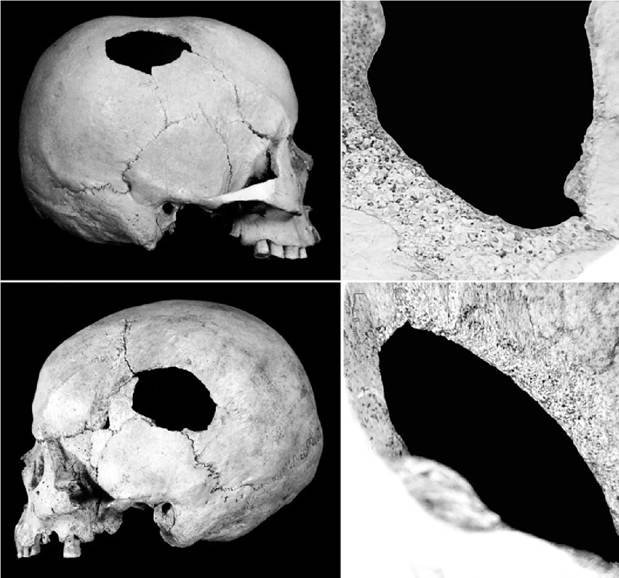
Figure 7.2 Perimortem blunt force injury on the right parietal of an adult probable female from the Late Jomon site of Sakaeiso, Shimamaki (top) and adult female skull of the Epi- Jomon found at Minami-Usu 6 (bottom), with images on right showing internal bevelling.
evidence for lethal injury - in the form of blunt force injuries to the cranium and embedded stone and bone projectile points in the post-crania with no signs of healing - providing a prevalence of 1.8 per cent of adults dying violently.[324] The authors of this study conclude that this is a low prevalence, but such literature-based reviews are problematic and further research would certainly increase this figure.
As one example of this problem, we offer the case of a large perimortem blunt force injury on the right parietal of an adult probable female from the Late Jomon site of Sakaeiso, Shimamaki, southern Hokkaido (an island not represented by any injuries in Nakao and colleagues' overview) (Figure 7.2). Another example involves an adult female skull of the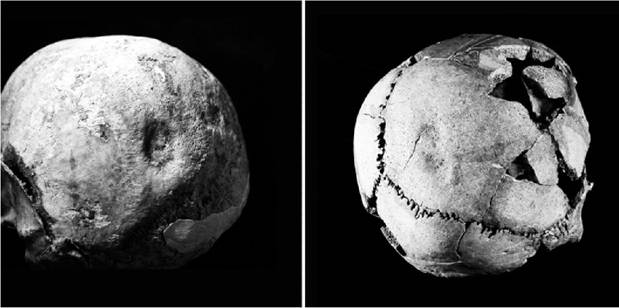
Figure 7.3 Blunt force cranial injuries from Kitakogane (left) and Takasago (right).
Epi-Jomon (a period excluded from Nakao and colleagues' study) found at the Minami-Usu 6 site, in southern Hokkaido. The published account of this skull focused on craniometrics to show a close affinity with Ainu skulls, but also mentioned as an aside the presence on the left parietal of ‘an egg-sized bony defect... presumably due to an artificial injury'.[325] This cranium was recently re-examined by Rick Schulting, who confirmed it as a case of perimortem injury (Figure 7.2). Blunt force cranial injuries with evidence of healing also occur in Hokkaido and the other islands, affecting both females and males (Figure 7.3). These cases are in the process of being systematically compiled.
Reports of violence for the Yayoi period can be found in Chinese chronicles such as the Wei zhi, which describe a state of warfare in western Japan in the third century ce. Without more texts, however, only archaeology is able to offer some traces of violence and warfare for the preceding centuries. In his reviews of warfare during the Yayoi, Hashiguchi collected data for western Japan on up to 262 cases of violence at 118 sites (either traces of violence on bones or weapon tips excavated from tombs that were assumed to have been originally lodged inside victims).[326] Cases from northern Kyushu alone represented 228 examples from 97 sites. Among all these cases, 21.2 per cent date from the Initial and Early Yayoi, 64.3 per cent from the Middle Yayoi, and 6.8 per cent from the Late Yayoi, leaving 7.7 per cent not related to any specific phase.
The over-representation of northern Kyushu and the Middle Yayoi is a preservation bias due to the tradition of burying the dead in huge jar coffins during that phase. However, the detailed data for the Middle Yayoi show that the first third of that phase appears to be far more violent (34.8 per cent of all cases) than the second (18.6 per cent) and final thirds (10.9 per cent).Among the cases identified by Hashiguchi, forty-two are clear traces of wounds on bones, either cuts, missing heads or halberd/sword/arrowhead tips stuck into bones. The earliest individuals showing traces of violence known for this period date to the transition between the Final Jomon and the beginning of the Yayoi. Two individuals from the Nagano Miya-no-mae site (Fukuoka) are thought to have suffered a violent death. In tomb 12 the bones have not been preserved but the body location is indicated by black pigment that originally covered the corpse. Two stone arrowheads of Korean style have been found in the chest area, both missing their tips and stems, a fact which led archaeologists to exclude them being burial goods. In tomb 5 at the same site, a stone arrowhead with a missing tip was found in the body area and interpreted in the same way. The first certain traces of violence from weapons left on bones is at the Shinmachi site (Fukuoka), dating from the transition between the Initial and Early Yayoi. This is a male individual from the stone-lined wooden coffin tomb 24-1, who has the tip of a stone polished arrowhead of Korean willow-leaf type embedded in his left femoral head. Two other fragments of this arrowhead were found around the femur and the position of these finds suggest that this individual was struck from above and behind. No traces of healing have been observed on the femur, so it was concluded that this wound - or others received at the same time - had caused this individual's death.
These traces of violence on individuals from the beginning of the Yayoi are all related to settlements of the first rice farmers who came from the Asian continent during the period.
Until the middle of the Early Yayoi phase, all these finds are situated in the northern coastal areas of Kyushu. Following this, during the second half of the Early Yayoi and the first half of Middle Yayoi, traces of violence extend to the interior of Kyushu in the Saga, Chikugo and Nakatsu plains, and then to the Kumamoto plain and Iki and Hirado in Nagasaki. This period corresponds with the time when the first bronze weapons appear in tombs in northern Kyushu. Then, from the middle of the Middle Yayoi phase onwards, traces of skeletal violence seem to disappear from northern coastal Kyushu and increase rapidly in the Saga and Chikugo plains. We know, for example, of an adult male who bears traces of a blow from a blunt object on his forehead at the Kuma Nishioda site (Fukuoka), two examples of heads buried alone at Kuma Nishioda and Fujisaki (Fukuoka), and two examples of beheading at Yokokuma Kitsunetsuka (Fukuoka) and Yoshinogari (Saga). Moreover, at the Nagaoka site (Fukuoka prefecture), six individuals show multiple wounds, as do several others at Kuma Nishioda. At the same time, the first traces of violence on human skeletons begin to be found in the Inland Sea and Osaka Bay areas, including sword injuries at Minamikata (Okayama) and Tamatsu Tanaka (Hyogo).[327]Burials
The Jomon period lacks so-called warrior graves. Graves with multiple individuals are known from several Jomon sites, often representing secondary burials of disarticulated and rearranged remains, but no direct evidence of skeletal violence has so far been reported from these. By contrast, ‘warrior graves' containing elaborate weaponry have been found from the Middle/ Late Yayoi onwards.[328] The first set of bronze weapons of Korean origin is found in the M3 wooden coffin tomb in the Yoshitake Takagi site (Fukuoka prefecture) at the beginning of the Middle Yayoi phase. Two bronze swords, a bronze spearhead and a bronze halberd were deposited along with a Korean-style bronze mirror, beads and a small pottery jar.
These (sword, spear and halberd) are the three main bronze weapons for the Middle Yayoi period. Seven other tombs on the same site contain one bronze sword each. For the Middle Yayoi, this kind of tomb is limited to the northern Kyushu- Yamaguchi area; tombs with weapons begin to appear outside this area from the Late Yayoi onwards. According to Terasawa's database ofYayoi tombs in western Japan, tombs containing bronze or iron weapons represent 63.2 per cent of the tombs containing burial goods.[329] Tombs containing weapons are more frequent during the Middle Yayoi (79.9 per cent of all tombs with burial goods for this phase) than during the Late Yayoi (54 per cent). Unfortunately, as Terasawa does not mention the overall total of tombs, it is impossible to estimate the importance of tombs containing weapons among the total of tombs known for the Yayoi period (the scale is 438 tombs with burial goods against several thousand tombs lacking goods). The number of tombs containing weapons varies from site to site, generally concentrated in areas reserved for the elites, as in Yoshitake Takagi, Yoshitake Oishi, Yoshitake Hiwatari, Tateiwa (Fukuoka), Karakodai (Ehime) or Miyauchi funkyubo (Tottori). Most of the tombs contain only one weapon (81.9 per cent of the tombs of the northern Kyushu Middle Yayoi and 66.7 per cent of the tombs of the Late Yayoi), generally a bronze or iron sword, sometimes a bronze halberd.Weapons and Artefacts of Violence
One of the problems with discussing Jomon conflict is the apparent absence of specialised weaponry. But the lack of formal weapons is not uncommon in hunter-gatherers and simple horticulturalists worldwide. Instead, everyday implements such as stone-headed axes, clubs, spears and the bow and arrow are brought to bear as and when required. The lack of any elaboration of weaponry may relate more to the absence of a specialised class of warriors who seek to differentiate themselves within their community through material culture.[330] A further issue is that, given the inclination to downplay violence, objects that could have been used for this purpose tend to be interpreted as something else.
The stone ‘rods' (sekibo) that are a feature of the Jomon period, for example, have usually been interpreted as ritual phalli, though Yasushi Kosugi has argued for their use as clubs in conflict,[331] and they indeed could have been responsible for the kinds of blunt force cranial injuries noted above. Late and Final Jomon examples sometimes have a flatter shape possibly influenced by bronze knives from northern China, leading them to be termed stone ‘swords' (sekken or sekito).The first weapons clearly not for hunting (unlike arrowheads, which can be used to hunt game or people) are polished stone daggers of the Initial and Early Yayoi phases. These items are mainly found in tombs that show a special status (such as the shisekibo tombs with large capstones that are termed ‘dolmens' in the West) and are clearly associated with individuals with an important social - and probably political - status. They originated on the Korean peninsula and were one of the numerous elements that were imported into northern Kyushu by immigrant farmers. When deposited complete in tombs, they are no doubt markers of status. Yet the tips of such daggers have also been found in tombs, such as burial jar 3 at the Sudare site (Fukuoka), where the tip was stuck between the second rib and second vertebrae of the buried individual.
Bronze weapons appear from the beginning of the Middle Yayoi in northern Kyushu and the Yoshitake Takagi cemetery (Fukuoka) is reputed to be the first site to hold them. These weapons (bronze swords, halberds and spearheads) are mainly found in tombs and are sometimes associated with Korean and then Chinese bronze mirrors for the richest burials.
Iron weapons appear in tombs in northern Kyushu at the end of the Middle Yayoi and replaced almost all bronze weapons and stone arrowheads during the Late Yayoi phase. Iron swords and arrowheads predominate, with some spearheads and halberds. In the Middle Yayoi iron weapons are associated with Chinese bronze mirrors and glass beads in the richest tombs of northern Kyushu. They also begin to appear in tombs outside Kyushu at the end of the Late Yayoi. All these weapons, in bronze or iron, are first imported from the continent, mostly from the Korean peninsula but several Chinese weapons are known too, such as the bronze sword from the Yoshinogari mounded tomb. Weapons of Korean style are produced locally in regional centres, while the Chinese ones are seldom imitated.
The most numerous weapons during the Yayoi period are sling stones (mainly found in settlements ditches) and arrowheads. Arrowheads are first made of stone, then of bronze (Middle Yayoi) and finally iron (Late Yayoi). Yayoi arrowheads were mainly used to hunt, but we can be sure they were also used as weapons as many examples have been found embedded in human skeletons, such as individual 124 at the Doigahama site (Yamaguchi), who had thirteen such embedded stone arrowheads. Some wooden weapons are also known, such as clubs, daggers or swords, halberds, arrowheads and bows. Wooden breastplates have been found at several sites including Minamikata (Okayama) and Sasai (Fukuoka). At Sasai, a breastplate was found with two fragments of a wooden lacquered shield, both dating from the Late Yayoi. The breastplate is decorated with incised strips of triangles and braided patterns and the shield is lacquered red on one side and black on the other. This is not only specialised armour but also suggests that, at least for some, war was a high-status activity. The wooden daggers and swords could suggest formal training in combat.
More on the topic Violence and the Archaeological Record:
- As the archaeological record shows, mass violence with lethal intent has been a part of human history for at least several thousand years.
- The archaeological evidence for violence and for the symbolic representation of violence in Iron Age Europe is abundant and complex.
- Archaeological Evidence for Violence in the Later Stone Age
- The Record of German Violence
- This chapter examines the diverse communities of Britain from the ninth century bce to the early fifth century ce, and uses a Web of Violence model to examine the archaeological and primary source evidence for violence in both periods.
- In dealing with archaeological materials, some fundamental differences distinguish the study of religion from other archaeological sub-disciplines, such as subsistence, trade or social structures.
- Record
- THE ARCHAEOLOGICAL CONTEXTS
- A MULTITUDE OF ARCHAEOLOGICAL MATERIALS
- 4 Record of condition of holding and fixed equipment
- Article 6.1 Triple C bond sales hit record high
- Article 3.1 Foreign investors dump Treasuries at record pace
- Archaeological Implications and Predictions
- Regional and Archaeological Setting
- Article 8.7 Eurozone borrowing costs hit record low
- Article 4.12 Asian credit markets expand at a record pace