Archaeological Evidence for Violence in the Later Stone Age
The first archaeological evidence from southern Africa indicating violent death was a skeleton recovered at Quoin Point, near Cape Agulhas, in the middle 1960s.11 Unfortunately there was little burial information as the bones were exposed by dune deflation and were recovered from the surface, but a radiocarbon date of 2220 ± 40 years bce (Beta 241163) has placed the burial securely within the Later Stone Age.
The evidence of violence on the skeleton is unambiguous: two bone arrow points are embedded in the lower thoracic vertebrae of the young adult female skeleton (Figure 4.1). Reconstruction of the events at death indicated that the victim was likely to have been lying on the ground in a prone position when the arrows were shot into her lower back. Although the exact cause of death could not be confirmed, the unhealed wounds suggested that death occurred soon after injury.The identification of violence in the case of the Quoin Point specimen was straightforward, but cases where the instrument of injury is no longer present are much more difficult to confirm. In order for a bone fracture to indicate intentional violence, it must be unlikely that it resulted from an accidental or disease process. Traumatic bone lesions can be classified into those that occurred antemortem (with evident signs of healing), perimortem (without healing but with signs of bone damage while still ‘green') and post-mortem (with signs of dry bone damage after soft tissue decomposition). Cranial lesions provide the most solid evidence of violent intent when the nature of
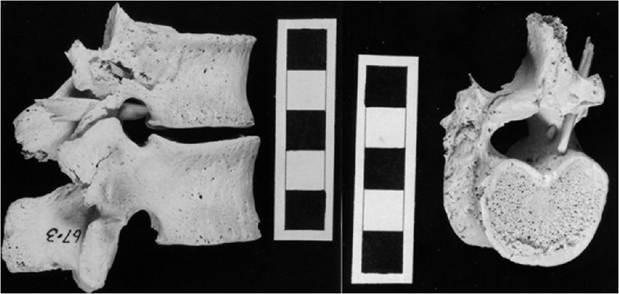
Figure 4.1 The 12th thoracic and 1st lumbar vertebrae of UCT 317 (Quoin Point) showing bone arrowheads in situ. Scale in cm. Left: right lateral view; right: inferior oblique view.
the impact point can be identified, and these can be seen as depressed bone segments or radiating fractures.
It is never possible to be absolutely sure whether an injury was due to accident or violent intent where the evidence is based solely on bone fractures, but similar patterns of injury over many individuals is strongly suggestive of non-natural injury.12Susan Pfeiffer and I have been independently reviewing the osteological evidence for violence in the Later Stone Age of southern Africa, examining human skeletons dating from the middle to late Holocene between 8,000 to around 2,000 years ago. We have found twelve cases with seventeen individuals where violent events can be identified.[186] [187] Table 4.1 lists each of these cases in order from unambiguous at the top to cases with weaker evidence towards the bottom.
The most obvious cases are where remains of the implement that caused the injury are still present. Quoin Point has already been mentioned, but
| Case* | Sex | Age | Wound | Reference |
| UCT 317 Quoin Point | female | 20-30 | Bone arrowheads in thoracic vertebrae | Parkington & Morris, 'Prehistoric Homicide’ |
| Durban Museum Ballilo Bay B | male | >40 | Stone flake in healed cranial lesion | Pfeiffer, 'Two Disparate Incidences’ |
| SAM 6054 a,b,c Modder River | 3 children | 1,6 & 12 | Cranial trauma from implement Depressed fractures with radiating cracks | Pfeiffer & van der Merwe, 'Cranial Injuries’ |
| SAM 6348 a,b | female & | adult & | Perimortem cranial trauma | Pfeiffer et al., 'Violent Human |
| Melkbosstrand | child | adolescent | Death’ | |
| UCT 332 Langklip | female | adult | Perimortem cranial trauma | Morris, 'Trauma and Violence in the LSA’ |
| UCT 372 Sniufklip | male | >5° | Two antemortem cranial lesions | Morris et al., 'Human Remains from Snuifklip’ |
| Faraoskop | ||||
| UCT 386 | male | 40-50 | Perimortem radiating cranial | Parkington & Dlamini, 'First |
| UCT 387 | female | 30+ | fractures | People’; Dlamini, 'Notes on |
| UCT 394 | female | + /-50 | Faraoskop’ | |
| A 2787 Andrieskraal | male | old | Antemortem depressed fracture with radiating cracks | Pfeiffer, 'Cranial Trauma’ |
Table 4.1 (cont.)
| Case* | Sex | Age | Wound | Reference |
| A 1187 Whitcher’s Cave | unknown | adult | Antemortem depressed fracture | Morris, 'Trauma and Violence in the LSA’ |
| SAM 6372 a Saldanha Bay | female | adult | Bone point found near cervical vertebrae | Dewar, 'Late Holocene Burial Clusters’ |
| UCT 591 Büffel’s Bay | male | adult | Bone point associated with skeleton | Pfeiffer, 'Population Dynamics’ |
| NMB 5 Plettenberg Bay | female | 30-50 | Healed cranial lesions, possibly caused by animal attack | Pfeiffer, 'Two Disparate Incidences’ |
* UCT (Department of Human Biology, University of Cape Town); SAM (Physical Anthropology Collection, Iziko Museums, Cape Town); A (School of Anatomical Sciences, University of the Witwatersrand); NMB (National Museum, Bloemfontein)
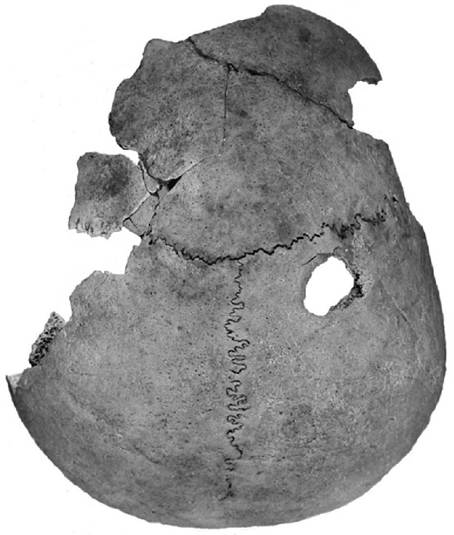
Figure 4.2 Superior view of cranial vault of UCT 332 individual 3 (Langklip) showing perimortem injury on the right parietal caused by a bluntly pointed object.
Pfeiffer has identified another case from Ballito Bay on the Natal coast where an embedded stone fragment remains in a healed cranial lesion in an older male.[188] [189] A second set of individuals (from Modder River, Melkbosstrand, Langklip and Snuifklip) all demonstrate very distinctive cranial lesions.15 The point of impact is localised and suggests a bluntly pointed implement with a narrow circular diameter as the agent of injury (Figure 4.2).
In the case of Snuifklip, the individual survived the assault, whereas at Modder River, Melkbosstrand and Langklip the injuries are perimortem. The next set of cases (Faraoskop, Andrieskraal and Whitcher's Cave) indicate a blunt form of trauma with radiating cracks extended from a broader impact site.[190] The two individuals from Andrieskraal and Whitcher's Cave survived the impact and subsequent cranial fractures, but the cranial damage at Faraoskop is more extensive and perimortem in origin. Of the six crania and mandibulae preserved (from thirteen individuals), Nonhlanhla Dlamini is convinced that four show perimortem injuries consistent with violence, of which the three reported here (UCT 386, UCT 387 and UCT 394) clearly demonstrate trauma with radiating fractures leading off from a specific point of impact.1[191] UCT 386 and 387 show classic ‘coup-contrecoup' injuries where a crushing blow is delivered to one side of the head on the ground resulting in additional radiating fractures from the location of the skull in contact with the substrate (Figure 4.3).Two sites noted by Pfeiffer and Genevieve Dewar have the weakest evidence, but still could be included in this sample.1[192] While the specimens from Saldanha Bay and Buffel's Bay do not show bone trauma, either antemortem or perimortem, in each case bone arrowheads similar in form to the two recovered with UCT 317 at Quoin Point were found in direct association with the bones.[193] These were not grave goods and could conceivably have been artefacts included with the grave fill, but at least in the case of the woman from Saldanha Bay, the bone point was in close association with the cervical vertebrae suggesting that it was lodged in the covering soft tissue before decomposition. The last case (NMB 5), from Plettenberg Bay, is a reminder that injuries could have other causes unrelated to interpersonal violence. Pfeiffer has proposed that the series of three healed lesions are consistent with bite marks from a large predator such as a brown
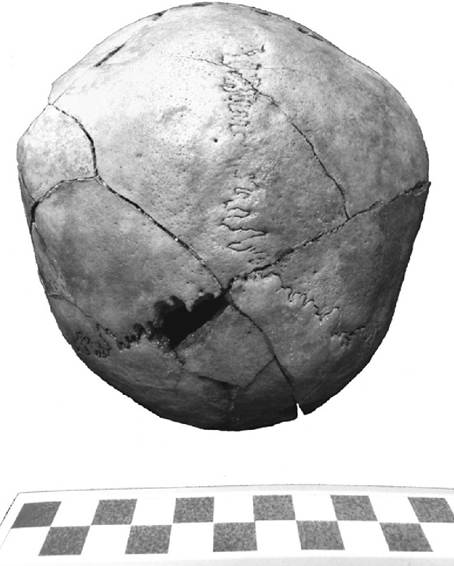
Figure 4.3 Posterior view of cranial vault of UCT 386 (Faraoskop) showing impact point on left side and radiating fractures on both sides of the skull.
Scale in cm.hyaena.[194] In this case, the person suffered significant injuries but must have survived the attack.
Summarising eleven sites (excluding the Plettenberg Bay case as a possible animal attack), there are some obvious patterns. Men, women and children were all victims and, in some cases, the wounds suggest that there could be no other reason for the violence except to kill the person. Pfeiffer has described the three children from a single grave at Modder River where each child had been killed by cranial trauma from an implement that is consistent with a Later Stone Age digging stick. Pfeiffer in particular has focused on the time and geographic location of these events. Only one case is not from the western or southern Cape coastal region, and there is a particular cluster of cases from the 150-kilometre-long coastal belt running north from Cape Town. Nine of the skeletons have been dated to between 2,100 and 2,700 years ago, with a mean of around 2500 bce.
More on the topic Archaeological Evidence for Violence in the Later Stone Age:
- The archaeological evidence for violence and for the symbolic representation of violence in Iron Age Europe is abundant and complex.
- Later Stone Age Violence in Context
- Violence during the Later Stone Age of Southern Africa
- This chapter examines the diverse communities of Britain from the ninth century bce to the early fifth century ce, and uses a Web of Violence model to examine the archaeological and primary source evidence for violence in both periods.
- The sacred from the Stone Age to the present and back again
- Violence and the Archaeological Record
- There are many items testifying to religious or ritual activity in the rich archaeological material of the Nordic Bronze Age (1700-500 BCE).
- ‘Knocking Her Teeth out with a Stone': Violence against Women in Ancient Greece
- As the archaeological record shows, mass violence with lethal intent has been a part of human history for at least several thousand years.
- In dealing with archaeological materials, some fundamental differences distinguish the study of religion from other archaeological sub-disciplines, such as subsistence, trade or social structures.
- As far back as we can trace it, Roman religion was multi-cultural. Archaeological evidence demonstrates that in terms of religion and other cultural components early Rome was influenced by Etruscans, Greeks and even Carthaginians.