Later Stone Age Violence in Context
The interpretation of the bone lesions is difficult. It is always possible that some could have been accidental, but the context of the skeletons and their archaeological association tends to confirm non-natural injury.
Pfeiffer has looked at the pattern of healed trauma on the long bones of human skeletons from 152 South African Later Stone Age specimens. Healed fractures were found in eleven individuals and the location distribution is consistent with accidental injuries - the most common sites being the radius and ulna. All of the fractures were without complex breakage patterns and no fractures were found on any femur, the largest post-cranial bone element. Although both men and women were affected, there was ‘no observation of healed trauma to any juvenile post-crania and crania' despite the presence of the five cases of healed cranial trauma in adults.[195] Yet four out of sixteen individuals with signs of violence (25 per cent) were juvenile and all were perimortem.As already noted, Lee described a significant number of violent deaths from interpersonal contact among the Kalahari San whom he studied.[196] Almost always it was men who were victims and the cause was invariably sexual jealousy. The weapon used was almost invariably a poisoned arrow. The pattern seen in the archaeological specimens is entirely different. Men and women were victims but there were also children prominent among the dead. In possibly three cases an arrow was involved (assuming that the presence of bone arrowheads in close approximation to the body was linked to the cause of death) but in at least six cases the injuries to the crania were caused by a small bore stick-like instrument, and in a further four or more cases the cause of death was blunt trauma. In a world where the poisoned arrow was the ultimate arbitrator of arguments, why kill your neighbours with the violence of the bludgeon?
Pfeiffer has presented a model in which community distress was the trigger for these prehistoric events of violence.23 She has combined a range of archaeological and environmental data to suggest that the time period of 3,000- 2,000 years ago was one of depleted resources and an intensification of residence at specific sites where food was more available.
This was especially true along the west coast of Western Cape Province where huge shell middens (‘mega-middens') of shellfish remains were accumulated in this period. Pfeiffer has paired with this the biological observation that body size among these people was more variable during this time because it included some exceptionally short adults. She has suggested a causative negative link between population density and stature[197] and has suggested that intensification of territoriality in the southern and south-western Cape resulted in ‘non-egalitarian social structures' reflected in inter- (and perhaps intra-) community violence.[198]Anthony Humphreys has come up with a broader proposition that would be applicable to a more general view of the hunter-gatherers in the region.[199] He argues that the rich linguistic variation across the Kalahari is inconsistent with regular contact and inter-marriage (gene flow) between groups. It only makes sense if territory is fixed and language is being used as an ethnic marker. His argument is rooted in behavioural ecology in which genetic relatedness and rigid ethnic identity would be more important than reciprocity and altruism between strangers. Violence would be a regular occurrence between bands as they contest territorial ownership. This would be consistent with Pfeiffer's stress period for the south-western Cape coast, but Humphreys would extend it to all of the foraging groups over a wider range of time; not just for specific periods of environmental tension. Modern ethnography has given possible glimpses of such a model. Hilary Deacon and Janette Deacon refer to the restricted territories of Kalahari language groups and note that within a given territory specific bands have water sources which they regard as their own.[200] Other bands may access these resources, but permission must be requested before they do. Since water is the scarcest resource in the desert environment, it is not unexpected that these water sources would be actively defended.
Ardrey (who had a vested interest in showing the San to be aggressive) noted that ‘Bushmen may wound an animal in the Kalahari Desert; but, famished though they maybe, they will not follow it if the animal crosses the neutral zone into the next band's territory.'[201]
There are also some historical data that suggest that the San, at least to outsiders, were far from ‘harmless' and were seen as dangerous adversaries to be feared. These historical descriptions are not unbiased, reflecting as they do the period of intense conflict between the San and European colonists in South Africa and Namibia between the eighteenth and the early twentieth centuries. During this period the San were entirely dispossessed of their lands and livelihood in a manner which can only be described as genocidal.[202] The San began to use stolen or traded European firearms as this war progressed, but primarily used the bow and poisoned arrow in its initial stages. The San do not appear to have possessed weapons specifically designed for war; their spears, arrows and sticks were all part of their hunting and gathering tool kit. The lethality of poison was of particular importance and the use of this weapon by the San, especially in the form of ambush, had a significant psychological impact on the invaders, as is evidenced by this oral testimony from Bantu speakers in nineteenth-century Natal: ‘an Umutwa is there under the grass; and the man feels when he is already pierced by an arrow; he looks, but does not see the man who shot it. It is this, then, that takes away the strength; for they will die without seeing the man with whom they will fight.'[203] Both Guenther and Robert Gordon have described how European colonists' views of the San changed.[204] Throughout the eighteenth and nineteenth centuries the San were depicted by colonists as ‘murderers' and ‘bandits', and the shift to ‘harmless people' or ‘tame Bushmen' only came as their power to fight back failed.
Even though the fight between the San and the colonists was very unequal, the San were able to invoke significant fear along the colonial margin with their comparatively limited weapon technology.The rock art of the San also provides some testimonies of San conflict in the few hundred years before historical contact. Patricia Vinnecombe
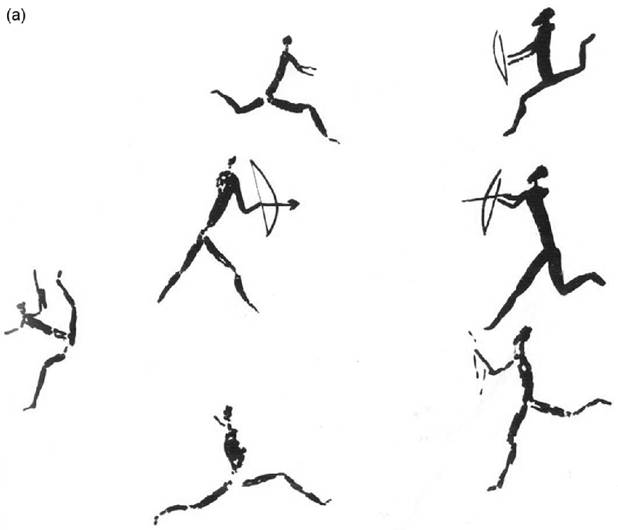
Figure 4.4 Tracing of rock art from Hippo Shelter, Qacha's Nek, Lesotho, showing men fighting with bows and arrows.
surveyed the art of the Drakensberg Mountains for her seminal 1976 study.[205] She identified 115 images of fighting out of 4,530 images recorded. The weapons recorded were bows and arrows and knobbed sticks. A few pictures were of San fighting other San (Figure 4.4), but conflict with Nguni cattle keepers was also recorded (Figure 4.5). Although these pictures are older than the historical record, they are still relatively recent in terms of the great depth of the Later Stone Age in southern Africa. The pictures only record men fighting and there are no signs of women or children as opponents or victims.
The historical and rock art data do suggest that foraging communities in southern Africa indeed had the occasion and capacity to inflict violence on each other in the recent past, but it is very unlike the archaeological evidence of violent injury from the earlier sites. The intense warfare between incoming Bantu speakers and European settlers was different and cannot be
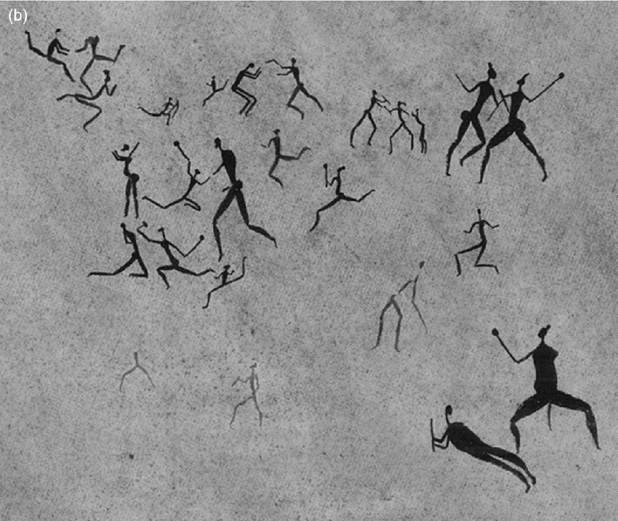
Figure 4.4 (cont.) Tracing of rock art from Hippo Shelter, Qacha's Nek, Lesotho, showing men fighting with knobbed sticks.
accepted as a pattern typical of the period earlier than 2,000 years ago. The archaeological evidence from the skeletons suggests that violence was regular but relatively rare, usually involving only one or two individuals.
But there are glimpses that such violence had at times escalated to broader conflict.Pfeiffer and colleagues have described the three fatally injured children from one grave,[206] but the Faraoskop site may have involved as many as thirteen individuals. The site at Faraoskop is still under active investigation, so any conclusions about the skeletons remain preliminary. There are several clues in the archaeology that indicate that all of these individuals may have died in the same event. The radiocarbon dates for the six dated skeletons cluster around 2030 bce and are within one standard deviation of the mean. The burials do not have the usual ritual patterns seen in graves from the same period, and John Parkington has argued that the bodies were all buried at the
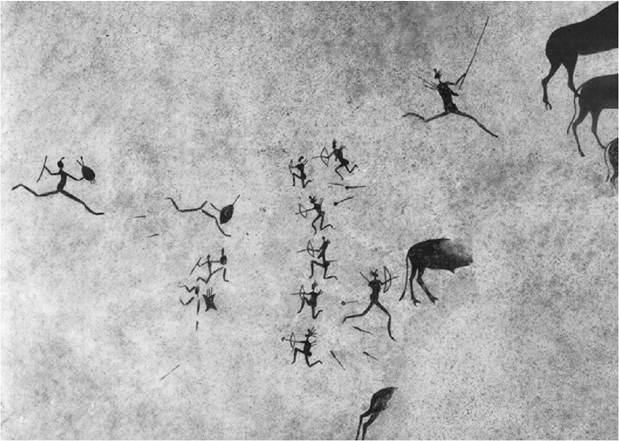
Figure 4.5 Tracing of rock art from Mpongweni north Forestry Reserve, Pholela, Underberg District Natal, showing San with bows and arrows defending against pursuing Nguni carrying spears and shields.
same time. Dlamini's careful skeletal analysis tells us that at least three and possibly more of the people were killed by physical trauma.[207] Parkington and Dlamini have gone so far as to suggest that this was ethnic conflict between a San band and incoming Khoekhoe pastoralists, but more information is needed before this is confirmed. The argument for violent ethnic conflict at Faraoskop is strengthened by the results of a recent investigation at West Turkana in Kenya.
Twenty-seven individuals were recovered from the site of Nataruk at a location which would have been a shallow lagoon in early Holocene times.[208] The people were hunter-fishers who lived somewhere between 9,500 and 10,500 years ago. Twelve individuals were articulated skeletons excavated in situ and the balance of the individuals were bones exposed on the surface by erosion.
There were no formal burials and the particular preservation of the site indicates that the bodies decomposed in various postures after death. Twenty-one were adults and six were children. Eight males and eight females were identified from sexual features of the skeleton. Five, possibly six, cases of sharp trauma were found on the head or neck. There were five cases of blunt force trauma and three microlithic artefacts were found within or embedded in two of the bodies. Marta Lahr and colleagues[209] have speculated that Nataruk reflects an intensification of settlement and a ‘materially richer, and demographically denser way of life', which may have triggered this antagonistic encounter between two social groups.How far back can we trace this evidence of prehistoric violence between African foragers? With the exception of the site at Nataruk, there is nothing in sub-Saharan Africa which suggests large-scale violence. The scale of violence at Nataruk (and possibly Faraoskop) would be consistent with the kinds of violence seen in the historic period between San and invading Bantu speakers and Europeans, but it remains inconsistent with the cases seen in my and Pfeiffer's analysis of the skeletal remains. We can envision a pattern where low levels of violence were always present between neighbouring bands resulting in occasional mortality, but this might have been triggered into intensive conflict because of special circumstances when resources were constrained. But why aren't more cases present throughout sub-Saharan Africa over the whole of the Later Stone Age starting from 100,000 years ago? There are probably several reasons. The concept of analysing human skeletons in what we would call a ‘bioarchaeology' context is relatively new. Nearly all of the studies of skeletons excavated before 1950 concentrated on the race of the individuals to the exclusion of palaeopathology and the reconstruction of past lives.[210] And even though bioarchaeological studies became more common in the 1970s and 1980s, researchers did not look specifically for signs of violence because of the underlying assumption that all of the foraging populations of Africa were non-violent. The last reason has been the difficulty in differentiating between perimortem and post-mortem injuries to bone. The flowering of forensic anthropology in the last two decades has sensitised researchers to look for evidence of events at death. The only paper in southern Africa that talks about violence in the archaeological context is that of Biden and Kling.[211] They identified without evidence
Violence during the Later Stone Age of Southern Africa elaborate and imaginary funeral rites including murder of the wife on the death of the husband. Although their interpretation of the skeletons is not valid, the lesson learned now is that all multiple burials need to be closely reexamined to see if indeed there are signs of violent death.
Direct archaeological evidence of ancient violence has changed our interpretation of aggression in the foraging groups of the Later Stone Age in southern Africa. The descendants of these people, who culturally survived into modern times, were thought to be an example of non-aggressive egalitarian foragers, but the picture from the past suggests more complex roots. Although intra-community violence has been noted among the living San in the form of murder of males over sexual jealousy, the evidence from the past suggests that antagonism between groups was a regular, if perhaps not common, phenomenon. Men, women and children were affected, and although evidence of death by arrow has been recovered, most of the cases involved trauma caused by a narrow or blunt instrument. Pfeiffer in particular argues that this violence is focused in one region over a specific time period, but other models suggest the practice may have been more widespread [212] The evidence presented here is drawn solely from the Holocene Later Stone Age of southern Africa, but it does suggest that we must not assume that low density prehistoric foragers were by nature non-aggressive. We need to be exceptionally careful in using modern or historical ethnographic material, especially that drawn on the Kalahari San.[213] Although sites like Nataruk and possibly Faraoskop indicate that large-scale violent events similar to historical events did occur in the past, the pattern of violence seen more generally in the archaeological record is very different.
More on the topic Later Stone Age Violence in Context:
- Slaughter and Celebration in a Nilotic Context
- Lawless Violence and Impunity in the Age of Electoral Democracy, c. 1990 to the Present
- Index
- This chapter examines the diverse communities of Britain from the ninth century bce to the early fifth century ce, and uses a Web of Violence model to examine the archaeological and primary source evidence for violence in both periods.
- Violence and the Archaeological Record
- Conclusions
- REFERENCES
- THE FATHERS OF HUMANKIND
- Notes
- S.C. Roy and Socio-Religious Dimension of the Oraon Worldview