Southern Africa
In southern Africa, the Neolithic transition was a shift from hunting-gathering into herding, not into farming and stockbreeding as in Europe. Another difference is that the speed was 1.4-3.3 km/y (Jerardino et al.
2014), therefore substantially faster than in the European case (previous section). From Fig. 5.1 we thus expect that the value of C (and, therefore, the cultural effect) will be higher in southern Africa than in Europe. This is indeed the case, as we shall now see. Figure 5.2 is the equivalent for southern Africa to Fig. 5.1 for Europe. Thus Fig. 5.2 follows exactly from the same model as Fig. 5.1. The curves are not the same in Figs. 5.1 and 5.2 only because the dispersal kernel (set of dispersal distances and probabilities) used was measured for populations of herders (Fig. 5.2) rather than farmers (Fig. 5.1). The kernel of herders (used in Fig. 5.2) was determined from 4,483 parent-offspring birthplace distances of herders collected by Mehrai (1984). But comparing Figs. 5.1 and 5.2, we note that the waves of advance of farmers and herders are in fact similar. Indeed, the speed obtained without cultural transmission (C = 0) is about 1 km/y in both figures, and the fastest possible speed (C to) is again similar (about 3 km/y). Therefore, as expected, the fastest speed for the southern African Neolithic (1.4-3.3 km/y, horizontal rectangle in Fig. 5.2) as compared to Europe (0.7-0.9 km/y, horizontal rectangle in Fig. 5.1) implies higher values for C in Fig. 5.2 (e.g. C = 10) compared to Fig. 5.1 (C < 2.5, black area in Fig. 5.1). This is why we find that the cultural effect was stronger in the southern African Neolithic. For example, without taking into account the effect of cultural transmission (C = 0) the predicted speed is about 1.0 km/y (0.9-1.2 km/y), whereas for ethnographically realistic values of C (6 < C < 15, see Ref. (Jerardino et al. 2014)) the speed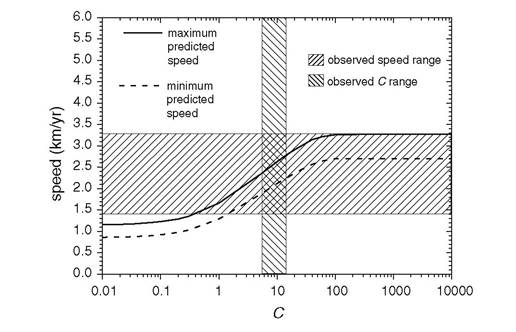
Fig. 5.2 The speed of the Neolithic transition in southern Africa, as a function of the intensity of cultural transmission C. The horizontal hatched rectangle is the observed speed range of the Neolithic transition in southern Africa, and the vertical hatched rectangle is the observed range for the intensity of cultural transmission from hunting-gathering into herding. Adapted from Ref. (Jerardino et al. 2014)
increases up to 2.8 km/y. Thus the cultural effect is about 60 % (more precisely, 57 ± 6 % (Fort 2012)) in southern Africa.
We conclude that the Neolithic transition was mainly demic in Europe (cultural effect about 40 %, i.e. 50 %, as explained in this section). Because the reproductive and dispersal behavior of both populations (farmers in Europe, herders in southern Africa) is likely similar (Jerardino et al. 2014), this difference could be due to a higher ease for hunter-gatherers to learn herding in comparison with farming.
5.6
More on the topic Southern Africa:
- Introduction
- Bovine Tuberculosis (BTB) in Cattle in Zambia
- Zimbabwe Village Savings and Loan Associations
- Bovine Tuberculosis in Zambian Wildlife
- Prevention and Control of BTB
- Policy Provisions for Bovine and Zoonotic Tuberculosis in Uganda
- Diagnosis of Bovine Tuberculosis in Zambia
- Towards the domestication of Rwandan genocide trials
- Other Mycobacterial Infections in Livestock and Wildlife in Tanzania
- Bovine Tuberculosis in Malawi