Europe
The integro-difference cohabitation model that refines Eq. (5.2) by taking into account a set of dispersal distances per generation and their respective probabilities (see Sect. 5.2) has been applied to the Neolithic transition in Europe (Fort 2012).
The results are reproduced in Fig. 5.1, where the horizontal hatched rectangle is the observed speed range from the archaeological dates, namely 0.9-1.3 km/y (Pinhasi et al. 2005). The vertical hatched rectangle is the observed range for the intensity of cultural transmission C from hunting-gathering into farming, according to ethnographic data (Fort 2012). The upper curve is the maximum predicted speed, i.e. that obtained from the model for the fastest observed reproduction rate of human populations that settled in empty space (aN = 0.033 yr-1) and the lowest observed value for the generation time (T = 29 yr). Similarly, the lower curve is the minimum predicted speed, i.e. that obtained from the model for the slowest observed reproduction rate of human populations that settled in empty space (aN = 0.023 yr-1) and the highest observed value for the generation time (T = 35 yr). Note that without taking into account the effect of cultural transmission (C = 0), the predicted speed is about 0.8 km/y (0.7-0.9 km/y), whereas for consistent values of C the speed increases up to 1.3 km/y. Thus the cultural effect is about 40 % (more precisely, 40 ± 8 % (Fort 2012)).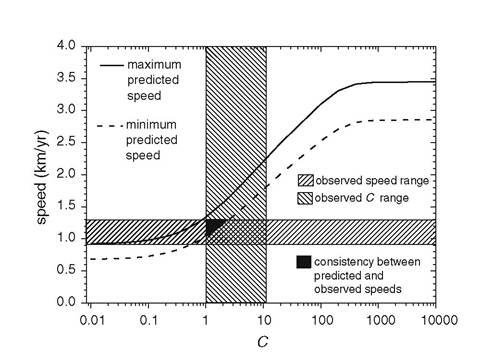
Fig. 5.1 The speed of the Neolithic transition in Europe, as a function of the intensity of cultural transmission C. The horizontal hatched rectangle is the observed speed range of the Neolithic transition in Europe (Pinhasi et al. 2005), and the vertical hatched rectangle is the observed range for the intensity of cultural transmission from hunting-gathering into farming (Pinhasi et al. 2005). Adapted from Ref. (Fort 2012)
5.5
More on the topic Europe:
- 20 The New Eastern Europe
- Muslims as a “Religious Minority” in Europe
- The idea of Europe
- Muslims and the idea of Europe
- Western Europe
- What Is Eastern Europe?
- The Slavs of Eastern Europe
- 19 The Quest for Europe
- Neutrality in Cold War Europe
- 11 Meanwhile in Europe
- Chapter 1 Roxolana in Europe[88]
- The United States, containment and Western Europe
- Light and Darkness in Eastern Europe
- The Expansion of Europe
- Islam in Eastern Europe and the Soviet Union
- The Ukrainians of Eastern Europe
- The Trough of Violence in Europe
-
Conflictology -
Ecology -
Economy -
Finance -
History -
Law -
Medicine -
Philosophy -
Religious studies -