Taiping Rebellion
The smaller rebellions of the mid-Qing were a foreshadowing of the massive explosion of religious violence that broke out in the second half of the nineteenth century. The first and greatest of these events occurred in the mountainous southern province of Guangxi.
It began with the career of Hong Xiuquan (1814-64), who, like so many thousands of other aspirants, had spent much of his life training and studying to take the imperial Confucian examinations, the gateway to a lucrative and prestigious position in the imperial bureaucracy. Competition for these positions was extremely intense, and after four attempts Hong had still not passed the shengyuan licentiate, the bar for entry into the ranks of the literati. It was at this point that he decided to act on a fever dream that he had had some time earlier. In this dream, Hong had met an old man who gave him a sword and commanded him to cast out demons (two motifs from Daoist exorcistic practice) and a younger man, who referred to Hong as his younger brother. Drawing on a missionary tract that he had received some years earlier, Hong interpreted these two figures to be the Christian God and Jesus, respectively, and took the dream as a sign to start a religious movement that became known as the ‘Teaching of the God Worshippers' (bai shangdi jiao). During the late 1840s, he and about 10,000 of his followers left their homes and moved to remote Zijing Mountain. Alarmed by the group's growth and its secrecy, the local Qing garrison (the Green Standard Army) launched an ill-fated assault on the community in 1850. The heavily militarised and well-organised community easily repulsed the Qing troops, and beheaded the commander. Now in open rebellion, the society abandoned any pretence of Qing loyalty, growing their hair long in contravention to the requirement that all men shave the top of the head in Manchu style, and earning the movement the nickname of the ‘hairy rebels' (fafei). Early in 1851, Hong completed the act of rebellion by proclaiming the foundation of a new kingdom, the Heavenly Kingdom of Great Peace (Taiping tianguo). Over the next two years, the armies of the Taipings (as Anglophone contemporaries came to term the movement) campaigned across a swath of southern China, easily defeating demoralised Qing troops, and growing in number with each victory. In 1853, they captured the city of Nanjing, which they renamed as Tianjing, literally the ‘Heavenly Capital' of the new kingdom.The unique beliefs and meteoric rise of the Taipings raise the questions of how deeply religion shaped the movement and how violent was their religion. The initial attraction of the movement was clearly shaped by the difficult conditions of life in mountainous Guangxi, a rough area of illegal mines, timber forests and ethnic division (Hong himself was a minority Hakka), where state influence and protection were only occasionally in evidence. Religious brotherhoods thrived in areas like this, and the appeal to the downtrodden remained a prominent attraction as the movement advanced. Peasant grievances were immediately reflected in the utopian promises that the Taipings made: redistribution of land, food to all who labour, the expulsion of the foreign Qing dynasty and restoration of the just and natural order. Such promises were stock features of peasant rebellions as early the second century CE, when an identically named millennial kingdom was established in the south-west.[65] At the same time, Hong's unique religious ideas pervaded the movement's numerous public statements. While still on Zijing Mountain, the movement banned a series of vices including opium, concubinage and prostitution, as well as women's footbinding, a Han Chinese custom that was not shared by the Hakka. More important, the place of Hong as the Heavenly Sovereign and of the movement as the legitimate government of China was always portrayed in terms of dispelling evil, punishing demons and serving the will of the Heavenly Father.
Taiping propaganda portrayed the foundation of the eternal realm as a divine command, and thus a responsibility from which none could shrink. An 1852 proclamation to the people of Hunan was typical of the rhetoric of the movement, casting the struggle in Manichean terms of absolute good and evil, in which the Manchu Qing were literal demons:Our Chinese empire has now received the great favor of the Great God who has ordered our Sovereign, the Heavenly King, to rule; how can the occupation and prolonged misrule of the Manchu barbarians be permitted to continue? You gentlemen have for generations resided in China; who among you is not a Child of God? If you can uphold Heaven in destroying the demons... you shall be a hero without compare in the mortal world, and in the heaven you shall receive glory without bounds. If instead you cling to your delusions, protect the false and reject the true, in life you will be a barbarian and in death a barbarian demon. Between obedience and disobedience there is a great principle.[66]
The Taiping advance was not just a military assault, it was also a chastisement of the institutions of the Qing. Once in power, the Taiping state maintained its face of uncompromising puritanism, but also became rent by internal division and a constant need for resources. As a result, the ‘Great Peace' was anything but peaceful. The Taiping capital was beset by struggles between the subordinate commanders known as the ‘Five Kings', and devolved into an ‘arena of carnage, greed and paranoia'. Suspicious of a plot by the ‘Eastern King' Yang Xiuqing, Hong ordered an attack on Yang and his entourage, initiating two weeks of slaughter in which 20,000 were killed. Foreign observers were initially intrigued by reports of a Christian rebellion, but such interest was short-lived. Beyond the problem of Hong's own beliefs, it became clear that the Taiping state was bad for business. Unwilling to accept the Taiping ban on the opium trade, British and French representatives in Shanghai quickly turned against the movement, even going as far as to provide the support of mercenary troops.
But even with such help, suppression of the Taipings was far beyond the capabilities of regular Qing forces, and eventually led to the formation of new types of locally led and financed units, most notably the ‘Ever Victorious' Hunan Army of Zeng Guofan.[67] Military action began in i860 and ended with the capture and sacking of the capital in 1864 (Figure 2.1). Hong Xiuquan himself had died of food poisoning before the final collapse of his movement. Victorious Qing troops disinterred his corpse, which they cremated and then shot out of a cannon, thereby denying a resting place to his spirit.The death total of the rebellion is extremely difficult to calculate. The conservative estimate of 20 million people killed would make it by far the deadliest event of the nineteenth century, vastly more so than either the Napoleonic Wars or the American Civil War. But the real number may
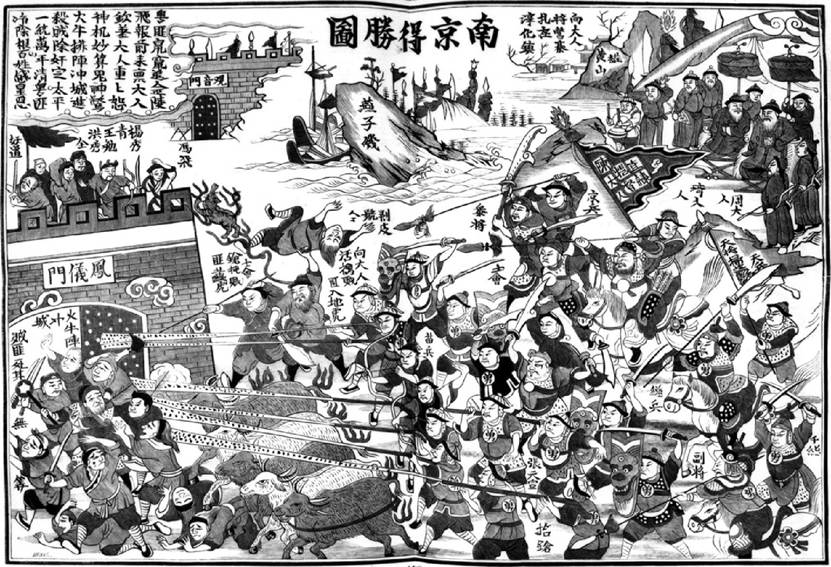
Figure 2.1 Qing troops storming the Taiping capital of Nanjing. The lower left-hand comer shows the tactic of driving cattle set on fire to burst the city gates.
have been much higher. The siege and capture of fortified cities was often followed by an orgy of recriminatory slaughter of the civilian population, and some important cities such as Anqing changed hands multiple times. Beyond the violence of the rebellion and its suppression, the destruction of supply routes, market towns and rice fields decimated an already precarious countryside, sending waves of refugees (and with them an outbreak of cholera) into safe havens such as Shanghai. The combined effect of these disasters completely depopulated vast swaths of one of China's most productive agricultural regions. In 1855, Guangde County in southern Anhui had a population of nearly 310,000. Ten years later, just over 5,000 remained, and within a generation newly arrived migrants would come to make up five out of six of the county's residents. Even with repopulation policies in place, the region was slow to recover. The 1953 population of four central provinces (Zhejiang, Anhui, Jiangsu and Jiangxi) was still nearly 20 million lower than it had been a century earlier.[68]
More on the topic Taiping Rebellion:
- Taiping Contemporaries
- Rebellion, Baghy
- Women as war leaders during the Great Andean Rebellion
- Religious Rebellion and a New Era
- Religion and Rebellion in China after Antiquity
- Religion as a Discourse of Opposition and an Inspiration for Rebellion
- REBELLION
- The British Rebellion
- Rebellion and Violence in Vietnam
- Rebellion in the Trinh Realm
- 12 Resistance, Rebellion, and the Subaltern
- Conclusion
- At its peak in the mid eighteenth century, the Chinese Qing dynasty (1644-1911) was arguably the world's strongest, wealthiest and most flourishing polity.
- The Jurist-Judge in al-Andalus: Ibn Rushd al-Jadd
- Women’s identity and gender relations in Aceh
- Like the other enduring empires in East Asia, the Han and the Qing, the Tang dynasty was an age of transformation.