Religious Violence and its Suppression
Qing law outlined a wide-ranging list of religious offences, demanding strangulation or exile for any who ‘pretend to summon noxious spirits, compose charms, chant incantations over water, perform spirit writing and pray to sages...
[those] who deceptively appear to be engaged in good works; and arouse and mislead the common people'.1 The breadth of this statute, copied almost word for word from the code of the preceding Ming dynasty (1368-1644), itself suggests the interests of the imperial state in [60] controlling religion, and, conversely, the wide diversity of phenomena that might be characterised as religious violence.Defining religion in expansive terms, we may consider these expressions of religious violence broadly in three categories.[61] The first is the violent suppression by the imperial state of threats to its moral and spiritual hegemony. As evinced in the calendar of rituals for the emperor and his ministers to thank Heaven (Tian) for the blessings of agriculture, the imperial state took literally its injunction to act both as the Son of Heaven and as the one and only linchpin in the moral universe. It could brook no pretenders to this claim. The emergence anywhere in the realm of parallel magic, unauthorised ritual or strange portents was no mere annoyance, but rather an existential threat to the legitimacy of the dynasty, and one that would justly be dealt with in the harshest terms.
The second was violence that was mobilised or aided by religion. Ordinary acts of banditry and criminal violence drew upon a pervasive tradition of protective magic, such as the use of charms, ashes and blessed water, as well as various dietary, ritual and martial arts techniques that promised to render the user invulnerable to harm. Religious ritual also provided the bond that held together legal structured organisations such as lineages, as well as illegal ones, such as sworn brotherhoods.
From a law-and-order perspective, such organisations could cut two ways. Intergenerational lineages provided stability and structure to rural society, but could also resort to violence in protecting or expanding their economic interests. Sworn brotherhoods, often characterised as ‘secret societies', in fact included a wide spectrum that ranged from criminal organisations to self-protection societies, the latter being especially important to vulnerable populations such as masons, soldiers, silver or coal miners, barge pullers or porters. Like lineages, these populations developed an internal hierarchy and identity around rituals and deities, often unique ones, and, like them, used the structure created by ritual to enable these groups to mobilise to defend themselves and their interests.[62]The third and most direct expression is violence that was directly instigated by what Qing law would have regarded as ‘perverse' (xie) religious ideas, notably the tradition of millenarianism that circulated freely within popular religious thought. Millenarian themes, such as the notion of sacred time, ran deep within the established orthodox traditions of Confucianism, Daoism and Buddhism. Over time, these three traditions merged into a popular eschatology based around a deity called the Eternal Venerable Mother (Wusheng laomu, a name that connotes escape from the cycle of birth and death), who sought the salvation of mankind before the end of the world at the close of the current epoch. This sort of eschatology combined familiar elements - demon quelling, the quest for post-mortem salvation, the fruition of sacred time and the moral justness of the universe - and variations on this same theme were ubiquitous in everyday ritual life across China. Ideas about the violent destruction of the current world intertwined with other religious beliefs, remaining submerged under ordinary circumstances, but ready to emerge in times of stress.
Qing rulers were acutely aware of the growing danger of religious militarisation.
Occasional mass panics about sorcery and uncontrolled dark magic had already arisen nationwide as threats to both sacred and public order. (See Map 2.1.) One such outbreak in 1768 became sufficiently widespread as to warrant the personal attention of the Qianlong emperor (r. 1735-96), who was frustrated at the apparent unwillingness of local officials to take the threat seriously. He was right to be concerned. That outbreak was followed in 1774 by a small rebellion in Shandong province that, although easily suppressed, nevertheless revealed a more widespread use of the same worrying themes: the use of charms, incantations and rituals intended to protect rebel troops. From 1796 to 1804, the so-called White Lotus Rebellions raged across numerous provinces of central China, fed both by economic difficulties and by prophecies of a new age. Soon thereafter, the Eight Trigrams Uprising of 1813 broke out in the suburbs of Beijing. This rebellion not only managed briefly to reach the Forbidden City itself, but, perhaps more menacingly, its leaders included figures who claimed to be the Maitreya Buddha and the true heir of the long-deposed Ming throne, the two themes of apocalyptic fervour and political sedition.[63]The rapid escalation of religious violence was without question prompted by the equally precipitous decline of internal conditions. The 1799 death of the long-reigning Qianlong emperor initiated a century of weak imperial
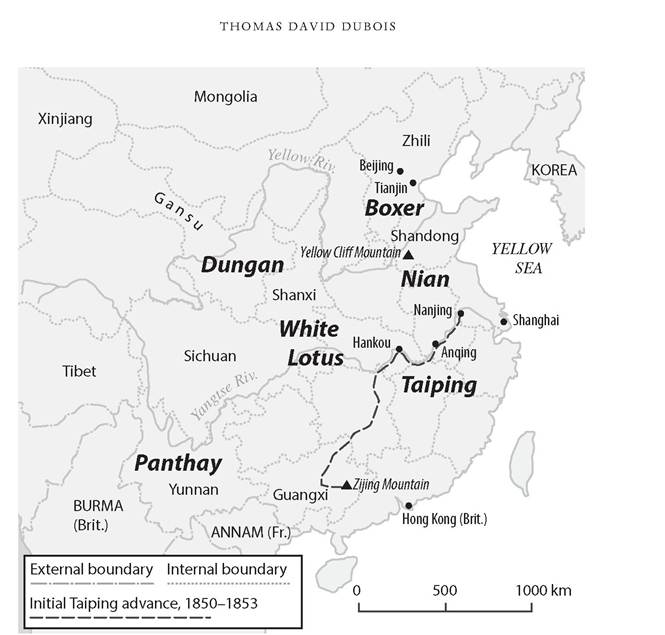
Map 2.1 Late Qing China, showing the approximate location of major religious rebellions.
governance, compounding pressing challenges in trade and foreign relations.[64] The greatest problem was demographic: after a century of steady population growth, China had by 1800 largely exhausted its ability to colonise new agrarian frontiers. Continued population growth (from roughly 295 million in 1800 to 430 million in 1850) was thus accomplished by increasing pressure on existing land resources.
The brunt of these trends was borne disproportionately by those at the bottom, who responded by emigrating, or by living more precariously (for example by colonising lands such as floodplains). In the worst cases, demographic stress pushed peasants to life and death decisions. As ritual propriety required families to produce at least one male heir, many at the edge of subsistence were forced to sell female children, or simplyleave newborn girls to die. Over time, millions of these individual decisions added up to produce a massive gender imbalance (with some counties in northern China reporting as many as 1.56 males for every female). With no hope of marriage or of producing an heir, these millions of extra men, referred to colloquially as ‘bare branches' (guang gun) on the family tree, would become a massive destabilising force in late Qing society. It would not take much to push them to violence. Religion would provide the catalyst.
More on the topic Religious Violence and its Suppression:
- The theme ‘religion and violence' or ‘religious violence' gained worldwide attention after the terrorist attacks on the Twin Towers and the Pentagon in 2001.1
- Though the rise of religious violence has been a global phenomenon in the modern period, perhaps nowhere is the arena of competition among contesting religious and secular politics greater than in South Asia.
- Religious violence
- Organised Religious Violence
- Religious Violence in the Early Twentieth Century
- AUTOLOGOUS CELL-MEDIATED KILLING RESULTS IN IMMUNE SUPPRESSION
- Towards the Dissolution of Religious Violence in Late Antiquity
- New Religious Ideas and New Forms of Writing Violence
- Religious Violence in the People's Republic
- Violence against Religious Minorities
- PART VI RELIGIOUS AND SACRED VIOLENCE
- Religious Violence in Late Antiquity