The concept of “empire” has long proven notoriously difficult to pin down, partly due to a steady accumulation of ideological baggage over time, but also because of the improbable range of historical phenomena
—temporal, material, political, cultural, economic—that are encompassed within its rhetorical sway.1 The ambitious range of scholarship in this collection offers vivid testimony to the ubiquity and diversity of polities and cultures readily labeled “imperial.” John Darwin's monumental study of the global sweep of imperial power since the late Middle Ages lays particular stress on empire as the “default position” throughout most of world history, cautioning against the temptation to view empires as somehow “unwelcome intrusions in a non-imperial world.”2 In a similar vein, the tendency to treat “imperial history” as synonymous with the 500-year span of specifically European overseas expansion and colonization has been eroded by the new perspectives of global history.
These insights have thrown open the interpretative possibilities for the history of empires, fueling a wholesale boom within the field. But it has also compounded the problem of discerning any conceptual or interpretative common ground that might underpin “the imperial” as a discrete object of enquiry.If “empire” has become a convenient blanket term that conceals wide divergences of historical experience spanning the millennia, one might have thought the same would apply for its polar opposite, “decolonization.” Yet here we encounter a surprising degree of semantic specificity in its scholarly usage and a far narrower frame of reference. One never hears of the “decolonization” of the Mongol, Ming, or Mughal empires, even though other related terms like “decline,” “collapse,” and “fall” remain ready to hand. This is not simply a matter of their antiquity. More contemporary episodes, like the winding up of the Ottoman or Japanese empires in the twentieth century, have never gone by the name of decolonization. Although the tendency in recent scholarship has been to ‘increase its geographical and temporal span', there is nevertheless something that intrinsically links decolonization to the denouement of Europe's maritime empires in the twentieth century.3
1 The foundational works are Koebner 1961; Koebner and Schmidt 1964.
For a more recent survey, see Colas 2007. Thanks are due to Astrid Rasch for her invaluable research assistance in the preparation of this chapter, and to Peter Fibiger Bang, Jimmi Ostergaard Nielsen, and Christian Damm Pedersen for their constructive comments on an earlier draft.2 Darwin 2007, 491.
3 Thomas and Thompson 2018, 3.
Stuart Ward, Decolonization and Neocolonialism In: The Oxford World History of Empire. Edited by: Peter Fibiger Bang, C.A. Bayly, Walter Scheidel, Oxford University Press (2021). © Oxford University Press. DOI: 10.1093/oso/9780197532768.003.0042.
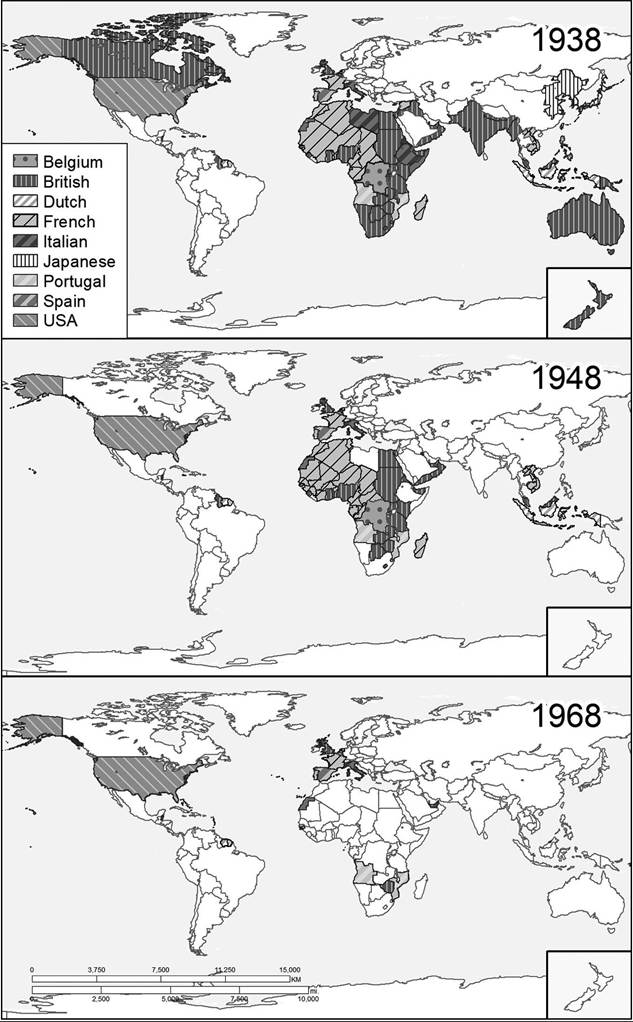
Map 42.1. Decolonization.
Copyright: Stuart Ward with Jonathan Weiland.
Nor can decolonization be said to resonate uniformly in European experience. It translates freely between English, French, and Portuguese, but rests uneasily with our understanding of the end of the German Empire in 1919 or the Soviet in 1989. It is routinely used to describe the end of the Dutch Empire (dekolonisatie) but not the Danish (afkolonisering). In Italian, decolonizzazione captures the dramatic denouement ofMussolini's African empire, but not the slow dissolution ofthe Venetian or the Roman. Even within British experience, its reach is curtailed by geographic, ethnic, and chronological boundaries. Thus Africa, the Caribbean, and Southeast Asia offer prime locations for historical narratives of decolonization, but less so Australasia, Canada, or the United States.[2593] Even the (apparently) archetypal case of India is by no means straightforward. “Decolonization” was never used by contemporaries—on either side of the independence struggle—to describe the events of 1947, and has only been applied retrospectively. Little wonder, then, that the major protagonists in the ongoing Falklands dispute remain at loggerheads over whether the Islands represent a problem of “self-determination” (the British emphasis) or “decolonization” (as Argentina would have it).[2594] Decolonization is charged with a set of assumptions and meanings derived from a peculiarly Western European, predominantly maritime colonizing context that invests it with a special potency and political resonance.
Virtually all would agree that the term embraces a wider realm of historical experience than the constitutional transfer of power to newly independent nations. It is nearly three decades since Louis and Robinson critiqued the stereotypical narrative, in which “an imperial state caved in at the centre like Gibbon's Rome, with infirmity in the metropole and insurgency in the provinces.”[2595] But precisely where to locate decolonization historically and how far we might stretch its compass remain problematic for several reasons. First, the term is laden with a set of assumptions and expectations that directly shape our view of the post-independence era. Or, as Frederick Cooper surmises, the problem “is that we know the end of the story.”[2596] The mere invocation of “decolonization” can skew our reading of complex social and political processes, reducing entire chunks of the globe to a uniform state of “postcoloniality.” Second, its conceptual utility invariably rests on an often crude and misleading estimate of the magnitude of the changes it engendered. And third, its explanatory power has frequently been hampered by the sense of historical inevitability that was implicit in its early usage. Thus it carries the risk of explaining away the very transformations it encompasses. There remains a degree of ambiguity between decolonization as a historical moment, describing a global process of material, ideological, and constitutional change (on the one hand), and decolonization as a historical artifact—a rhetorical tool that was instrumental in effecting those outcomes.
This chapter attempts to untangle these threads by examining the conventional 30-year time span of decolonization (circa 1938-1968) and its neocolonial afterlife through the interplay of events, agencies, and the ideas that emerged to make sense of them. It takes its point of departure in the intellectual rumblings of the interwar years, the formation of anti-colonial pressure groups in the capitals of Europe, and the corresponding campaigns of civil disobedience and violent upheaval the world over that emerged in the 1930s.
The Second World War amplified these tendencies and brought new ideological pressures and political aspirations to bear that fundamentally transformed the imperial landscape, not only among colonized peoples but also their metropolitan counterparts. Into the postwar era, despite official pronouncements and widespread public expectation that the maritime empires of Britain, France, the Netherlands, Belgium, Portugal, and Spain would be maintained and redirected toward the goal of “development,” the political demands of anticolonial nationalists only served to widen the ironic gap between altruistic claims and the repressive measures needed to uphold them. European populations became increasingly unwilling to countenance high levels of public expenditure on counterinsurgency campaigns, especially in intractable settings that seemed incapable of non-violent resolution.[2597] The Suez crisis of 1956 not only embroiled the British and the French in an embarrassing and costly defeat, but also raised awareness about the material and political limits of their imperial reach. By the end of the 1950s, France was looking increasingly vulnerable in Algeria, while African peoples throughout the continent were rapidly achieving independence. It was only during this final, rapid phase of imperial retreat that the term “decolonization” found a permanent foothold in the political lexicon to describe a process whose full implications were only beginning to take shape. Significantly, no sooner had the term become common currency than its political antonym, “neocolonialism,” was promptly pressed into service.Europe's maritime empires unraveled at the intersection of the major upheavals of the twentieth century: the defeat of Nazism and imperial Japan, postwar reconstruction, the onset of the Cold War, the accelerating pace of globalization and the political and economic integration of Western Europe. Disaggregating cause and effect is exceedingly complex, as each overlapped significantly with the transfer of power to scores of newly independent states across the globe. The conceptual history of decolonization and neocolonialism is particularly instructive, because the terms themselves became deeply implicated in the legitimacy claims of the major parties involved in rolling back Europe's imperial aspirations. As such, we can begin by asking how the language of decolonization first evolved, and to what ends?