The ‘Conquest of Mexico': ‘Some of Evil Disposition'
As men, not all of us are very good - rather, there are some of evil disposition Bernal Diaz, 1580s[231] Viewing the violence of the decades after 1517 as a pair of thirty-year wars is innovative because it privileges the indigenous perspective, which is not how the invasion has tended to be seen for the past five centuries.
For Mesoamericans, year after year the invasion's many forms of violence disrupted their lives and destroyed their families. But for Spaniards, the war was soon reduced to a two-year story of miraculous triumph. That story was the 1519-21 war in Mexico, culminating in the siege and seizure of the Aztec capital of Tenochtitlan. For Spaniards and other Europeans, the war soon became known as the Conquest of Mexico. That term - which Spaniards began using soon after the war - was set in stone after 1552 by the success of Francisco Lopez de Gomara's La Conquista de Mexico, a hagiographic history that praised and promoted the role of Cortes as the leading conquistador in that war.[232] Still used today as the common name for the war, it ignores the violence and warfare that followed 1521, and helps perpetuate the Spanish view of the war as a brief, predestined and glorious conquest of a barbarian empire.The essential events of the war are well known, but it is worth summarising them with an emphasis on the forms of violence that the conflict brought to, or exacerbated in, Mesoamerica. The 1517 expedition sponsored by Governor Velazquez, which had returned early following a punishing defeat by a Maya army on the coast of Yucatan, was followed by two more, in 1518 and 1519. The Spanish captains who led these expeditions were mandated by Velazquez to explore, trade and - if the captains could use the legal loopholes of ‘Indian' cannibalism and rebellion - enslave, but not to conquer and settle.
Yet the men who comprised these companies were not primarily explorers, merchants or soldiers; they were armed settlers. They explored, fought and sought to trade in loot and slaves as a means to an end: to settle as privileged colonists in new Spanish provinces.The 1518 expedition reached the coastal edges of the Aztec Empire, turning back to report to the Governor of Cuba as instructed. But the 1519 company pushed further up the coast, into the region around today's Veracruz, where they quarrelled for four months over whether to return to Cuba or reconstitute themselves as a new company answerable only to the Spanish king. The company had initially consisted of about 450 Spanish men and over a thousand Taino slaves and servants, as well as small numbers of African slaves and servants, some non-Taino women, a dozen horses and some mastiffs (or war dogs). The majority would die in the war that followed, replaced by others (the original 450 men constituted less than 15 per cent of the total number of conquistadors who came from the Caribbean and Spain to join the conflict of 1519-21) and supplemented by many tens of thousands of indigenous allies.
Choosing to betray Velazquez and replace him with Cortes, the company set off in August 1519 on an inland march that would take them, three months later, into the Valley of Mexico and the heartland of the Aztec Empire. En route, they encountered the city-state of Tlaxcala, which they fought to a stalemate. The Spaniards and the Tlaxcalteca agreed to a treaty and an alliance; the leaders of Tlaxcala persuaded the Spanish captains that the Aztec Empire, the long-term antagonist of the Tlaxcalteca, was now their common enemy. In October the combined Spanish-Tlaxcalteca force entered an important Aztec client city, Cholula; during three days of violence the city's population was massacred and the survivors enslaved.
In November the Spanish company reached Tenochtitlan, where they were welcomed in a diplomatic ritual by the huey tlahtoani, or emperor, Moctezuma (more properly, Moteuctzomatzin).
Cortes and his fellow captains later depicted the encounter as a formal surrender, leading to the seizing of Moctezuma, through whom the Spaniards claimed to rule the empire for the next eight months. That interpretation also allowed the Spaniards to characterise the deterioration of peaceful relations with the Aztecs over these months as a growing rebellion. The ‘revolt' was propelled by a massacre of Aztec celebrants during the Toxcatl festival in the city centre, while most of the Spanish company was temporarily absent, facing a rival expedition from Cuba. The absent Spaniards returned with the members of that company to find Tenochtitlan in a state of war; weeks of fighting resulted in the killing of Moctezuma, the death of two-thirds of the Spaniards and the desperate nocturnal flight and retreat of the survivors to Tlaxcala in July 1520.From the Spanish perspective, the challenge was then to crush the revolt of an empire that had been won through hard-fought battles and skilful diplomacy. That challenge was met, they claimed, through the forging of a growing alliance of city-states that had been either enemies of the Aztecs (such as Tlaxcala) or elemental to their empire (such as Tetzcoco). With Tetzcoco in the alliance by the end of 1520, the siege of the island capital of Tenochtitlan could gradually be executed, culminating in August 1521 with the capture of the last emperor, Cuauhtemoc, and a great city largely reduced to rubble.11 [233]
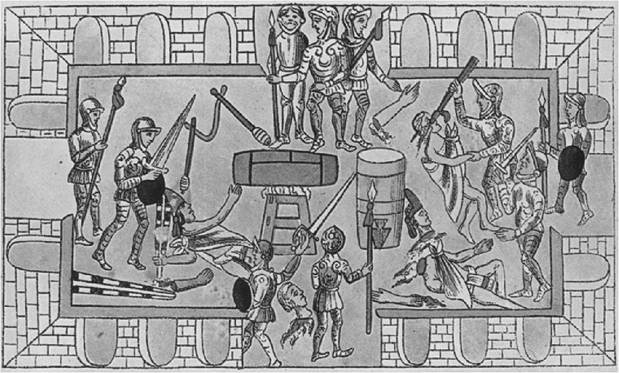
Figure 7.2 The Codex Duran's rendering of the Toxcatl Massacre - initiated by Pedro de Alvarado - in the central plaza of Tenochtitlan in the middle of the 1519-1521 Spanish- Aztec War. The hybrid Spanish-indigenous style conveys well conquest-era butchery by sword-wielding conquistadors of unarmed indigenous men.
For Spaniards, the conclusion of the siege marked the end of Tenochtitlan, from whose ashes would rise the new viceregal capital of Mexico City, and the end of the barbarous Aztec age, replaced immediately by the Christian Kingdom of New Spain.
Subsequent military activity, extending north and far south of central Mexico, and lasting until about 1547, would constitute a consolidation of conquest that Spaniards termed ‘pacification’ - much of which was classified as the suppression of rebellion, thereby permitting the enslaving and selling of indigenous men, women and children.Yet despite the thriving slave market in Mexico City and the constant decades-long movement of Spanish settlers and companies of indigenous warriors between Mexico and the conquest frontiers, Spaniards viewed their Conquest of Mexico as over. For them, the perpetuation of conquest violence was far less significant than the steady imposition of three colonial institutions: the administrative hierarchy of the colonial regime (stretching from the Spanish viceroy in the city of Mexico down to the cabildos or councils of prominent indigenous men who were confirmed as rulers of Mesoamerican towns and villages); the network of encomiendas (grants of those towns and villages to Spaniards, who thereby had privileged access to their labour and tribute goods); and the new church, its parishes and buildings, preachings and dogma, imposed variously and often with violence.[234] [235]