Thirty Years Wars: ‘A Bellicose People'
These Indians have forced us into many battles and denied us entry into their land, because they are indomitable Indians, a bellicose people
Merida cabildo, 154213
Yet even from the perspective of those Spaniards who fought in the war against the Aztecs, it was for most of them part of a broader regional experience.
The conquistadors who went to Mexico and other Mesoamerican regions in the 1520s had seldom come directly from Spain; more often, they had spent years sailing, enslaving and settling in the Caribbean. There they learned that interaction with indigenous communities inevitably resulted in violence (which was invariably blamed on the ‘Indians'), and that enslaving indigenous people was the quickest (or, many believed, only) way to profit from expeditions of exploration and conquest.To see the Spanish-Aztec War more clearly, with its multiple forms of violence at the centre, we need to adopt perspectives and emphases that avoid the traditional story - which tends to be centred on a legendary version of Cortes as the heroic architect of the Conquest.[236] There are various ways to cirumvent that triumphalist narrative, but here I suggest three. The first has already been introduced: to place the 1519-21 Spanish- Aztec War in a larger context, thereby including the violent exploration and settlement in the Caribbean that preceded and paralleled events in Mexico, as well as the continuation of that process in northern Mexico and in the Maya region.[237]
The second emphasis is the appreciation of multiple Spanish and indigenous protagonists. By removing Cortes as the military genius and master manipulator, the other Spanish captains, self-interested, jostling for survival and advantage, come into clearer view; and the war is seen more accurately as less controlled, more chaotic and consequently more violent.
By the same token, the crucial roles played by multiple indigenous leaders are thereby given fuller attention. Men like the upstart tlahtoani (ruler or king) of Tetzcoco, Ixtlilxochitl, who emerges as a powerful player - rather than a puppet of Cortes’s - manipulating the Spaniards and Tlaxcalteca to tip the balance of power in the Valley of Mexico from Tenochtitlan to Tetzcoco. That not only gives us a more accurate, less Hispanocentric view of the war; it helps us to understand why it became so violent. For Ixtlilxochitl’s ability to control all the players and the outcome of the war was limited. His role has been greatly underestimated, but he was not able to achieve total control or rein in all the competing and self-interested sides in the war any more than was Cortes. As a result, there were exceptionally high mortality rates among civilians as well as combatants, village and town massacres were frequent, and hundreds of thousands of Mesoamericans were enslaved (mostly women and children).That, indeed, is my third emphasis here: to place at the story’s centre the high incidence of massacre and enslavement, rather than moments of surrender or the battles that have been inscribed as tragic or glorious. The massacre at Cholula has traditionally been presented as if it were exceptional, the only incident of its kind in the war; in fact, it was typical of how most Mexicans experienced the 1519-21 war, as well as how most Mesoamericans experienced the wars that spanned thirty years.
Useful evidence of the oft-ignored centrality of slaughter and slavery in the wars can be found buried in the telling by Bernal Diaz of what he called the Conquest of New Spain. Diaz was a conquistador-settler who participated in the wars in Mexico and Guatemala, writing a long account that was first published in 1632 - and is still widely read today. But his original manuscript included chapters omitted from the first publication and from almost all modern editions. Titling the chapter ‘Why so many Indian men and women were branded as slaves in New Spain’, Diaz insisted that because Moctezuma surrendered to Cortes, the violence that later broke out was an Aztec revolt.
As we have seen, rebels could be enslaved under royal law. Thus in the middle of the 1519-21 war, claimed Diaz, the Spanish king ‘granted us permission’ to ‘enslave and brand on the face with this G the Mexican Indians and those natives of the towns that had risen up and killed Spaniards’.[238]In truth, there had been neither surrender not rebellion, but a diplomatic welcome to the invaders, followed eventually by a growing resistance as war consumed the region. Part and parcel of warfare with ‘Indians' was the Spanish expectation of loot and slaves - Diaz's G stood for guerra (‘war'). Admitted Diaz:
Certainly great frauds were committed over the branding of Indians, because as men, not all of us are very good - rather, there are some of evil disposition, and because at that time there came from Castile and from the islands many Spaniards who were poor and so greatly covetous and avaricious and ravenous to acquire wealth and slaves that they took measures necessary to brand the free.[239]
Thus, in a nutshell, did Diaz unwittingly convey all three of the emphases I am making here. In evoking the larger context of prolonged warfare, the expectation by thousands of conquistadors of the rewards of loot and slaves, and the fact that the branding iron and the sword were routinely wielded together, Diaz showed in one short chapter how those factors worked together to inflict lasting violence upon indigenous Mesoamericans. No wonder the chapter was left out of most editions of his book.
Diaz's reference was not just to the Spanish-Aztec War, but to the larger Spanish-Mesoamerican Thirty Years War (although he did not name it). One of the many conflicts within the larger one was what we might call the Spanish-Maya Thirty Years War. It deserves some separate attention, in part because it offers contrasting patterns of violence, and in part because the war against the Aztecs has been studied far more than that against the Maya.
The initial date of Spanish-Maya conflict (1517) saw the first full-scale battle between conquistadors and a Maya army - the encounter that forced the Hernandez de Cordoba expedition back to Cuba. The end date (1547) saw the final killings of the third entrada or invasion led by Francisco de Montejo in eastern Yucatan, with most conquest events elsewhere in the Maya world falling in between.[240] At that point, there were two small Spanish colonies in the Maya area - in north-west Yucatan and in highland Guatemala - and a scattering of even smaller ones, many of which would
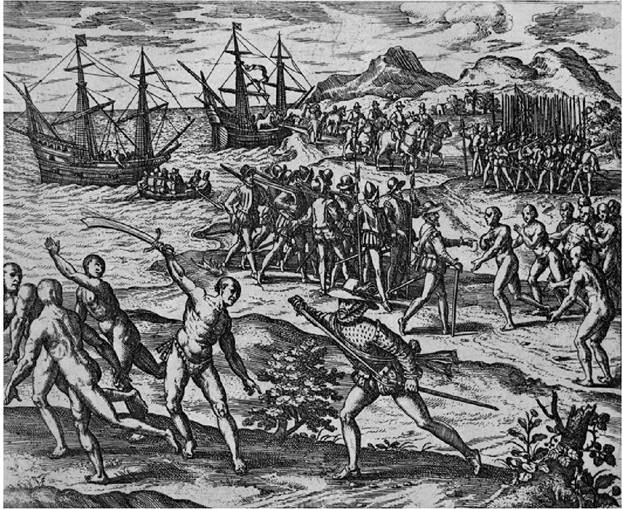
Figure 7.3 Theodore De Bry's fanciful visualization, from the 1595 edition of Girolamo Benzoni's Historia (plate XIX), of the Spanish conquest of Mayas in northern Yucatan, led by Francisco de Montejo, depicted in the foreground unsheathing his sword, with the ‘Indians' as naked (thus barbarian) victims of the invasion - all save one either surrendering or running away.
become abandoned during the decades that followed. Thus the conclusion of the Spanish-Maya Thirty Years War resulted in an archipelago pattern of Spanish colonisation, with most of the Maya area unconquered until the Spanish destruction of the Itza Maya kingdom in what is today's northern Guatemala in 1697, after which many smaller Maya polities still remained independent - some into the twentieth century.
Thus instead of a single event or short, decisive war that marked a ‘Conquest of the Maya', there were three violent decades of ‘long drawn out, painful, and halting' Spanish-Maya conflict (as an early historian put it),19 followed by centuries more of intermittent violence. How do we explain the protracted nature of the conflict? In contrast to Mexico, where an intense
19 Chamberlain, Conquest and Colonization, p. 3. two-year war was followed by prolonged violence across the surrounding regions, the Maya region experienced only the latter period.
Why? That same historian drew upon the opinions of the conquistadors themselves to offer three causes: lack of gold and silver to tempt Spaniards; the distractions of conquest campaigns in other regions (such as Peru in the 1530s); and a Maya ‘resistance' and ‘opposition' that he characterised as ‘stubborn'.[241]There is validity to the first two of those explanations, but the last one simply reflects the frequent conquistador complaint that the Mayas, ‘raised from birth in warfare', as Merida's settlers put it a few months after the city was founded in 1542, ‘have forced us into many battles and denied us entry into their land, because they are indomitable Indians, a bellicose people'; Cortes too had lamented that the Mayas he encountered in northern Guatemala in 1525 were ‘very bellicose and bold in war' and did ‘much harm to the Spaniards'.[242] What the Spaniards explained by resorting to a stereotype, seeing persistent Maya bellicosity, was in reality a manifestation of the violence that was endemic to these decades, one that stemmed both from Spanish methods of attempted conquest and colonisation, and from the tenacious way in which Maya communities understandably resisted Spanish invasions.
An additional explanation for the prolonged nature of the Spanish-Maya War was the lack of a Maya empire, with the Maya area comprising at least forty polities or kingdoms. In the words of Gaspar Antonio Chi, a Maya nobleman who was born during the Spanish-Maya War and became an interpreter in the early colony of Yucatan ‘When the conquistadors invaded these provinces, the provinces were already divided, and as each one was an enemy of the other, they fought with one another on little pretext, going out with their captains and their banners, most of them naked, painted with black stripes as a mark of grief to come.'[243] Conquistador captains sought to leverage regional rivalries and deploy one Maya polity against another.
That tactic was conventional conquistador wisdom everywhere after 1521, as it was believed that Tenochtitlan had fallen because of Cortes's skilful use of Tlaxcalteca allies (whose role had indeed been crucial). To some extent it worked in Maya country. The Alvarado brothers benefited in highland Guatemala from the willingness of the K’iche’, Kaqchikel and Tzutujil to use the disruption of the Spanish invasion to pursue old vendettas. The leaders of Spanish campaigns into eastern and south-eastern Yucatan in the late 1520s and early 1530s survived because anti-Spanish cooperation between Maya polities was sporadic and because local leaders could not resist the temptation of sending the dangerous and demanding foreigners into neighbouring kingdoms (wounded, exhausted, disoriented and undernourished invaders were all too easily manipulated). But those campaigns were disasters. Old rivalries set the scene not for a successful conquest, but for for extended violence on many fronts.Whereas the Aztec Empire made Spanish colonisation possible because the empire could be preserved - its structure of provinces, trade routes and tribute patterns slowly turned into the sinews that held New Spain together - turning neighbouring Maya polities against each other preserved nothing more than their traditional enmity. The tactic did not foster post-invasion colonisation; it fostered prolonged regional warfare that postponed or prevented effective colonisation. Thus the Alvarados' stirring up of K'iche'- Kaqchikel rivalry contributed to two decades of brutal violence in the highlands. The result of the so-called Great Maya Revolt of 1546-7 (which was in fact yet another Spanish campaign into Yucatan's north-east) was not to extend the frontier of the colonial province, but to help ensure there was a frontier for centuries to come. The failure of the Spanish conquest in what is now southern Quintana Roo and Belize would prove to be permanent and likewise ensure for centuries a cycle of small-scale but persistent Spanish- Maya violence.
Thus the multiplicity of Maya polities, and the short-sighted Spanish reaction to their regional rivalries, prevented the forging of large colonial provinces, instead permitting only hard-won small ones. As a result, the protracted nature of the Spanish invasions became self-generating: that is, with every entrada or campaign that failed or achieved minimal success, the Spanish invaders lost the advantages of surprise and unpredictability, and of horses and steel; by the same token, Maya polities gained the advantages of anticipating Spanish patterns of behaviour and response.
In frustration, Spaniards resorted to the same short-term tactics of violence and enslavement that had undermined efforts to settle the Caribbean. In doing so, they exacerbated the problem of population decline caused by epidemic disease, disruption to agricultural cycles and warfare. In the Maya area, demographic decline prolonged the wars of invasion and hindered colonisation because - without the gold and silver mines that the Montejos and Alvarados had hoped for in vain - the Maya people themselves were the primary resource upon which colonies might be built. As one conquest era chronicler noted in explaining why the small Maya kingdom of Acalan (settled in 1530 by Montejo as the projected new centre of a peninsula-wide colony) was abandoned in 1531: ‘the Indians were too few to support the Spaniards, and they gave no gold in tribute but only items of food'.[244] In addition, the persistence of independent Maya polities encouraged flight from war zones and conquered kingdoms - a kind of tactical migration catalysed by repeated entradas and in turn ensuring prolonged violence and the pattern of limited, archipelago colonisation by Spaniards.[245]
Finally, Maya leaders did not respond to the invaders with consistent hostility, but with friendly curiosity alternating with hostility (fostering Spanish complaints of ‘Indian' duplicity). The deep-rooted pre-Columbian history of migration within the Maya area, and of contact with central Mexico, had fostered mythologies among the Yucatec, K'iche' and other Mayas of the remote or foreign origins of their ruling elites. As a result, Mayas were inspired at times to take a closer look and appraise the behaviour of outsiders - some of whom were potentially future insiders. The Yucatec term for foreigner, dzul, was also a Maya patronym (and a dynastic polity or kingdom name in south-eastern Yucatan);[246] it likely meant ‘outsider' rather than ‘foreigner', lacking racial implications before the Spanish invasions.
Maya leaders therefore often initially met Spaniards with welcoming interest, which the invaders hungrily interpreted as surrender, keen to see a repetition in every Maya kingdom of Moctezuma's famous capitulation to Cortes in 1519. But Moctezuma's surrender was a lie, invented after his murder by the Spaniards, already blossoming by the time of the Spanish-Maya Thirty Years War into a spectacular fiction believed as fact by Alvarados, Montejos and other captains - who were thus driven mad with frustration over the failure of Maya leaders to play roles as mini Moctezumas.[247]
The interested welcome that Spanish captains misread as surrender often proved to be something else, just as it had done in Tenochtitlan in 1520: a gathering of information leading to a violent attempt to evict the invaders. In Mexico, in Maya kingdoms and in other parts of Mesoamerica, Spaniards were quick to imagine victory. They founded cities and planned colonies, only to despair in violent infuriation over ‘rebellions' by the ‘Indians'. Spaniards were unaware that from the indigenous perspective there had been neither surrender nor rebellion, neither victory nor defeat - only repeated cycles of invasion, epidemic disease, starvation, slaughter and enslavement. Such misunderstandings served to further prolong the multivalent violence of the wars of invasion in the Caribbean and Mesoamerica.
More on the topic Thirty Years Wars: ‘A Bellicose People':
- The “War to End all Wars”
- Antony Robert, Carroll Stuart, Pennock Caroline D. (eds.). The Cambridge World History of Violence. Volume 3: AD 1500-AD 1800. Cambridge University Press,2020. — 710 p., 2020
- Controversy Within MIT