The end of apartheid in South Africa
The collapse of the Portuguese Empire not only heightened Africa’s profile within the Cold War, but also had profound implications for the future of the apartheid regime in South Africa, which became more isolated than ever.
With the buffer between it and Black Africa now removed, the South African government felt that its country was under siege by hostile forces linked to the Soviet Union. South African self-confidence was thus replaced by a restless sense of insecurity, which led it to introduce greater repression at home and to try to browbeat its neighbours into denying sanctuary to the ANC. Thus, South Africa steadily isolated itself even further from the international community, while turning its domestic politics into a powder keg.In retrospect it can be said that the end of apartheid began in June 1976, when an uprising erupted in the black township of Soweto, outside Johannesburg, which was rapidly followed by protests, strikes and riots across the country. The primary causes of this upsurge in unrest were domestic factors, such as the rise of the Black Consciousness movement, the deteriorating economic conditions after the oil price hike of 1973 and anger at the attempt to introduce the compulsory learning of Afrikaans in black schools. It was therefore a largely spontaneous, indigenous phenomenon that had few direct links with the Soviet-backed ANC. However, the government in Pretoria saw these events through a Cold War prism, and thus believed that, rather than a sudden explosion of fury, it was the premeditated work of ANC agitators encouraged by news of the MPLA victory in Angola. Accordingly, the initial conclusion drawn from the Soweto uprising was that South Africa needed to toughen both its external and internal security policies. It was within this context that in 1977 the Black Consciousness leader Steve Biko was murdered while in police custody.
South Africa’s claim that its new campaign of repression was justified by the threat from communism did not, however, win much sympathy abroad, and in October 1977 the UN General Assembly introduced a mandatory embargo on arms sales with which even the United States and Britain complied.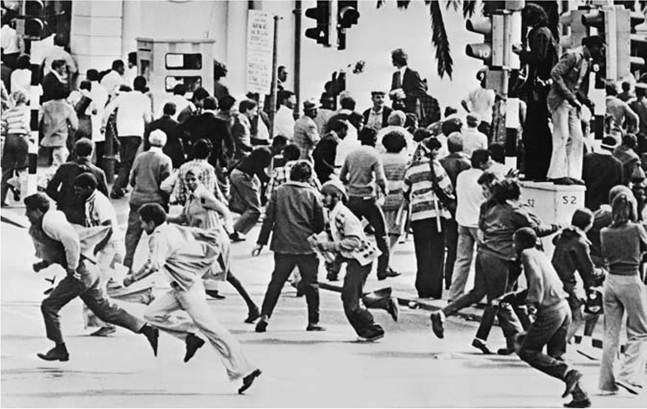
Plate 17.1 Cape Town, South Africa, October 1976. After clashes in Soweto in June 1976, new incidents erupted between demonstrators and police in Cape Town. In that month the UN Security Council condemned the South African government for the repression of black protests in Soweto that resulted in hundreds of deaths and thousands of injured. (Photo: AFP/Getty Images)
Faced with international condemnation and a deteriorating security situation, the government of P. W. Botha, which took office in 1978, introduced limited reform of the apartheid system, removing some of its more objectionable, ideologically derived features in an attempt to appease its domestic and foreign critics. Thus labour laws were relaxed and the law banning mixed marriages was repealed. In addition, in the late 1970s and early 1980s a number of the Bantustan homelands were given nominal independence and in 1983 a new constitution was introduced which gave limited rights to coloureds and Indians. However, these steps were not enough to pacify black opinion or critics within the international community. From the mid-1980s the pressure on the Botha government escalated both at home and overseas. In 1985 a new wave of political mass action began, including outbreaks of violence, which soon forced the government to introduce a formal state of emergency over much of the country. Reflecting broad international distaste with the South African government, the US Congress in 1986 passed the Comprehensive Anti-Apartheid Act, overriding President Reagan's veto. The Act introduced sanctions against a wide range of South African goods and banned the export of oil products.
Botha's government had no answer to its mounting problems, a point that was underlined when the prime minister's much touted ‘Rubicon' speech of August 1985 emphatically rejected the idea of ‘one man, one vote'.The effect of the National Party's paralysis in the face of this worsening situation was that the white coalition which had sustained apartheid since its heyday in the 1950s and 1960s began to break up. In particular, faced with the fact that apartheid could no longer deliver economic prosperity or social order, the business community signalled its dissatisfaction by holding private talks with the ANC leadership. This change in attitude was reflected in the elections that took place in September 1989, shortly after Botha had passed the reins of power to F. W. de Klerk. In this election, for the first time since 1958, the National Party won less than half of the total votes cast, losing support both to liberals and to right-wing Afrikaner parties whose supporters felt that too much had already been conceded. Influenced by this disarray in white ranks and the unceasing violence in the black townships, de Klerk staggered his country and the world on 2 February 1990 by announcing the end of apartheid and the lifting of the ban on the ANC. Ten days later Mandela was freed from custody and South Africa began the tortuous road to its first democratic elections in 1994, which culminated in a sweeping ANC victory.
These dramatic changes in South Africa were rooted in domestic factors, which boiled down to the fear that apartheid was unsustainable and that if it collapsed involuntarily, it could lead to economic chaos and political violence on an unprecedented scale. However, the Cold War also had some influence on events, for it was arguably the Soviet Union's withdrawal from the Third World in the Gorbachev period that made the ANC acceptable as a potential government of South Africa. This was important for two constituencies that played a crucial role in the collapse of apartheid, namely the business community within South Africa and the countries, such as the United States, that tightened the sanctions noose from 1986 onwards. Thus, the de-escalation of the Cold War was important, because it created a new situation in which a shift towards black majority rule was not as terrifying a prospect for the white community and for America and its allies as it had once been.
More on the topic The end of apartheid in South Africa:
- The Impact in Africa
- Nonpolitical Politics
- One World, Many Peaces
- Narrators of the Indian Ocean
- Christianity in Africa since Independence
- Notes
- Collective Moral Responsibility as Joint Moral Responsibility
- Nature Before Nature
- The Last Century
- World Peace