The Fiscal System and the Land
The first major feature of the early Tang institutional complex was the integrated system of state-owned land and taxation. The Han dynasty had relied on taxing privately owned land, but subsequent rulers, particularly in the north, had relied on income from state-owned lands that were worked by resettled refugees who became a serf-like hereditary status group.2 In the first century of the Tang, particularly in northern China, landholding, taxation, and labor service formed an integrated complex centered on the adult male household head.
The basis of this complex was the “equal-field system,” which had developed in north China since the fifth century as the final form of state-owned land.Beginning in the last century of the Han dynasty, large areas of the North China Plain had been abandoned by their cultivators, who had moved south under the
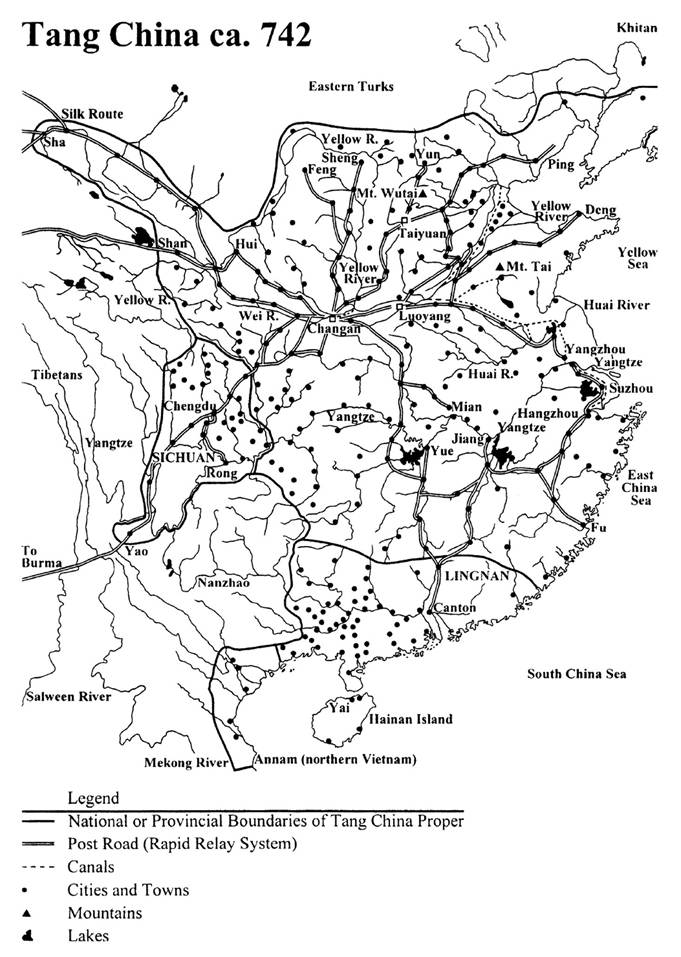
Map 13.1. Tang China, ca. 742.
Source: Benn, 2004, China’s Golden Age: Everyday Life in the Tang Dynasty, p. xii. Copyright: Oxford University Press.
pressure of floods and invasions. The abandoned land was claimed by the rulers, who relocated peasants on the land in order to secure their revenue. In 486 Emperor Xiaowen of the Northern Wei instituted a plan in which state-owned lands were divided into family-sized plots and given to peasants in exchange for the payment of regular taxes and the provision of labor service. With modifications, this policy was continued by subsequent dynasties and carried forward into the Tang as the equalfield system.
In theory, each married couple was entitled to a grant of land from the state for the duration of their taxpaying life. If there was more than one adult male in a household, the size of the grant would double. Households with slaves received a small allotment of land for each adult male slave.
This land remained the property of the state and was returned when the couple ceased to pay taxes and provide service. However, because the land used for growing mulberry trees, which were necessary to produce the silk which served as currency for paying certain taxes, needed continuous cultivation over decades before it became productive, a separate category of hereditary land was also instituted.This second category of land was in theory passed on from generation to generation, subject to limits on the size of total holdings. In places where hemp rather than silk was the primary material, families received permanent land for hemp. Since hemp is an annual crop like food grains, this undercut the original rationale of the system and ultimately allowed wealthy families to accumulate larger and larger plots of land under the name of “hemp fields.”[1084]
Because the purpose of this system was to bring under cultivation as much land as possible, the original land grants were quite large, about seven times the size of the average farm in nineteenth- or twentieth-century China. The law also sought to limit the accumulation of large estates by officials and leading families, but this worked no better than similar attempts under the Han and the intervening dynasties.
The correlate of receiving land was the obligation to pay taxes and labor service. The basic unit of taxation was the same as the unit for granting land, i.e., the individual adult male head of a household. Taxes consisted of a fixed capitation tax and associated labor services, with no differentiation on the basis of capital or income. This system is commonly called zuyong diao: zu indicating a tax paid in grain, yong meaning labor services, and diao a tax paid in cloth. The amount of these liabilities did not take account of the actual circumstances of the household, since in theory all households had equal holdings.[1085]
However, there were great exceptions to tax uniformity, based not on wealth but on membership in privileged status groups.
Anyone even distantly related to the imperial family, families with noble titles, holders of official rank, and members of the Buddhist and Daoist clergy were exempt from taxation and labor service.Moreover, exemption could be granted to morally exemplary individuals or regions that had suffered major catastrophes. Thus, the taxation system, like much of early Tang society, was structured on the principle of segmentary division of the population into status groups.
After the An Lushan rebellion, the state lost the ability to keep the detailed records of these patterns of landholding and taxes, and local administration in much of north China was controlled by the military governors who had defeated the rebels. Thus the state's fiscal foundation had to be completely changed. These fiscal reforms, introduced in 780, were called the “two-tax system,” which refers to the collection of taxes twice a year according to the agricultural cycle. However, more important was the abandonment of the imaginary typical male adult as the unit for calculating taxes. Instead, assessments were figured on the basis of property and cultivated land. This formally abandoned the defunct “equal-field system.” For the first time in Chinese history, the government attempted to base taxes on actual measurements of wealth and property.[1086]
The second great fiscal innovation of the second half of the Tang dynasty was the revival of the salt monopoly that had been a major source of income during certain periods of the Han. Specially appointed extra-bureaucratic commissioners had been appointed in the first century of the Tang to regularize the transport of provisions and taxes along the recently established canal system, to register large numbers of missing peasant households, and to command the emergent frontier armies. In 758, as income from the old land and tax system vanished, a new “commission for salt and iron” was appointed to institute a monopoly in the sale of salt.
This salt commission became the chief fiscal agency of the late Tang state, producing the income that sustained the court for the second half of its rule.[1087] Like the new land tax based on actual wealth, a salt monopoly in various forms remained important throughout late imperial China.This reliance on income from the south, and the resultant power of the southern provincial governors and salt commissioners, had a tremendous impact on the Tang. Unlike the earlier prefects, the highest local officials prior to the An Lushan rebellion, provincial governors now ruled over millions of people and, at least in the lower Yangzi, disposed of immense revenues. Such posts, though officials bemoaned them as a form of exile, presented an opportunity for accumulating vast personal fortunes. Even if scrupulously honest, such officials wielded great financial power, and the court was totally dependent upon them. The southern governors and salt commissioners thus became great financial magnates able to exert tremendous economic pressure on the capital, just as the northern generals (see later discussion) exerted military pressure. However, unlike their military colleagues in the north, southern governors remained dependent on the court for appointments and looked to it in hope for an eventual return. For all their regional power, they remained agents of the court. Moreover, there is no evidence that any southern region possessed the deep-rooted and pervasive local loyalties that came to characterize the northern, military commands.[1088]
These new fiscal institutions became a major factor in the development of regionalism in the late Tang Empire. In general, revenue in the north was derived largely from the double tax, which was administered by the public revenue department, while that from the south came from the salt monopoly, administered by the salt and iron commission. Throughout the late eighth and early ninth centuries, these offices battled for fiscal domination of the empire and used their taxes as bases of local power and imperial influence.
In time, the salt monopoly took over the minting of money, state mines, the taxation of tea and other goods, and the imposition of transit taxes. In 810, an edict recognized the financial division of the empire between the two authorities when it made agents of the salt and iron commission responsible for the double tax revenue in the Yangzi Valley.The salt and iron commission not only controlled the fiscal administration of the south, but also threatened to take control of civil administration. From the 780s on, the commissioners, already the most powerful financial officers in the empire, began to receive concurrent territorial jurisdiction over the rich and productive provinces of the Yangzi delta. This combination of immense financial resources with territorial control of the region that accounted for most of the state's revenue was perhaps a graver threat to the dynasty than that posed by the military governors of the north, who remained loyal in all but the payment of taxes.[1089]
The new financial administrations also had a significant impact on several aspects of political power. First, just as the new armies encouraged military professionalization, so the new financial services led to increased professionalization in finance. All the leaders of the salt and iron commission and the public revenue department rose through financial experience, and it became the pattern to select such administrators from the proteges of earlier commissioners. Thus expertise in financial administration, rather than conventional administration or the literary matters tested on the examinations, became an avenue by which “new men” rose to power. In time these patterns of patronage and professional training were reinforced by intermarriage to create the “fiscal aristocracy” that dominated Song government in the eleventh century.[1090]
More on the topic The Fiscal System and the Land:
- Chapter 9 Simulating Land Use of Prehistoric Wetland Settlements: Did Excessive Resource Use Necessitate a Highly Dynamic Settlement System?
- Organizational Power II: Fiscal Administration
- The Changing Value OfMultipliers and Fiscal Policy
- A Fiscal-Military State?
- Searching for New Rules of Fiscal Policy
- 5.04 By virtue of s 1(1) of the 1986 Act, an ‘agricultural holding’ is defined to mean the ‘aggregate of the land (whether agricultural land or not) comprised in a contract of tenancy which is a contract for an agricultural tenancy’
- Perspective and Fiscal Policy: An Analysis for COVID-19 Outbreak
- Epidemics Before COVID-19 and Intervention Through Fiscal Policy Instruments
- COVID-19 Pandemic and Intervention Through Fiscal Policy Instruments
- The Ottoman Fiscal-Military State in Comparative Perspective
- The Crisis As a Pivot: The Limits to Fiscal and Monetary Policy and the Need to Devise New Policy Tools
- Corona Virus-Based Millennium Outbreaks and Intervention Through Fiscal Policy Instruments
- Chapter 1 NEOCLASSICAL MODELS OF ENDOGENOUS GROWTH: THE EFFECTS OF FISCAL POLICY, INNOVATION AND FLUCTUATIONS
- II THE USE OF LAND
- 3 Agricultural land
- Certification/land titling
- 1 Aggregate of agricultural land
- The present version of the statement that traces the flow of funds in and out of the firm, the statement of cash flows, became mandatory, under SFAS 95, for issuers with fiscal years ending after July 15, 1988.
- 1 Land Use Planning and Nature Conservation
- Global Fiscal Policies Implemented Within the Scope of Fight Against COVID-19, a Global Public Bad